


Table of Contents


Enterprises across industries are rethinking how software is built and used as data volumes continue to grow at unprecedented rates. Commercially available software systems often fall short when it comes to handling complex decisions or extracting meaningful insights in real time. This is where AI development services are gaining attention, as they help organizations move beyond static automation toward systems that can learn and improve over time.
A well-known example is Netflix, which uses artificial intelligence to power its recommendation engine. According to Netflix, more than 80% of the content watched on its platform is driven by its recommendation system, highlighting how AI directly influences user engagement and retention.
Such outcomes show that AI is no longer experimental. It has become a practical investment for enterprises aiming to improve their efficiency, decision-making, and customer experience at scale. This blog breaks down how these systems are built, where they are applied, and what enterprises should consider before adopting them.
What Are AI Development Services for Enterprises?
AI development services refer to the process of designing, building, and deploying intelligent systems that can analyze data, learn patterns, and support decision-making.
In an enterprise setting, these services focus on solving specific business problems using data-driven models. They go beyond basic automation by enabling systems to improve their performance based on new data inputs. AI development solutions are often integrated into existing systems to enhance their efficiency, accuracy, and scalability across operations.
Here are the key components of an enterprise AI software solution:
Data Engineering
Data engineering forms the foundation of any AI system. It involves collecting, cleaning, and organizing large volumes of structured and unstructured data. This stage ensures that the data used for training models is accurate and consistent. It also includes building data pipelines, handling missing values, and preparing datasets for effective analysis and model training.
Model Development
Model development focuses on creating algorithms that can identify patterns and make predictions. This includes selecting the right machine learning or deep learning techniques based on the problem. Data scientists train models using prepared datasets and fine-tune parameters to improve accuracy. The goal is to build a model that performs reliably when exposed to new, unseen data.
Deployment and Integration
After properly training the model, it is deployed into a production environment. This step involves integrating the model with existing enterprise systems such as applications, databases, or APIs. It ensures that the AI system can function in real-time scenarios. Proper deployment also considers scalability, system compatibility, and response time requirements.
Monitoring and Optimization
After deployment, continuous monitoring is required to track the model’s performance. Over time, models may lose their accuracy due to changes in data patterns. This process includes evaluating outputs, detecting errors, and updating the model when necessary. Optimization helps maintain performance standards and ensures that the system continues to deliver relevant and accurate results.
What Are the Differences Between AI Tools and Custom AI Development?
Enterprises often face a dilemma in deciding when to adopt artificial intelligence and whether to use ready-made AI tools or invest in custom-built systems. To make an informed decision, it is essential to understand the difference between the two models, their business goals, and their long-term plans.
While pre-built tools can be deployed right away, hiring an AI development service to create a custom-built system provides deeper control and flexibility for complex enterprise needs.
| Aspects | AI Tools | Custom AI Development |
|---|---|---|
| Implementation Time | Quick to deploy with minimal setup and configuration required | Requires longer development cycles due to design, training, and testing |
| Customization Level | Limited customization based on predefined features and capabilities | Fully customizable to match specific business requirements and workflows |
| Cost Structure | Lower initial cost; often subscription-based pricing models | Higher upfront investment with long-term value and ownership |
| Scalability | May face limitations when scaling for complex or large datasets | Designed to scale based on enterprise data, users, and system demands |
| Integration Capability | Basic integration options with common platforms and tools | Deep integration with existing enterprise systems, APIs, and infrastructure |
| Competitive Advantage | Limited differentiation as tools are available to competitors | Offers unique capabilities that can create a strong competitive edge |
This comparison highlights that the right choice depends on the level of complexity and control an enterprise requires from its AI initiatives.
Why Enterprises Are Investing in AI Development Services
Enterprises are increasing their investments in artificial intelligence as it moves from experimentation to real business impact. These systems are now used to improve operations, enhance customer experiences, and support faster decision-making across industries.
Operational Efficiency and Automation
The core reason why enterprises adopt AI is to improve their overall operational efficiency. These systems are designed to handle repetitive, rule-based tasks, reducing human effort and errors while performing the work with accuracy and consistency. For example, companies like Siemens use AI in their manufacturing processes to detect product defects early and improve production quality.
Data-Driven Decision-Making
Enterprises generate large volumes of data, but without proper analysis, much of it remains unused. In this scenario, AI helps in processing and interpreting this data to support faster and better decisions. Amazon, for instance, uses AI models to forecast product demand and manage inventory across its global supply chain.
Personalization at Scale
Customer expectations have changed quite a bit in recent years. People now notice when a platform understands their preferences and when it does not. This is where AI starts to make a visible difference. For example, Spotify studies its users’ listening habits to suggest songs that feel relevant to each of them, which keeps people engaged for longer sessions.
Accenture reports that 91% of consumers are more likely to buy from brands that offer relevant recommendations. This clearly shows that personalization is no longer optional; it has a direct impact on how customers interact with a brand.
Competitive Advantage and Innovation
Many enterprises now see AI as a way to stay ahead of their competitors rather than just improve existing processes. It allows companies to explore ideas that were difficult to execute earlier. Tesla is a good example, as it uses AI to keep improving its self-driving features through real-world data. This kind of progress is hard to match quickly.
Google CEO Sundar Pichai has pointed out that AI will have a long-term impact on how technology evolves. This shows that AI development solutions are not just supporting innovation but also shaping how companies compete in the market.
Cost Reduction and Process Optimization
AI helps businesses locate any hidden inefficiencies and reduce their operational costs over time. For example, UPS uses AI-driven route optimization to save gallons of fuel each year. This not only reduces their costs but also improves delivery efficiency. Deloitte reports that companies implementing AI-based optimization strategies have seen cost reductions of up to 20% in certain operations.
Key Types of AI Development Services Offered to Enterprises
Enterprises adopt different types of AI capabilities based on their business goals, data maturity, and industry requirements. These services vary from developing custom systems from scratch to integrating AI into their existing workflows. Understanding these categories helps organizations identify where artificial intelligence can create a measurable impact.
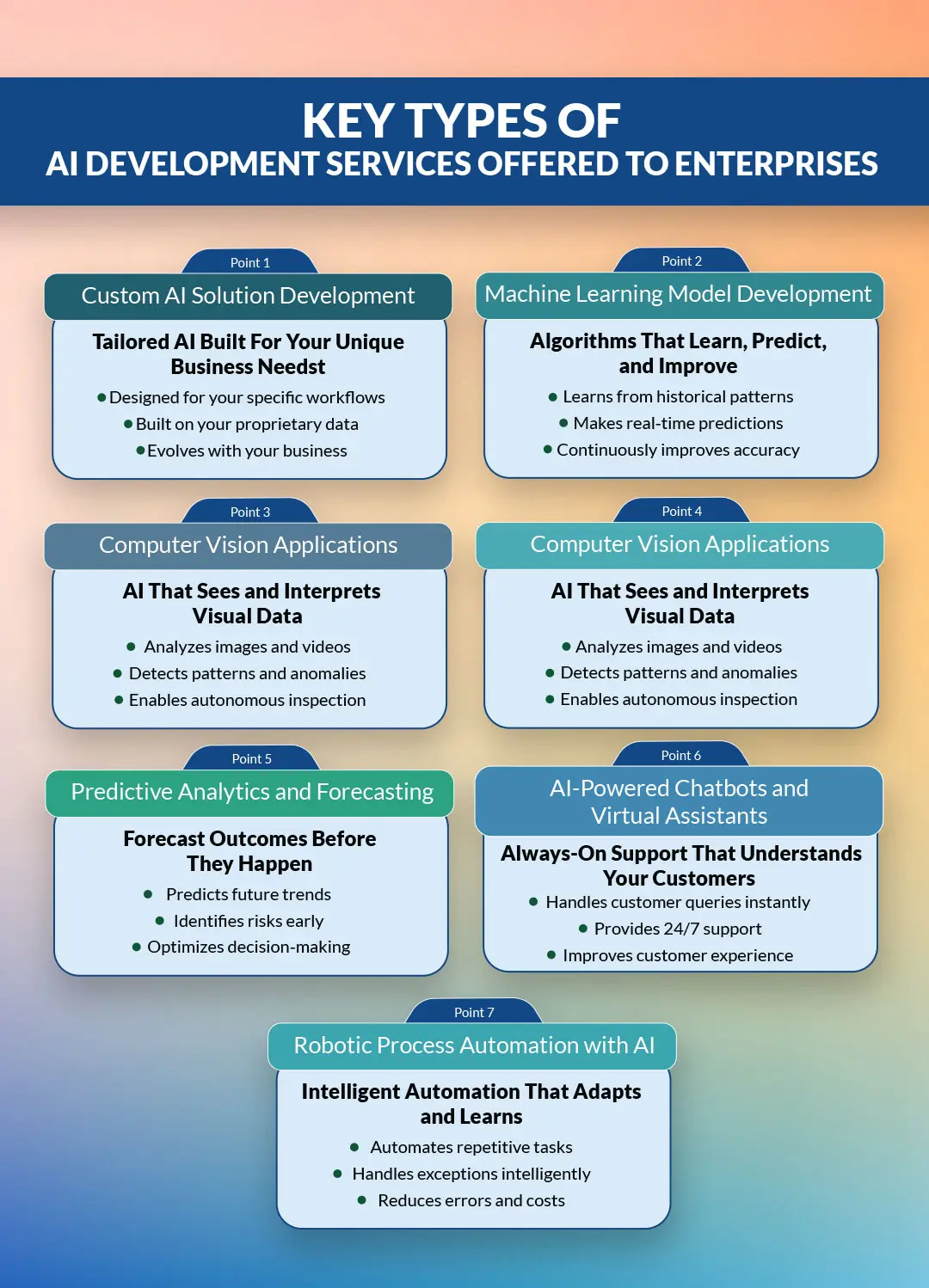
Custom AI Solution Development
Custom AI solution development is about creating systems that fit a particular business need instead of using commercially available AI tools. These solutions are built around how a company actually works, using its own data and processes. This makes them more relevant in day-to-day operations, as they are designed with specific goals in mind rather than general use cases.
For example, a logistics company may build a route optimization system based on its delivery patterns and constraints. This approach offers better control and accuracy over outcomes.
Many enterprises choose AI development services for such use cases because they require flexibility and long-term scalability. These solutions evolve as new data becomes available and business needs change.
Machine Learning Model Development
Machine learning model development involves designing algorithms that learn patterns from data and make predictions. These models are trained using historical datasets and are refined to improve performance. Common use cases include fraud detection, demand forecasting, and customer segmentation.
For instance, PayPal uses machine learning to detect fraudulent transactions in real time. AI development solutions in this area require careful model selection, feature engineering, and continuous evaluation to maintain accuracy as data patterns shift.
Natural Language Processing (NLP) Solutions
Natural language processing puts its emphasis on enabling machines to understand and process human language. Enterprises use NLP for applications such as sentiment analysis, document processing, and automated customer support. For example, banks use NLP systems to analyze customer queries and provide instant responses. This reduces the time taken to respond to any query and improves the overall service quality. AI development services in NLP often involve training models on large text datasets and refining them to understand context, intent, and variations in language.
Computer Vision Applications
Computer vision allows systems to interpret and analyze visual data such as images and videos. Many enterprises use these applications for quality inspection, recognition of facial features, and medical imaging analysis. For example, Tesla uses computer vision in its autonomous driving systems for accurate detection of objects that enables the driver to make better driving decisions.
These applications require large datasets and high processing power. AI development solutions in computer vision focus on building models that can accurately identify patterns in visual inputs under different conditions.
Predictive Analytics and Forecasting
Predictive analytics, in general, uses historical data to forecast outcomes. Enterprises apply it in areas such as sales forecasting, risk assessment, and maintenance planning. One of the best examples is airlines using predictive models to forecast equipment failures and schedule maintenance in advance.
In aviation, predictive analytics reduces downtime and enhances operational efficiency. AI development services in this space involve data modelling, statistical analysis, and continuous updates to maintain prediction accuracy as new data is introduced.
AI-Powered Chatbots and Virtual Assistants
AI-powered chatbots and virtual assistants offer better management of customer interactions for an enterprise. With the effective deployment of these systems, it can answer queries, guide users, and perform generic tasks without human intervention.
Financial institutions, such as banks and NBFCs, use chatbots to handle thousands of customer requests daily. This reduces workload on support teams and improves response time. AI development solutions for chatbots include intent recognition, conversation design, and integration with backend systems to deliver accurate responses.
Robotic Process Automation (RPA) with AI
Robotic Process Automation (RPA) with AI combines rule-based automation with intelligent decision-making capabilities. It is used to automate repetitive tasks such as data entry, invoice processing, and report generation. When combined with AI, these systems can handle exceptions and adapt to new inputs. For example, UiPath, a leading enterprise automation platform, integrates AI features such as agentic capabilities to improve automation efficiency across workflows. AI development services in this area help organizations move from basic automation to more adaptive and intelligent processes.
Step-by-Step Process of Enterprise AI Development Solutions
A structured process helps enterprises move from idea to implementation of AI-driven systems without unnecessary delays or cost overruns. While the exact approach may vary, most AI development services follow a well-defined set of stages to build reliable, scalable systems.
Step 1: Discovery and Requirement Analysis
This stage focuses on understanding what the business needs, not just what sounds technically possible. Teams discuss goals, constraints, and existing workflows. In many cases, initial assumptions change after deeper discussions. Stakeholders define the problem, expected outcomes, and success criteria. A clear scope at this stage prevents confusion later and helps avoid building something that looks good technically but does not solve the real issue.
Step 2: Data Collection and Preparation
Data is gathered from various sources such as databases, applications, or external systems. However, raw data is rarely ready for use. It often contains missing values, duplicates, or inconsistencies. Teams spend a significant amount of time ‘cleaning’ and organizing it. This step may feel slow, but it directly affects model performance. Poor data quality often leads to unreliable results, which can impact business decisions.
Step 3: Model Development and Training
In this phase, data scientists select suitable algorithms and begin training models using prepared datasets. Different approaches are tested to see what works best. It is not always a straightforward process, as models may perform well in testing but fail in real scenarios. Iteration is common here. AI development solutions often require multiple training cycles before reaching acceptable accuracy and stability.
Step 4: Testing and Validation
Before deployment, the model is tested using separate datasets to check how it performs under different conditions. This helps identify errors, biases, or unexpected outputs. Teams validate whether the model meets the defined objectives and KPIs. Sometimes results highlight gaps that require revisiting earlier steps. This stage is critical because even a small issue, if ignored, can create larger problems once the system is live.
Step 5: Deployment and Integration
Once validated, the model is deployed into a production environment. It is integrated with existing enterprise systems such as applications, APIs, or dashboards. This step involves more than just launching the model. Teams must consider performance, response time, and system compatibility. In real-world settings, integration can be slightly more complex than expected, especially when dealing with legacy systems.
Step 6: Monitoring, Maintenance & Optimization
After deployment, the system requires ongoing monitoring to track performance and accuracy. Data patterns change over time, which can reduce model effectiveness. Teams regularly update and retrain models to keep them relevant. This step also involves fixing issues, improving efficiency, and adapting to new business requirements. Continuous improvement is what keeps AI systems useful in the long run.
How Much Do AI Development Services for Enterprises Cost?
The cost of building AI systems in an enterprise setting can vary widely. It depends on their technical complexity, data readiness, and how deeply the solution needs to integrate with existing systems. While there is no fixed pricing model, understanding the major cost drivers helps businesses budget more realistically.
- Complexity of the Solution The scope and complexity of the project play a major role in determining its cost. A simple chatbot or basic prediction model will require fewer resources compared to a system that involves real-time decision-making or multiple data streams. More complex systems often require longer development cycles, more advanced models, and higher computational power, which increases overall investment.
- Data Availability Data readiness directly affects both time and cost of AI development. If data is already structured and accessible, development can move faster. However, in many cases, enterprises need to collect, clean, and organize large datasets before they can be used. This process can take a significant amount of effort and may increase costs, especially when dealing with unstructured or scattered data sources.
- Model Type Different AI models require different levels of expertise and resources. For example, basic machine learning models are generally less expensive to build compared to deep learning systems or large language models. Advanced models often need more training data, specialized hardware, and longer development time, which contributes to higher costs.
- Integration Requirements Integrating AI into existing enterprise systems can sometimes be more challenging than building the model itself. Businesses often operate on legacy systems that may not easily support modern AI capabilities. This requires additional work to connect systems, manage data flow, and maintain performance, which can increase development time and cost.
Estimated Cost Breakdown
Although pricing depends on several factors, AI projects in the US and Canada usually follow a broad cost pattern depending on their scale and functionality.
- Small AI Projects Smaller projects, such as basic chatbots or simple analytics models, may range from approximately USD 10,000 to 50,000. These projects typically have a limited scope and require fewer integrations.
- Mid-Scale Enterprise Solutions Mid-level solutions, including predictive analytics systems or recommendation engines, can range between USD 50,000 and 200,000. These projects often involve moderate data processing and integration with existing systems.
- Large, Complex AI Systems Advanced AI systems, such as real-time fraud detection or autonomous decision-making platforms, can exceed USD 200,000 and may go significantly higher. These projects involve complex architectures, continuous learning models, and large-scale data handling.
Popular Enterprise AI Use Cases Across Industries
AI adoption is not limited to one sector, as different industries are applying it in ways that directly address their operational challenges and customer expectations.
AI in Healthcare
AI is helping doctors and hospitals work with more clarity and speed. Systems are used to support diagnosis and study patient records for patterns that may not be obvious. For example, IBM Watson Health has been used to assist in identifying treatment options based on patient data.
AI in Finance and Banking
Banks rely on AI to monitor transactions and flag unusual activity in real time. It also helps in assessing credit risk and supporting trading decisions. JPMorgan uses AI tools to review large volumes of financial data, which improves the accuracy of risk assessments and trading strategies, while reducing manual effort.
AI in Retail and E-commerce
Retailers use AI to understand customer behaviour and predict demand. Recommendation engines suggest products based on browsing patterns. Amazon is a well-known example, where AI plays a key role in product recommendations and inventory planning.
AI in Manufacturing
Manufacturers use AI to reduce downtime and improve product quality. Predictive maintenance helps identify machine issues before they lead to failure. Siemens applies AI in its production lines to monitor equipment and maintain consistent output quality.
AI in Logistics and Supply Chain
AI supports better planning in logistics by optimizing delivery routes and managing inventory levels. UPS uses AI-driven route optimization systems to reduce fuel consumption and improve delivery efficiency across large networks.
AI in Customer Service
Customer service teams use AI to handle high volumes of queries without delays. Chatbots answer common questions, while sentiment analysis helps understand customer feedback. Companies like Zendesk offer AI features that improve response time and customer experience.
How to Choose the Right AI Development Partner
Selecting the right partner plays a critical role in the success of any enterprise AI initiative. A well-matched team can reduce risks associated with project failure, technical challenges, and misalignment between business objectives and AI capabilities, while also improving implementation speed and bringing practical insights that go beyond theoretical knowledge.
What to Look for in an AI Development Company
Enterprises should look for a company that demonstrates both technical depth and practical experience. A strong partner should have expertise in data science, machine learning, and system integration. It is also important to assess their ability to understand business problems, not just build models. Teams offering AI development services should be able to explain their approach clearly, including how they handle data, testing, and long-term system performance.
Evaluating Technical Expertise and Portfolio
A company’s past work provides insight into its actual capabilities. Enterprises should review case studies, technical documentation, and sample projects where possible. It helps to look beyond surface-level claims and understand the complexity of problems they have handled. A strong portfolio usually reflects experience with different industries, datasets, and system architectures, which can be valuable when dealing with unique enterprise requirements.
Importance of Industry Experience
Having specialized knowledge of the target industry can reduce the time required to implement an AI solution. For example, AI systems in healthcare must comply with strict patient data regulations, while those in financial services need high accuracy and regulatory compliance.
An experienced AI development service provider can identify potential challenges early and recommend practical solutions. This helps reduce implementation lead times and lowers the risk of errors often seen when enterprises lack domain-specific expertise.
How to Get Started with AI Development in Your Enterprise
Getting started with AI requires a clear focus on practical steps rather than broad assumptions. Enterprises that begin with structured planning and realistic expectations often see better outcomes in the early stages of their AI development journey, including data preparation, model training, and early testing.
Quick Checklist to Follow on How to Start AI Development for Businesses
- Identify one high-impact business problem where accurate data is already available and measurable outcomes can be defined.
- Evaluate existing data sources to check their quality, accessibility, and gaps before planning any AI initiative.
- Initiate the process with a small pilot project to test its feasibility instead of committing to a full-scale implementation.
- Involve both technical and operational teams early for alignment with expectations and practical use cases.
- Choose the right partner or internal team based on project complexity and long-term goals.
A structured approach helps enterprises avoid costly missteps and build systems that deliver measurable results over time. Many organizations fail not due to a lack of technology but due to unclear direction and poor planning. With the right mindset and consistent effort, AI development solutions can support long-term business growth. Over time, these investments often move from experimental projects to core business capabilities.
Frequently Asked Questions
What are AI development services?
The term ‘AI development services’ includes the entire process of developing and implementing solutions that utilize artificial intelligence (AI) technologies to analyze large amounts of data to produce insights that can then drive action. Examples of this include data preparation, modelling creation, system integration, and continuous monitoring of the AI-based engines after they have been deployed with the intent of providing ongoing benefit to the enterprise.
Some of the primary reasons enterprise companies use AI development services are to solve specific problems such as demand forecasting, workflow automation or enhanced customer interaction. AI developers also strive to ensure that the model being developed will perform optimally when it is deployed into a production environment.
How long does it take to develop an AI business solution?
How much data is required to build an AI model?
Can AI systems integrate with existing enterprise software?
What are the main challenges in AI development for enterprises?
Request a
Free Quote Today!


