


Table of Contents


The way people search for information online has changed faster than most businesses expected. AI tools like ChatGPT, Gemini, Perplexity, and Google's AI Overviews now answer millions of questions daily. They do not simply rank pages. They select specific sources to cite, and those citations carry real weight with readers who trust AI-generated answers.
A detailed analysis of nearly 8,000 AI citations across 57 diverse queries was published on Search Engine Land. This citation data was sourced and tracked by Rankscale.ai, a platform that tracks which brands and sources get cited in AI-generated answers across the web. The findings show that different AI search tools have very distinct preferences.
For example, what Perplexity pulls in regularly is not always what Google AI Overviews selects. Getting that distinction right is now a meaningful part of any serious SEO plan.
Most businesses are still focused on traditional search rankings, and that still matters. But if your content is not appearing inside AI-generated answers to consumer questions, you are missing a growing share of your audience every single day.
Here, we examine how AI systems identify trusted sources and what businesses can learn from those 8,000 AI citations. We also cover practical steps to improve your visibility in AI search results.
How to Get Cited by AI: What 8,000 Citations Reveal About the New Rules of Search
Understanding what AI engines trust and why they trust it puts you in a far better position to build a content strategy that earns citations across multiple platforms.
1. Every AI Engine Has Its Own Citation Preferences
Not all AI tools behave the same way. ChatGPT leans toward high-authority, factual sources such as Wikipedia, major news outlets, and established industry blogs. It rarely pulls in user-generated content, social media posts, or vendor product pages. Perplexity takes a broader approach, sometimes citing as many as thirteen different brands in a single response, which gives smaller and niche businesses a genuine chance of showing up.
Google AI Overviews pulls heavily from community content, including Reddit threads, review pages, and even vendor-published material. Gemini tends to blend authoritative blogs and news coverage with community content like YouTube and user reviews, especially for consumer-focused topics.
The practical takeaway is that a single content strategy may not serve all the platforms equally. Knowing which AI tool your audience uses most often should shape where you publish and what kind of content you create. Treating each platform as a separate citation opportunity will get you much further than taking a blanket approach.
2. Strong Traditional SEO Still Drives AI Citation Probability
Before you can get cited by an AI engine, you generally need to rank well in traditional search. AI engines that use search results as a primary input, including Google AI Overviews and Gemini, tend to pull from pages that already appear at or near the top of organic results.
This means that the fundamentals of SEO remain essential. Quality content, solid backlinks, clear site structure, and consistent technical performance all contribute to being included in AI-generated answers.
However, ranking at the very top is not always a guarantee of this. Instances exist where a highly authoritative page from a lower search position was cited over a weaker piece that ranked higher.
AI engines are paying attention to credibility, not just position. For instance, a well-cited piece from a respected industry publication can outperform a commercially motivated page that happens to top a Google SERP. Avoiding common SEO mistakes and building strong SEO fundamentals remains the most reliable path into AI citations. No shortcut replaces that groundwork.
3. Deep, Specific Pages Get Cited Far More Than Homepages
One of the clearest patterns in the dataset of 8,000 citations is that AI engines strongly prefer deep, specific pages over broad homepages or category-level pages. A detailed guide on a focused topic gives AI far more usable (and quotable) information than a homepage that introduces an entire brand in broad strokes. Listicles, how-to articles, product comparison pieces, and expert guides are all well-positioned to earn citations, provided they are well-structured and genuinely informative.
Internal linking to these deep pages matters. If your own site does not signal that these pages are important, AI engines are less likely to discover and trust them. Audit your most valuable content pages and make sure they are easy to find, well-linked, and clearly written for a specific reader with a specific question in mind.
4. E-E-A-T Signals Are the Foundation of AI Trust
Google's framework of experience, expertise, authority, and trustworthiness, commonly referred to as E-E-A-T, has been important in traditional search for years. For AI citations, it plays an equally critical role.
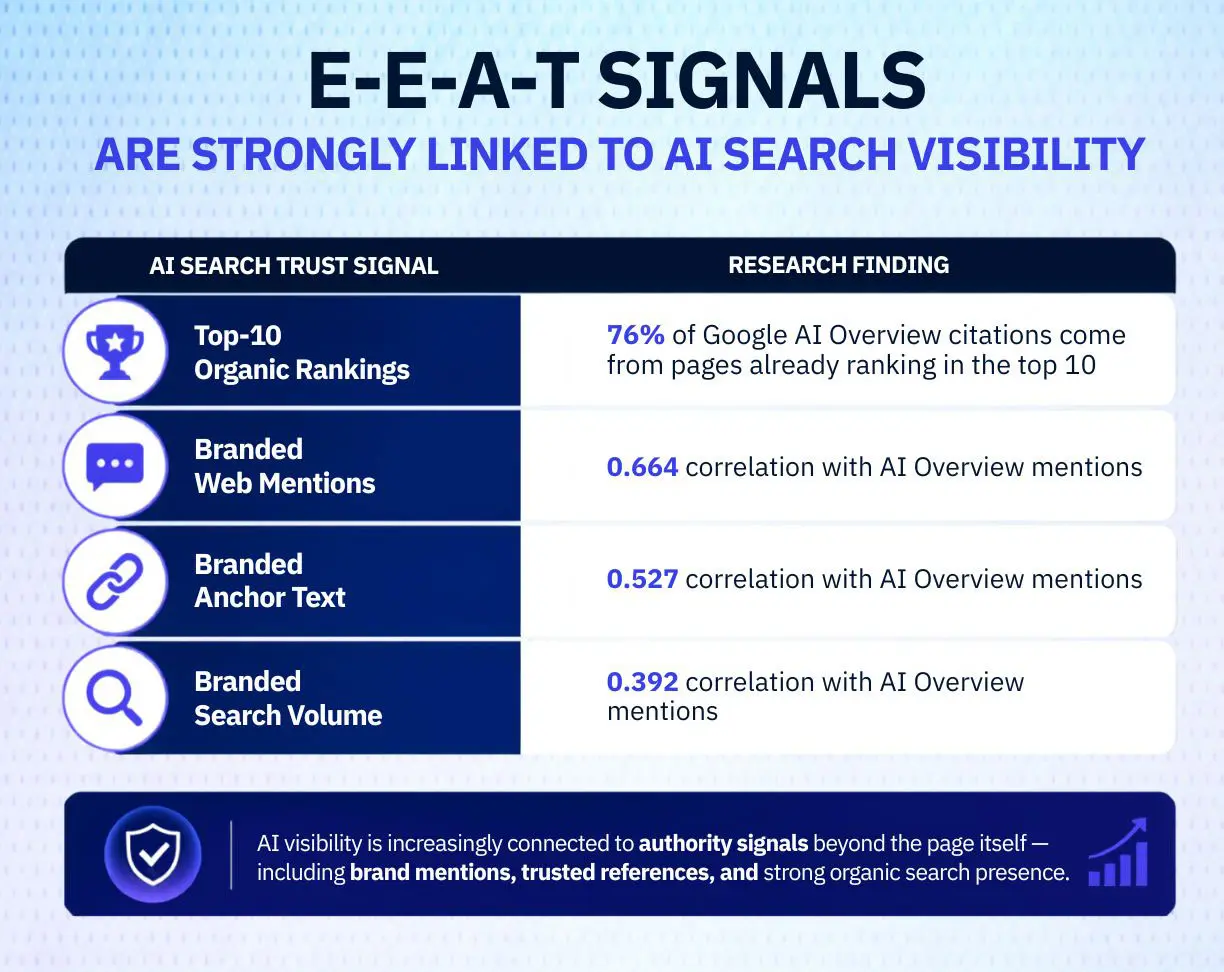
AI engines are designed to avoid spreading misinformation, so they look for signals that a source is genuinely credible. This includes clear author bios showing real-world expertise, citations of external data sources within the content itself, positive user reviews on third-party platforms, and consistent factual accuracy.
Publishing under a real name with verifiable credentials helps. So does earning mentions from well-regarded publications in your industry. Google explicitly considers E-E-A-T signals as part of what qualifies a source for AI citation.
For example, a blog post written by a named expert and supported by citations from published research will carry far more trust than anonymous content with no backing. Detailed author pages with career history and credentials can directly improve your AI citation rate over time.
5. Content Must Match User Intent at a Deep Level
AI systems interpret what a user wants with more sophistication than traditional keyword matching ever allowed:
- If someone asks a comparison question, AI will look for content that offers a balanced, criteria-based breakdown.
- If someone wants a step-by-step fix, AI favours detailed, actionable instructions.
- If someone is researching a purchase, AI looks for content that clearly weighs the pros and cons of each choice.
Generic articles that touch on a topic without going deep are rarely cited. The data from that 8,000-citation study reinforces this pattern. AI engines reward content that fully addresses a topic, provides meaningful context, and anticipates the follow-up questions the reader might have.
This is precisely where AI search engine optimization services differ from older SEO approaches. The focus shifts from keyword density to genuine depth of coverage. Writing for a real person who has a specific problem and actually solving that problem within the page is the single best thing you can do to earn consistent AI citations.
6. Third-Party Authority Matters as Much as Your Own Website
Being cited by AI often depends as much on where others talk about you as on what you publish yourself. Reddit is one of the most-cited sources across all the popular AI platforms. Review platforms like G2, Capterra, and Trustpilot are also cited regularly. Industry publications and news outlets that mention your brand carry significant weight.
This signifies that your content strategy needs to extend well beyond your own blog. Actively taking part in relevant online communities, earning mentions in reputable industry press, and encouraging genuine customer reviews on major platforms all feed into how AI engines assess your credibility.
For instance, a brand with consistent, positive mentions across five or more external domains sees measurable improvement in AI citation rates. Building that kind of distributed, multi-platform presence takes time but is one of the most durable forms of authority you can develop in the AI era of search.
7. Structured, Well-Formatted Content Gets Pulled More Easily
AI engines need to extract and synthesize information quickly. Content that is clearly structured makes that job easier, and content that is easier gets cited more often.
This means:
- Using clear headings that reflect the actual questions your audience is asking.
- Writing short, focused paragraphs rather than long blocks of dense text.
- Using numbered lists or bullet points where a sequence of steps or a set of options genuinely calls for it.
Structured data markup, such as FAQ schema or how-to schema, gives AI engines an even clearer picture of what your page contains.
Working with an AI SEO agency that understands how generative engines process and extract content can make a significant difference in how often your pages are selected as citation sources. Well-structured content also tends to perform better in traditional search, so your investment pays off in multiple ways. Clean, readable formatting is not about aesthetics alone. It is about making your content as usable as possible for both AI and the humans who read the answers.
8. Vendor Blogs Earn AI Citations When Done Right
There is a common assumption that AI engines avoid product-focused or brand-authored content. The data from the 8,000-citation study challenges that assumption.
Vendor and product blogs can earn citations, particularly for "best of" and "top list"-style queries, but only when the content is objective, thorough, and genuinely useful rather than promotional.
If your brand blog reads like an advertisement, it will not be cited. If it reads like an honest resource that happens to be published by a company with deep expertise in the topic, it has a real shot. The distinction is tone and intent. Covering a topic honestly, including mentioning alternatives or limitations where relevant, builds the kind of credibility that AI engines recognize.
For instance, a software company that publishes a detailed guide comparing several tools in its category, including its own, with real performance data and honest trade-offs, will almost certainly be trusted more than one that only promotes itself. A regular publishing cadence also signals that your site is an active, maintained resource to which it is worth returning.
9. B2B & B2C Intent Shape Which Sources AI Engines Trust
The kind of query significantly influences which sources an AI engine chooses to cite. For all B2C queries such as "best smartphones" or "top running shoes," AI engines tend to favour consumer-focused platforms. YouTube reviews, consumer review sites, and Wikipedia feature prominently.
For all B2B queries such as "top CRM software" or "best cloud hosting for enterprises," the citation pool shifts toward company blogs, analyst reports, and LinkedIn content.
For mixed queries that sit between both worlds, AI typically leans on neutral, factual references such as research reports and industry news. This distinction matters a great deal for how you plan and distribute content.
A B2B company that invests primarily in YouTube without also building presence on LinkedIn and in industry publications is missing where citations actually come from. Understanding the intent profile of your most valuable keywords will tell you where to concentrate your third-party presence to maximize your chances of appearing in AI-generated answers for the queries that matter most to your business.
10. Multi-Source Validation Significantly Boosts Citation Rates
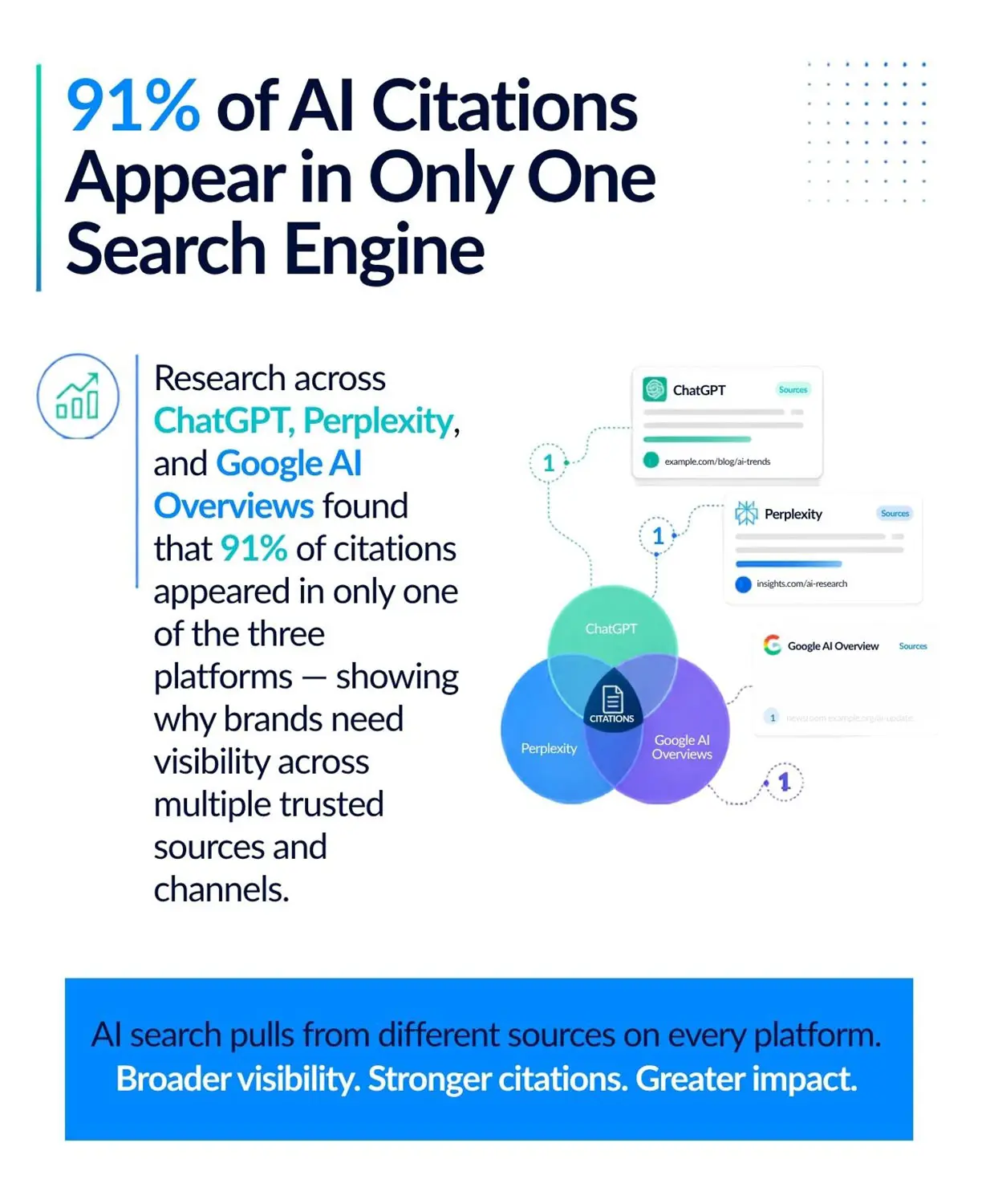
Getting cited by AI is not just about having great content on your own site. It is also about how many credible, external sources reference, mention, or discuss your brand.
This principle is similar to traditional link building, but it applies more broadly. Getting a mention in a respected industry publication is not enough on its own. Getting mentioned in an industry publication, a forum discussion, a user review, and a LinkedIn post by a recognized expert creates the kind of multi-layered authority AI engines look for. That combination of sources is what AI platforms use as a trust signal when deciding which brands to surface in generated answers.
For instance, a B2B software company that earns a write-up in a trade publication, prompts a thread on a relevant subreddit, and appears on G2 with detailed user reviews is building exactly the kind of web presence AI engines trust.
Consistent information about your brand across platforms, including your name, address, and contact details, reinforces your entity's credibility as a whole.
11. Tracking Your AI Visibility Is a Non-Negotiable Part of Strategy
Getting cited once is not the same as being consistently visible across AI platforms. AI search is evolving quickly, and your citation presence can shift as engines update their source preferences or as new competitors build stronger authority.
Tracking where your brand appears in AI-generated answers should now be a standard part of your SEO reporting. Tools exist specifically for this purpose, including platforms that monitor which queries your brand appears in across ChatGPT, Gemini, Perplexity, and Google AI Overviews.
One practical starting point is to manually ask these AI tools questions in your industry niche and note whether your site appears in the citations. From there, AI-driven SEO services can help you automate this monitoring at scale and identify gaps in your citation coverage before competitors fill them.
Reviewing which pages are cited most often reveals what content format, depth, and topic angle is working. You can then use that data to guide what you produce next.
How Sourcedesk's Services Support Your AI Citation Strategy
Getting cited by AI calls for more than a single strong piece of content. It can take a coordinated, technically sound approach that connects content quality, authority building, and platform strategy. Here is how the right support makes a direct difference.
Digital Marketing Services That Build the Right Content Foundation
Earning AI citations starts with having content that is genuinely worth citing. Sourcedesk's digital marketing services are built to support exactly that kind of content foundation. The team works across SEO, content strategy, and paid performance to help businesses grow their online presence in a way grounded in real audience research and search data.
That means producing deep, well-structured articles and guides that address specific user questions rather than broad, generic topics that no AI engine will ever cite. It also means publishing consistently, because AI engines and traditional search algorithms both favour sites that demonstrate ongoing expertise through regular output.
For B2B businesses in particular, aligning content topics with the queries that AI engines are actively pulling results for can make a measurable difference in citation frequency. A smart content program does not just improve traditional rankings. It builds the kind of consistent, multi-page authority that earns placement in AI-generated answers and keeps it over time as the search landscape shifts.
Technical SEO Support for AI-Era Visibility
Even the best-written content will struggle to earn AI citations whenever the technical foundations of a website are weak. Slow page load times, poor mobile performance, missing structured data markup, and unclear site architecture all reduce the likelihood that an AI engine will trust and cite all your pages.
Sourcedesk's web development and digital marketing teams work together to address these technical factors at the source. This includes implementing the schema markup that helps AI engines understand what each page is about, ensuring fast and reliable site performance across devices, and building clean URL structures that make it easy for crawlers to find and index your deepest, most informative pages.
Choosing an AI-powered SEO service provider that knows both the technical and content sides of AI visibility means you are not solving one problem while ignoring another. Technical credibility and content credibility work together. A site that loads quickly, structures its information clearly, and publishes genuinely helpful content is far more likely to show up in AI-generated answers on a consistent basis.
Building Multi-Platform Brand Authority Through Sourcedesk
As the citation data makes clear, your website is only part of the equation. AI engines draw on signals from across the web, so where your brand appears rightly matters as much as what your website says. Mentions on Reddit, coverage in industry publications, customer reviews on G2 or Clutch, and commentary from all the recognized experts on LinkedIn shape how AI tools assess your credibility.
Sourcedesk helps clients build this kind of wider visibility through digital marketing that works across channels. That might mean pursuing press coverage in the right publications, encouraging customers to leave reviews on platforms that AI engines trust, or developing a LinkedIn content program rooted in genuine expertise. The aim in each case is to give AI engines multiple, consistent reasons to trust your brand.
Presence across multiple high-authority platforms may tend to compound. Each mention can reinforce the others, and over time the effect on both AI citations and traditional search rankings becomes quite significant. Any brand that appears regularly across several trusted platforms builds a stronger authority signal than one that can dominate a single channel.
AI Development Expertise That Informs a Smarter Citation Strategy
One advantage Sourcedesk brings to AI-related strategy is a genuine understanding of how AI systems are built and how they process information. The team builds AI and machine learning products, which means they understand how AI engines retrieve and evaluate information, how they judge whether a source is credible, and what factors influence which sources get selected when someone asks a question.
That knowledge can shape better content and SEO advice. For all the companies looking at AI search engine optimization services as a pathway to sustained visibility, working with a partner who understands how these systems are built, not just how they appear to behave, makes a real difference to your success. As AI tools continue to update how they select and cite sources, that technical grounding helps clients adapt early rather than scramble in order to catch up every time something changes within AI search.
The rules around how to get cited by AI are becoming clearer, and the data from nearly 8,000 citations cited here gives businesses a solid starting point. Authority, depth, structured content, and presence across multiple platforms are not optional. They are what earns your brand a place in AI-generated answers that people trust and act on. The businesses that take this seriously now will be in a much stronger position as AI search continues to grow. As an AI powered SEO service, Sourcedesk brings together digital marketing, technical SEO, and hands-on AI development experience to help your brand build the kind of presence that AI engines recognize and cite. Getting there takes a consistent, well-considered approach. There are no shortcuts to modern SEO success.
Frequently Asked Questions
1. What exactly is an AI citation in SEO?
2. Which AI engines should businesses prioritize for citation strategy?
3. Does traditional SEO still matter if you want AI citations?
4. How long does it take to start earning AI citations?
5. Can smaller or even niche businesses realistically get cited by AI?
6. What content formats earn AI citations most consistently?
Request a
Free Quote Today!


