


Table of Contents


Most business owners keep a close eye on their Google reviews and search rankings. Checking what an AI chatbot says about their company, however, is a step most have not taken.
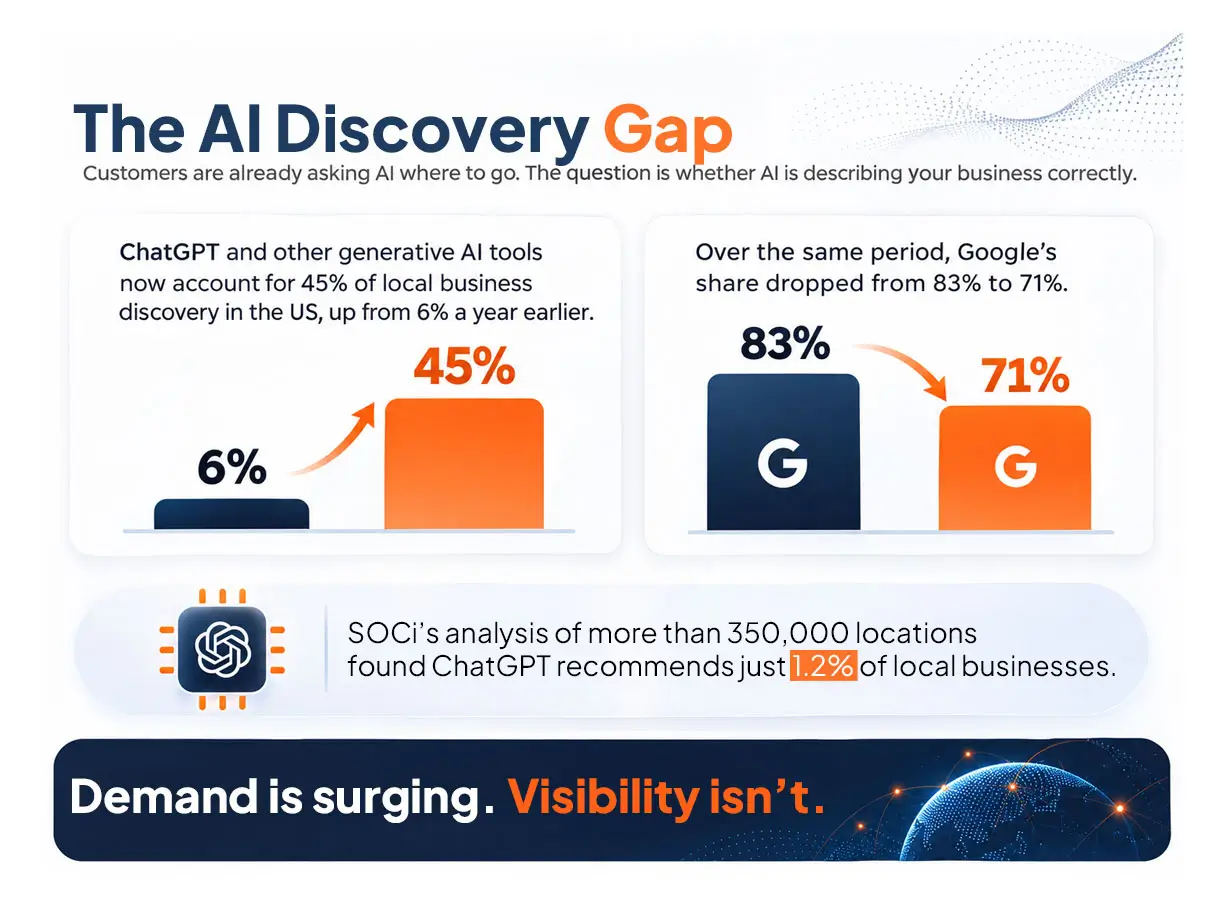
That gap matters more now than it did even a year ago. AI tools like ChatGPT, Google Gemini, and Perplexity have become a common first stop for people researching services and deciding which businesses to contact. When a potential customer asks one of these tools about a local service provider, the AI produces a description.
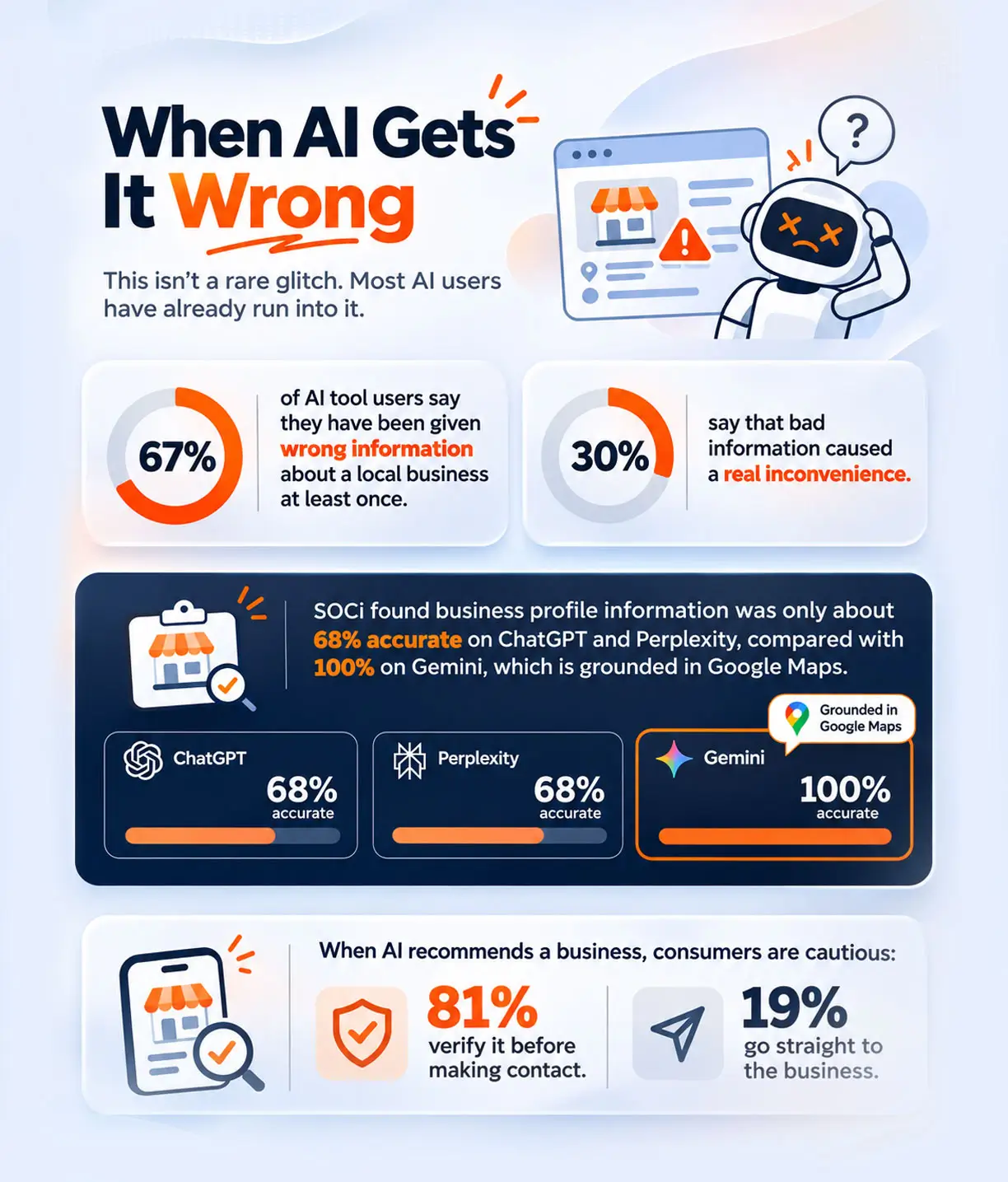
The problem is that AI platforms don't always describe businesses accurately. They draw from training data and online sources that may be months or years out of date. A business that has changed its services, relocated, or expanded may still be described in older terms. For example, a discontinued service may still appear active, or a new offering the business actively promotes may not appear at all.
When these inaccuracies reach a customer, they form an impression based on incorrect information and expect something the business no longer offers. This is why AI brand monitoring becomes essential for businesses.
AI brand monitoring is the practice of regularly checking and responding to what AI platforms say about your business. This article covers why inaccurate AI descriptions happen, how businesses can audit what AI currently says about them, and what practical measures move the needle toward more accurate representation.
How Incorrect AI-Generated Business Information Can Affect Customer Decisions
Before exploring what businesses can do about the problem of AI misinformation, it's worth understanding what the problem actually costs. Inaccurate AI responses don't just sit there harmlessly but travel with every customer who reads them.
1. Customers May Never Consider the Business
When someone asks an AI tool for a recommendation, they usually trust the response. If the AI describes a business incorrectly—with the wrong specialty, say, or service area—that business effectively drops off the customer's list before they have even considered it.
The customer doesn't suspect anything is wrong. They simply move forward based on the information they have received. This is one of the quieter consequences of a damaged AI brand perception, because a business can lose customers without any visible sign of the problem.
2. AI May Recommend Services That Are No Longer Available
Businesses change over time as products get discontinued, service lines get restructured, and pricing models shift. AI platforms, however, don't always keep pace with those changes.
A business that stopped offering a particular service two years ago might still be described as offering it today. When a customer reaches out expecting that service and learns it no longer exists, the experience feels misleading—even if no one at the business intended any confusion.
This gap between what an AI says and what a business actually offers is one of the more damaging forms of AI-generated misinformation about businesses circulating today.
3. New Capabilities May Not Be Recognized
The reverse problem is equally frustrating. When a company adds a new service, opens a new location, or earns a new industry certification, AI platforms may not capture that update for a long time.
A business that has expanded significantly may still be described in older, narrower terms. Customers who could benefit from new offerings never learn about them. That’s because the AI they consulted simply didn't have that information, and nothing prompted them to look further.
4. Conflicting Information Can Create Customer Confusion
Sometimes the issue isn't a single wrong answer but inconsistent answers across different platforms. One AI tool describes a business one way while another describes it differently. A third pulls details from a review site that hasn't been updated in years.
Customers who research across multiple tools encounter contradictions, and that confusion erodes trust. Even if the business itself is excellent, conflicting AI descriptions can make it appear disorganized or unreliable before anyone speaks to them.
Why AI Platforms Sometimes Get Business Information Wrong
Understanding the cause of AI platforms showing wrong information helps businesses respond more effectively. The issue usually isn't carelessness on the part of AI developers. It comes from how these systems are built and how they gather information.
1. AI May Rely on Outdated Information
Most large language models are trained on data collected up to a specific point in time. After that training window closes, the model's core knowledge doesn't update automatically. A business that changed its services, relocated, or rebranded after the model's training cutoff may still be described using old information.
This applies to nearly every AI tool that provides business information. Even platforms with real-time web access tend to favour older, more frequently cited sources, which may not reflect recent changes at all.
2. Multiple Online Sources May Contradict Each Other
AI platforms often pull from dozens of sources simultaneously. Business directories, review sites, forum discussions, old news articles, and archived press releases all contribute to what the AI "knows" about a company.
When those sources disagree, the AI must make a judgment call. It may favour whichever source appears most frequently, even if that source is outdated. The result is a confident-sounding response that contains inaccurate details.
This is a central challenge in AI search reputation management of a company's online reputation. It is now partly shaped by which sources an AI decides to trust, not just by the company's own messaging.
3. A Website Update Does Not Immediately Update Every AI Platform
A common assumption is that updating a business website will quickly correct what AI tools say about that business. In practice, the relationship between a website update and an AI response is not that direct.
AI tools may reference cached versions of web pages, or rely on third-party data aggregators that haven't refreshed. They may prioritize older articles that rank highly in search results over newer but less-linked pages. Updating the website is a necessary step, but one that rarely corrects brand accuracy in AI search results right away.
4. This Problem Is Sometimes Called LLM Positioning Lag
Researchers and digital strategists have started using a specific phrase to describe this delay: LLM positioning lag. It refers to the gap between how a business operates today and how it is described by AI language models.
LLM positioning lag can persist for months. It affects businesses across industries, from local service providers to global brands. The lag doesn't make AI useless for business visibility, but it does mean that businesses need to monitor what AI says about them and work to close the gap over time.
How to Check What ChatGPT and Other AI Platforms Say About Your Business
Any company can check what AI tools say about its business, and no special software is required. It does require a methodical approach, though, and a willingness to record what you find.
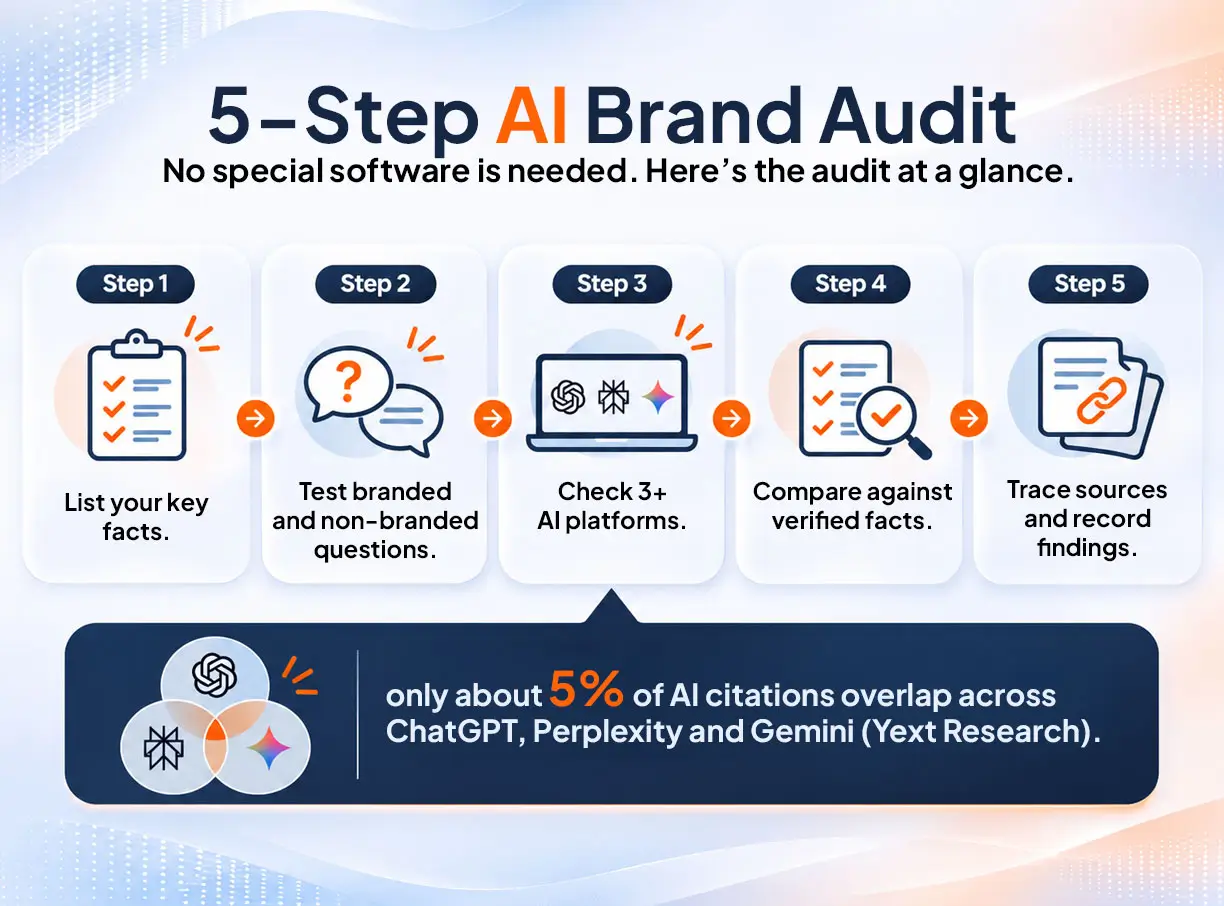
Step 1 – Identify the Business Facts You Need AI to Get Right
Before testing anything, businesses should write out a short list of facts that matter most to them. This typically includes:
- Business name and location — Particularly if there are multiple locations or you have moved recently
- Core services or products — What the business offers today, not what it offered in the past
- Target audience or service area — Residential, commercial, local, national, or otherwise
- Notable credentials or affiliations — Any information that shapes trust or differentiation
- Current contact details — Phone, email, booking methods, and operating hours
This baseline becomes the reference point for evaluating everything AI platforms say. Without it, there is no clear way to judge whether a response is accurate.
Step 2 – Test Branded and Non-Branded Questions
Testing should cover two distinct types of questions.
Branded questions use the business name directly. For example, "What services does [Business Name] offer?" or "Where is [Business Name] located?" These reveal what AI platforms know specifically about that business.
Non-branded questions describe what the business does without naming it. For example, "Who are the best flooring installers in Etobicoke?" These reveal whether the business appears in category-based queries at all and, if so, how it's described.
Both types of questions matter. A business may be described correctly when named but missed entirely in category-based queries. That's a ChatGPT brand visibility issue worth addressing separately from factual inaccuracies.
Step 3 – Check More Than One AI Platform
The AI landscape isn't a single platform, as ChatGPT, Google Gemini, Microsoft Copilot, Perplexity, and other tools are all widely used. Each has its own training data, its own sources, and its own approach to presenting business information.
A business described accurately in one platform may be described poorly in another. Restricting the check to a single tool gives an incomplete picture of how AI is understanding your business. Testing at least three platforms builds a more meaningful sample of how the business appears across the broader AI ecosystem.
This kind of multi-platform testing is a core part of AI reputation monitoring—understanding not just what one AI says, but what AI says broadly.
Step 4 – Compare Responses Against Verified Information
Once responses are collected, the next step is comparing them against the verified facts from Step 1.
For each AI response, the business should ask:
- Is the service description accurate and current?
- Is the location or service area described correctly?
- Are discontinued services still being mentioned as active?
- Is the business missing from responses where it should reasonably appear?
- Is the description consistent with how the business currently positions itself?
Flagging each inaccuracy clearly makes it easier to decide what to fix first.
Step 5 – Investigate Sources and Record Findings
When an inaccuracy appears, the logical question is: where did the AI get that information? Some AI platforms, like Perplexity, show the sources they draw from, while others do not.
Where sources are visible, businesses should note which sites are contributing to the inaccuracy. A particular directory listing, an old press release, or a competitor comparison article could be the root cause.
Recording all findings—both accurate and inaccurate—creates a useful document. It tracks the starting point and allows the business to measure whether things improve over time.
Which AI Brand Information Problems Should Businesses Fix First?
Not every inaccuracy carries the same weight. When a business discovers multiple issues, it helps to prioritize them based on the potential impact on customer decisions.
Fix immediately:
- Incorrect core service descriptions that could lead customers to contact the business expecting something it no longer offers
- Inaccurate location details or service area information that could send customers to the wrong place
- Missing information that removes the business from AI recommendations entirely
- Any description that contradicts current pricing models, appointment processes, or booking methods
Address next:
- Outdated descriptions of secondary services or add-ons
- Missing new offerings that the business would like customers to know about
- Inconsistencies across different AI platforms that create confusion
Monitor over time:
- Positive but incomplete descriptions that don't actively mislead anyone
- Accurate information that may become outdated as the business continues to evolve
Fixing the most damaging inaccuracies first reduces the risk of losing customers due to wrong information. Businesses can then address lower-priority items in follow-up review rounds.
How Businesses Can Address Incorrect Information in AI Search
Correcting what AI platforms say about your business isn't as direct as editing a web page. However, businesses can take several practical actions, each of which contributes meaningfully to the overall result.
1. Correct Outdated Information on Your Website
Your business’s website is the most authoritative source of information about your business. When an AI platform seeks to verify a claim, the official site is typically one of the first places it checks.
Businesses should review their website for outdated service pages, old location details, discontinued product descriptions, and content that no longer reflects their current operations. Updating these pages doesn't guarantee immediate changes in AI responses, but it does provide a solid foundation upon which to build.
This is a foundational step in AI search optimization, making sure the most authoritative source is as accurate as possible before looking outward.
2. Review Third-Party Business Descriptions
Business directories, local citation sites, review platforms, and industry databases often contribute to what AI tools know about you. These should be reviewed and updated wherever possible.
Common sources include:
- Google Business Profile
- Yelp and similar review directories
- Industry association listings
- Chamber of commerce directories
- Mapping services
Each listing should reflect the current state of your business—accurate category, services, address, and contact details. Outdated details on even one high-authority directory can influence what AI platforms say about you for a long time.
3. Make Important Business Changes Explicit
When a business goes through a significant change like a rebrand, a new service launch, or a location move, communicate it clearly across the website and in announcement content.
A press release, a blog post, or a clearly dated news announcement gives AI platforms a dated reference point that signals that the information is current. This kind of intentional, dated content is a practical application of generative engine optimization, i.e., creating content that helps AI systems understand what a business does today, not just what it did in the past.
4. Improve Access to Current Business Information
Structured data and schema markup help search engines and AI systems read web content more accurately. While implementing these may require developer support, they are worth considering for businesses serious about managing how they appear in AI-generated results.
Equally important is publishing content that answers the same questions customers ask AI platforms. An FAQ page, a detailed About page, and a regularly updated blog give AI multiple current reference points from which to draw.
5. Report Specific Errors Where Correction Channels Exist
Some AI platforms offer formal feedback or correction mechanisms. For instance, ChatGPT allows users to flag responses as inaccurate. Google's AI features have similar options.
Where these channels exist, businesses should use them. Submitting a correction doesn't guarantee an immediate fix. However, it does contribute to the feedback loop that platform developers use to improve accuracy over time.
6. Verify the Result Rather Than Assuming the Fix Worked
After making corrections, businesses should re-test the same questions across the same platforms. Changes may take weeks or months to surface in AI responses.
Re-testing confirms whether the correction worked. It also reveals whether new inaccuracies have appeared since the last review. Treating this as a periodic exercise rather than a one-time effort is what gives it long-term value.
How to Measure Whether AI Brand Accuracy Is Improving
Tracking improvement requires something to measure against. That is why the records from the initial audit carry weight beyond the first review — they become the reference point every future check is measured against.
Each time a business revisits the same questions, the comparison tells a clearer story than any single snapshot would. Movement in the right direction might look like:
- Fewer inaccurate service descriptions across platforms.
- The business appearing in category-based queries where it was previously absent.
- Consistent descriptions across multiple AI tools rather than contradictory ones.
- Outdated details replaced by current, accurate information.
Measuring improvement is not about achieving perfection. It's about tracking direction. A business that was described incorrectly across most platforms a few months ago and is now described accurately across the majority has made real, meaningful progress.
Ongoing AI brand monitoring is what transforms this from a one-time fix into a sustained advantage. Businesses that check regularly and update proactively will generally maintain a stronger AI brand perception than those that only check after a customer complaint surfaces the problem.
It also helps to document what changes were made and when. When AI responses improve, knowing which action likely caused the improvement informs smarter decisions going forward.
AI platforms draw from whatever publicly available information exists. If that information is outdated or contradictory across sources, the output reflects that. The platform is not solely at fault—the inputs are. That places a clear responsibility on businesses. Keeping information accurate across the official website, directories, and third-party listings directly influences what AI platforms learn and repeat. Businesses that build AI reputation monitoring into their regular operations rather than treating it as a one-off fix are the ones best positioned as AI becomes a primary channel through which customers find and evaluate services.
Frequently Asked Questions
1. Why does ChatGPT show outdated information about a business?
ChatGPT and similar AI tools are trained on data collected up to a specific cutoff date. After that point, the model's internal knowledge does not update automatically. Even when a platform has real-time web access, it may still prioritize older, more frequently cited sources over recent updates. This creates a gap—often called LLM positioning lag—between what a business does today and what the AI says about it.
2. Can a company directly update what an LLM knows?
3. How can businesses check whether AI-generated brand information is accurate?
4. Does updating a website automatically correct AI search results?
5. How often should businesses monitor AI-generated descriptions of their brands?
Request a
Free Quote Today!


