


Table of Contents


Businesses today are making decisions that would have been nearly impossible to make so fast without artificial intelligence just a decade ago. Examples include:
- A retailer forecasting next month's demand easily before placing supplier orders.
- A bank flagging a fraudulent transaction within milliseconds of it being initiated.
- A streaming platform uses viewing history to surface content that keeps subscribers engaged long enough to renew.
None of these forecasting activities run on spreadsheets or manual analysis. It runs on machine learning systems that were built for a specific business, trained on that business's own data, and designed to solve a defined operational problem.
That shift is what AI & ML development services represent in practice. These are not generic software tools, built to solve common business problems. They are purpose-built intelligent systems that help organizations move from reactive decision-making to proactive, data-informed operations. They also address a wide range of problems, and the level of intelligence they can provide is broader than most businesses initially expect.
This article explores five of the most impactful real-world applications of artificial intelligence and machine learning in business. Each section examines what the technology does in practice, where it is being used, and what kind of value businesses are generating from it.
Predictive Analytics and Forecasting Models
Every business decision carries with it some uncertainty, but predictive analytics is built to reduce it using evidence rather than instinct.
Instead of relying on last year's numbers and a general sense of market direction, businesses can now use machine learning models to generate statistically grounded forecasts across demand, customer behaviour, equipment performance, and financial outcomes.
What Predictive Models Do
A machine learning forecasting model works by analyzing historical data like sales figures, user behaviour, equipment readings, and financial records and detecting patterns within it. Once those patterns are established, the model applies them to new data and generates probabilistic forecasts.
It does not produce certainty. Instead, it produces a well-informed probability that gives decision-makers a far stronger foundation than guesswork alone could.
Predictive analytics is being applied across industries for a wide range of business decisions:
- Inventory and supply chain planning: Organizations forecast demand by product, region, and time period. This approach reduces both stockouts and excess inventory at the same time.
- Customer churn prediction: Companies identify customers at risk of leaving before they cancel. That advance notice gives retention teams time to respond with targeted outreach.
- Predictive maintenance: In manufacturing and utilities, predictive models flag equipment likely to fail before a breakdown happens. Unplanned downtime drops as a direct result.
- Revenue forecasting: Finance teams model outcomes under multiple market scenarios, then plan resources accordingly. Decision cycles become faster and better informed.
Why Forecasting Models Deliver Strong Business Returns
When organizations have a clearer picture of what lies ahead, the downstream effect on resource decisions is significant. Procurement, marketing allocation, and staffing all become more defensible because they are guided by evidence rather than assumptions that frequently miss real conditions.
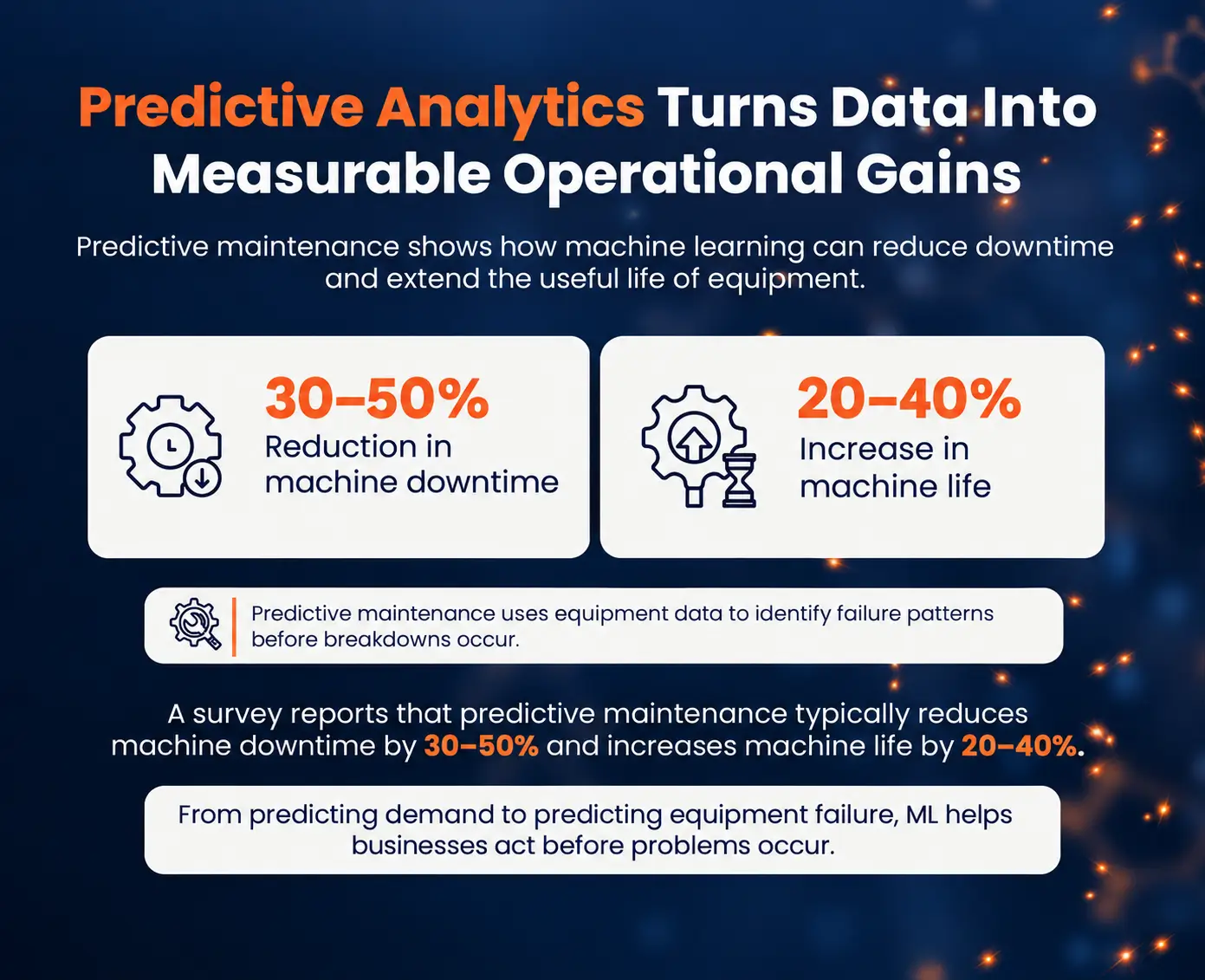
An AI and ML development company with forecasting experience builds predictive models that grow more accurate as new data comes in. The longer the system runs on real business data, the more reliable its outputs become, making predictive analytics a stronger investment over time rather than a diminishing one.
Computer Vision and Image Recognition
Most people first encounter image recognition through facial recognition on a smartphone or photo-tagging on social media. In a business context, though, computer vision is doing considerably more complex and commercially significant work.
Computer vision gives machines the ability to interpret and analyze visual data like photographs, video streams, documents, medical scans, and satellite imagery. It is one of the more established branches of machine learning, with production applications now running at scale across multiple industries.
How Computer Vision Systems Learn
A computer vision model is trained on large, labelled datasets of images. The system learns to identify visual patterns such as shapes, colours, textures, and spatial relationships that correspond to specific objects, defects, or conditions. Once trained, this model analyzes new images with a speed and consistency that human review simply cannot match at high volumes.
Real-World Applications in Business
AI development service providers are helping businesses apply computer vision in practical, day-to-day operational settings:
- Manufacturing quality control: Systems inspect products during production, catching surface defects, dimensional inconsistencies, or assembly errors in real time without slowing the line.
- Retail inventory management: Smart shelf systems monitor stock levels continuously and flag gaps before staff notice them, reducing missed sales from empty shelves.
- Medical imaging support: AI tools help clinicians analyze scans for patterns linked to potential abnormalities, supporting diagnostic decision-making without replacing the physician.
- Agriculture: Drone-mounted cameras combined with vision AI assess crop health, identify pest damage, and generate detailed field reports at a pace that ground-level inspection cannot approach.
- Security and surveillance: Intelligent monitoring systems detect unusual activity as it occurs rather than relying on retrospective footage review after an incident.
At the end of the day, human inspection is limited by how many people are available and how long they can sustain their focus. Computer vision has no such limit, as it processes the same volume at two in the morning as it does during peak hours, with consistent accuracy throughout.
For any organization where quality control is central to the operation, that reliability at scale is what makes it a practical investment.
Natural Language Processing and Chatbots
Human language is one of the most difficult things for a machine to handle well. The same word means different things depending on who is saying it, in what context, and to whom, and the way people write and speak shifts continuously across regions, generations, and platforms. Yet natural language processing has made striking progress in recent years, giving machines the ability to read, interpret, and generate human language in ways that are genuinely useful for business.
The result is a set of tools that businesses are using to improve customer communication, automate repetitive workflows, and draw useful insights from text-based data at scale.
What Natural Language Processing Covers
NLP is a broad field that encompasses a wide range of practical capabilities:
- Sentiment analysis: Systems scan customer reviews, support tickets, and social media to assess how people feel about a product, service, or brand at scale.
- Document classification: Automated tools sort incoming documents such as contracts, invoices, and complaints by category and priority without manual handling.
- Text summarization: Long research reports or articles are condensed into concise summaries, saving significant analyst time across teams.
- Named entity recognition: Systems extract specific information like names, dates, locations, and product codes from large amounts of unstructured text in seconds.
- Machine translation: Content is converted across languages for global audiences without building out separate translation teams in each market.
AI & ML development services that include NLP capabilities are being used to build one of the most commercially visible tools in business today: the chatbot.
The Operational Value of Chatbots for Business
Well-designed chatbots do considerably more than answer basic frequently asked questions. They also handle appointment bookings, qualify sales leads, process returns, deliver detailed product information, and escalate complex cases to human agents—all without manual oversight from the team.
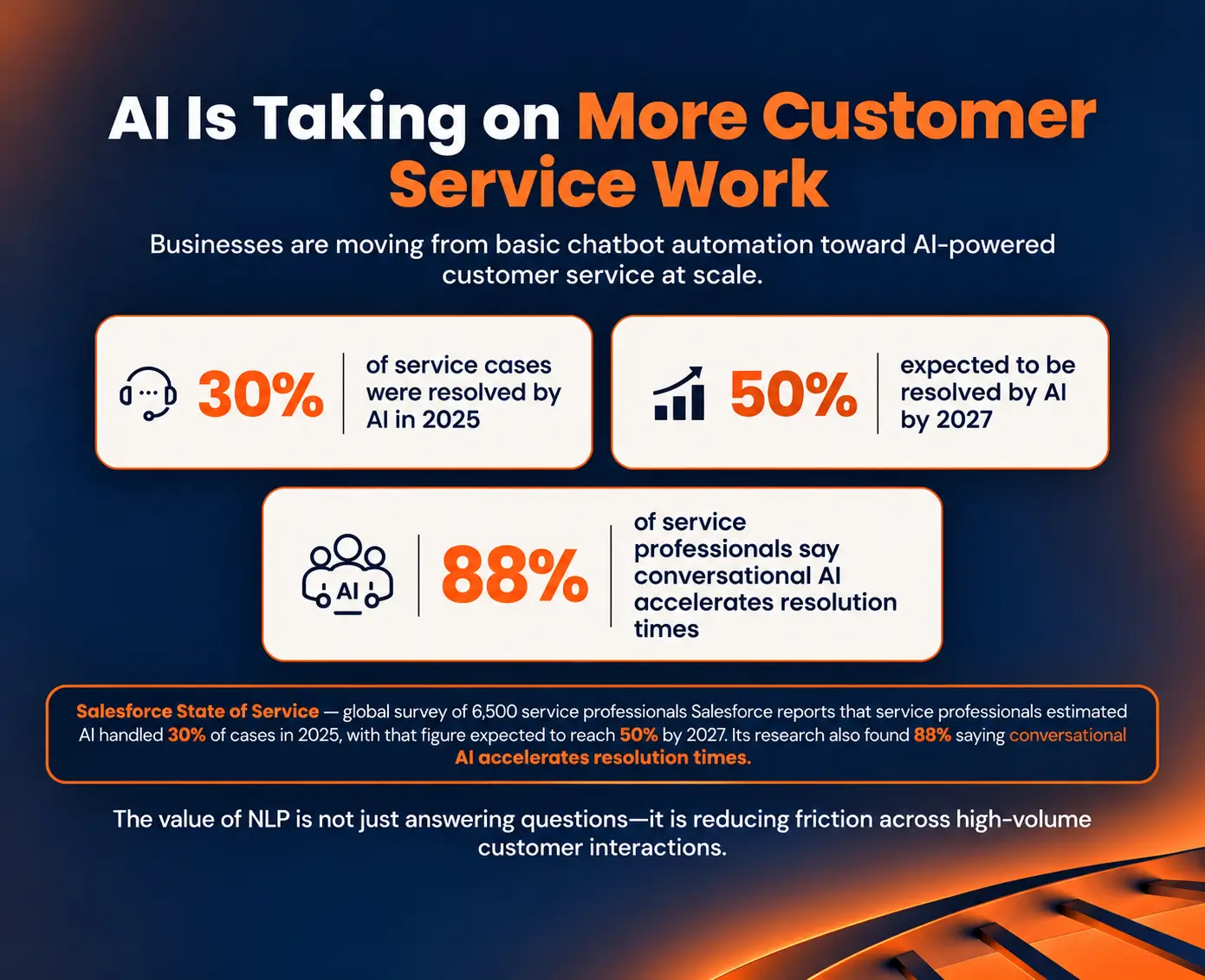
For businesses managing high contact volumes, this shifts how work gets distributed meaningfully. Response times improve because the chatbot resolves routine queries without any wait. Human agents can then direct their attention toward interactions that genuinely require judgment. Every chatbot conversation also generates data that most businesses would otherwise never capture. It reveals what customers are asking, how they phrase questions, and where they drop off. That gives teams an ongoing and unfiltered view into real customer behaviour.
Recommendation Engines and Personalization
The idea behind recommendation engines is not complicated. People are more likely to engage with, purchase, or return to something when it matches their interests and past behaviour. Businesses that consistently show customers relevant options see better conversion rates, longer session times, and stronger long-term retention.
That is the commercial case. However, the mechanics involved are considerably more interesting.
How Recommendation Systems Work
Recommendation engines analyze behavioural data that involves clicks, purchases, searches, skipped items, ratings, et cetera, and use those signals to surface relevant suggestions. Two primary approaches drive most recommendation systems in use today:
- Collaborative filtering: The recommendation system identifies users with similar behavioural histories and recommends content that one group engaged with to another. It looks at user-to-user patterns across the platform.
- Content-based filtering: The system examines the attributes of content a user has engaged with and recommends items with similar characteristics. It focuses on item properties rather than user comparisons.
Most sophisticated platforms combine both approaches. They often layer in additional signals like session length, time of day, geographic location, or device type to further improve relevance and surface suggestions that are timely as well as relevant.
An AI and ML development company that specializes in recommendation systems helps businesses determine which behavioural signals are most predictive of real engagement. Beyond building the recommendation model itself, they connect the output to the front-end interfaces where customers experience recommendations directly—and where the commercial impact becomes tangible.
Where Personalization Is Making a Difference
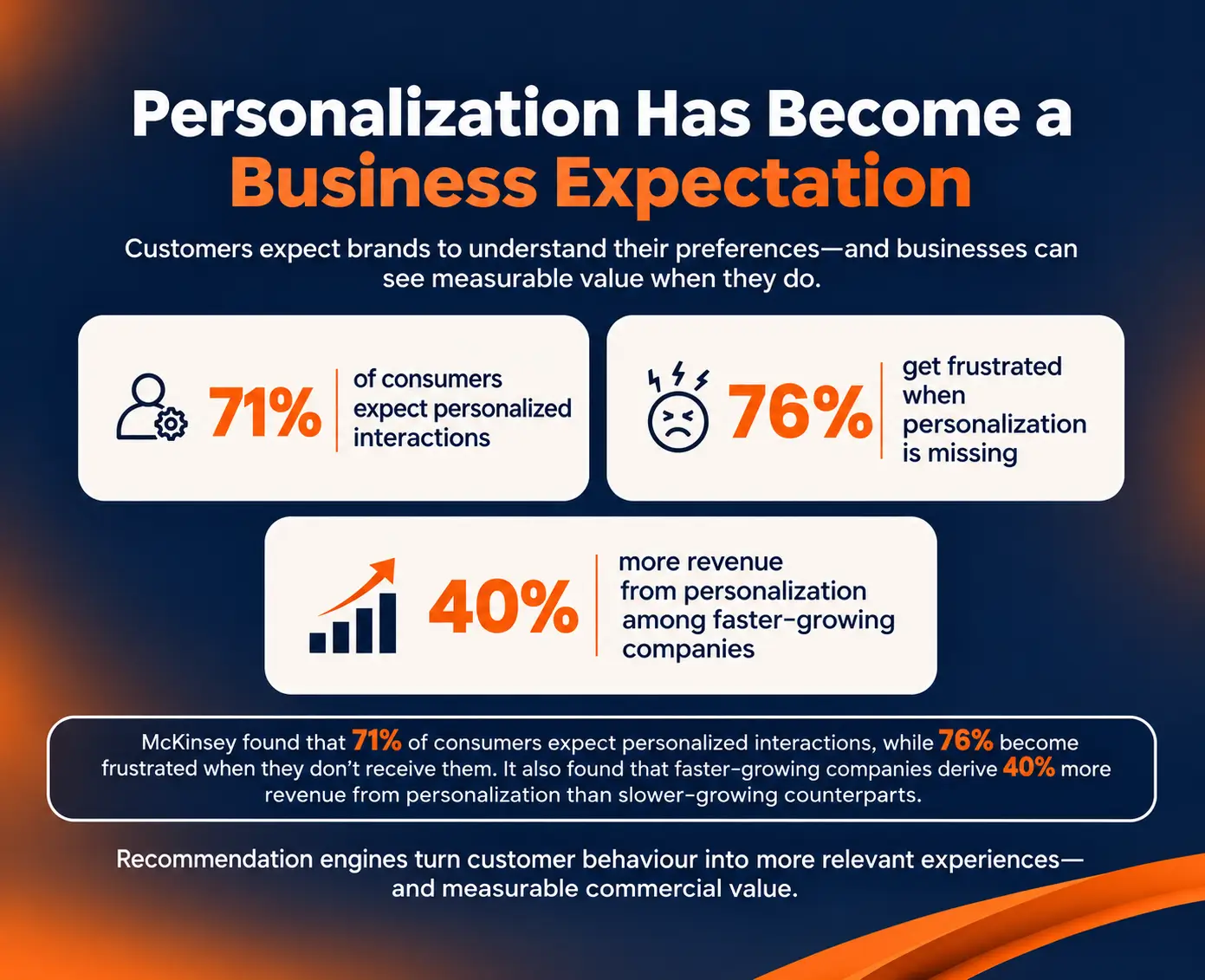
Recommendation systems are at work across a wide range of industries today:
- E-commerce: Product suggestions on category and product detail pages consistently drive a meaningful share of total purchase volume on major platforms.
- Streaming and media services: Personalized content queues keep users actively engaged and reduce the likelihood of subscription cancellations.
- Online learning platforms: Course or module suggestions based on a learner's past behaviour support natural progression and sustained engagement.
- B2B software: Recommendation systems help professional users discover relevant features, integrations, or documentation they might otherwise miss entirely.
- Financial services: Platforms surface relevant products—such as savings accounts, investment options, and insurance plans—based on individual customer financial profiles.
AI & ML development services built around recommendation logic tend to deliver compounding returns over time. Customers who find the experience relevant to them spend more and return to your website more often. That dynamic accumulates meaningfully across the customer lifecycle.
Fraud Detection and Risk Management
Financial fraud is not a new problem. But the methods used to commit it are evolving quickly, and so are the tools being developed to detect it.
Traditional fraud detection relied on rule-based logic: flag any transaction above a certain value, from an unfamiliar location, or outside a typical time window. These approaches work up to a point. But they miss the subtleties of sophisticated fraud patterns, and those gaps are exploited with consistency by those who understand how rule systems operate.
Machine learning takes a fundamentally different approach to this challenge.
How Machine Learning Detects Fraud
ML fraud models are trained on historical transaction data, including both fraudulent and legitimate activity. The model learns what suspicious behaviour looks like across many variables simultaneously, rather than evaluating one rule at a time.
Unlike rule-based systems, ML-based fraud detection:
- Adapts to new fraud patterns without requiring manual rule updates every time a new method appears.
- Evaluates many variables at once, identifying correlations invisible to sequential rule logic.
- Considers individual user context. This means that the same transaction may be entirely normal for one account and clearly suspicious for another.
- Reduces false positives, which remain a persistent operational problem in legacy fraud systems across industries.
Fewer false positives matter operationally. When legitimate transactions are incorrectly blocked, customers experience unnecessary friction. Trust erodes quickly when that happens, often leading to long-term account attrition.
Applications Across Key Industries
AI development service providers working in the fraud and risk space are helping organizations in several critical sectors:
- Banking and financial services: Real-time monitoring catches unauthorized transactions, often before the account holder is aware anything has occurred.
- Insurance: Claims analysis tools flag patterns consistent with fraudulent or inflated submissions, reducing payout leakage at scale.
- E-commerce: Systems identify fake accounts, bot-driven purchasing behaviour, and suspicious return patterns before they result in significant losses.
- Healthcare: Billing fraud detection scans claims for patterns inconsistent with standard medical coding and treatment timelines.
- Identity verification: AI-assisted KYC (Know Your Customer) processes identify document inconsistencies and flag high-risk applications automatically during onboarding.
Risk management beyond fraud is a growing application area in its own right. ML models are being used to assess credit risk, evaluate supplier reliability, model regulatory exposure, and forecast financial stress scenarios under different conditions.
In this broader context, an AI and ML development company with risk expertise helps organizations shift from reactive problem-solving after something goes wrong to proactive risk awareness before it does. AI and ML development services in this space are increasingly viewed not just as a security function but as a core component of how forward-thinking businesses manage operational and financial risk at every level.
Choosing the Right AI Development Partner
Understanding these applications is one thing; building them well is another. Most businesses do not have the in-house data science teams or infrastructure needed to develop production-grade ML systems, which is why working with a specialist makes practical sense.
The right AI development service provider brings more than technical skills to the table. It also brings experience from real deployments, knowledge of what commonly goes wrong, and the ability to make sensible trade-offs between accuracy, speed, and cost.
What a capable development partner typically offers includes:
- Data audit and preparation: Identifying what data exists, what is missing, and how to structure it for effective model training before a single line of model code is written.
- Model development and validation: Building models that perform consistently in real conditions, not just impressively in controlled demonstrations where the data is already clean.
- Production deployment: Connecting models to live operational systems with appropriate monitoring, logging, and fallback handling built in from the start.
- Ongoing refinement: ML systems need regular attention and updates as the data they operate on changes. A model that is not maintained gradually becomes less reliable.
An AI and ML development company that treats each engagement as a long-term collaboration gives businesses the stability to build on what works, adjust what doesn't, and continue improving over time.
Artificial intelligence and machine learning have moved well past the experimental stage. They are now active parts of how competitive businesses operate every day. The five applications covered in this article each started as a concept and are now delivering real, measurable outcomes across industries. What determines whether a business captures that value comes down to the quality of the development work behind it. For organizations ready to move forward, partnering with the right AI & ML development services provider is not just a technology decision. It is a strategic one that shapes business performance for years ahead.
Frequently Asked Questions
1. What types of businesses benefit most from AI and ML development services?
The honest answer is that the size of the business matters far less than most people assume. What actually determines whether AI is a good fit is the quality of data a business already has and how clearly it can define the problem it wants to solve. A mid-sized logistics company with clean, well-organized shipment data is often better positioned than a large enterprise sitting on years of inconsistent records with no clear use case in mind.
Finance, healthcare, retail, and manufacturing are among the sectors where adoption is furthest along, largely because those industries generate structured data at high volumes and have well-defined operational problems that machine learning addresses well. Smaller businesses are also finding their footing, particularly in customer service automation, demand planning, and fraud prevention — areas where the investment threshold is lower and the results show up relatively quickly.
2. How long does it take to develop a custom AI or ML solution?
3. Does a business need large volumes of data before working with an AI development company?
4. What is the practical difference between a rule-based system and a machine learning model?
5. How should businesses measure the return on investment from AI and ML development services?
Request a
Free Quote Today!


