


Table of Contents


AI search strategy is getting significant attention right now from digital marketing teams. Businesses want to understand how to get featured in AI Overviews, what generative results mean for the visibility of their clients’ websites, and how content strategies should evolve. AI search strategy conversations are happening at every level, but many businesses are skipping a step that matters far more than the strategy itself.
AI search optimization strategies will not deliver results on a website that has broken technical foundations. Before spending resources on content campaigns, schema experiments, or AI-focused tactics, there’s a more direct question that deserves an answer. Can search engines actually access, read, and index the site’s most important pages?
This blog covers the seven most common website technical SEO issues that hold websites back. It also explains why fixing these problems is the logical first move before any AI search investment is made.
Why Technical SEO Still Matters in AI-Powered Search
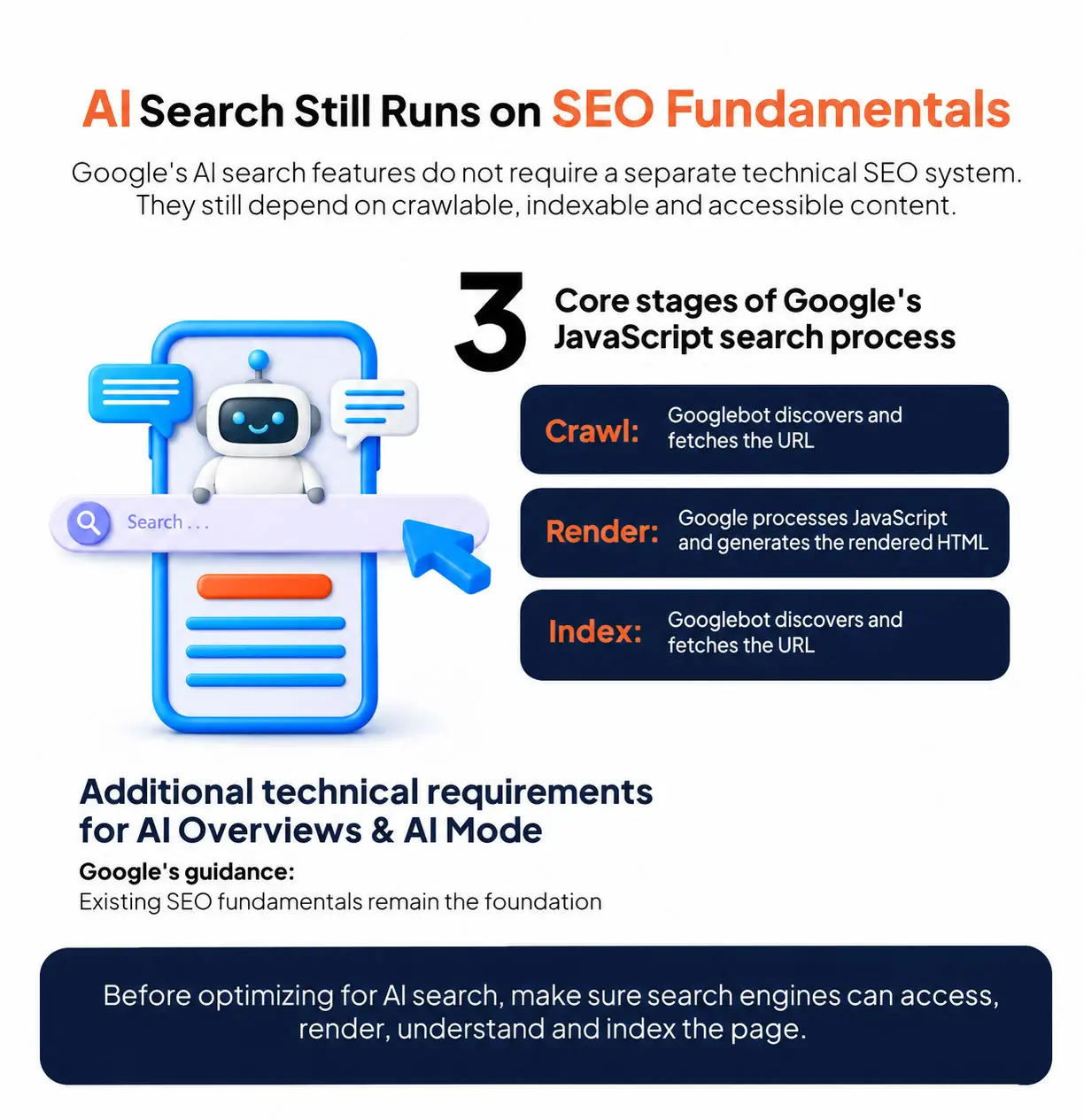
Despite how different AI-powered search looks on the surface, the process behind it hasn’t changed in the way many assume. Crawlers still discover content, indexing still determines which webpages appear in results, and content quality signals still influence which pages get surfaced.
What has changed is the presentation layer of how answers are assembled and shown to users. What hasn’t changed is how search engines access the content sitting underneath those answers. If a crawler can't reach a page, the AI summarizing search results can't use it either.
How Technical SEO Supports Content Discovery
Technical SEO is what makes content findable in the first place. Without a properly functioning technical foundation for the website, well-written and carefully researched webpages can remain completely invisible, regardless of how strong the content strategy is.
<Here is what technical SEO actually does for content discovery:
- Crawlability: It is the ability of search engines to access and visit webpages on a website.
- Indexing: It determines which pages get stored in a search engine's database and become eligible to appear in results.
- Page signals: It communicates the purpose, structure, and relevance of each page.
- Link equity flow: It distributes authority throughout the site through a thoughtful internal link structure.
When these elements are working correctly, content has a genuine opportunity to perform in both traditional and AI-powered results. When they are missing or broken, even excellent content tends to go completely unnoticed.
Google's Recent Comments for Website Owners on AI Visibility
Google has been consistent in its guidance to website owners about appearing in AI-driven search features. Rather than publishing a separate rulebook for AI visibility, the company has consistently pointed back to the same foundational principles it has always promoted.
For technical SEO for Google AI Overviews, Google's guidance centres on content that is easy to access, clearly written, and well-structured. There are no proprietary techniques or hidden requirements specific to AI search. Technically sound websites that produce genuinely helpful content are in the best position, and that hasn't changed with the rise of AI.
7 Technical Website Problems That Deserve Attention Before AI SEO
The following issues are among the most frequently identified during technical audits. Each one has the potential to significantly limit a website's visibility in both traditional search results and in AI-generated answers.
1. Search Engine Crawlers Cannot Access Important Pages
Crawl access is the most fundamental requirement in search, and it's the right place to start any technical conversation. If a crawler cannot reach a webpage, nothing else about that page matters from a search perspective. No schema, no content quality, and no AI search crawlability strategy can help a webpage that is blocked at the crawling stage.
Crawl-blocking issues often stem from development decisions that were never revisited after launch. Common blocking situations include:
- Webpages blocked through the robots.txt file—often by accident during site builds or migrations
- Login walls or access restrictions that prevent crawlers from entering certain sections
- Server configurations that identify and block certain user agents, including search engine crawlers
Businesses should treat crawl access as a baseline check before anything else. The first question is not whether a page is optimized for AI search. The first question is whether a crawler can get to that page at all.
2. JavaScript Rendering Makes Important Content Difficult to Process
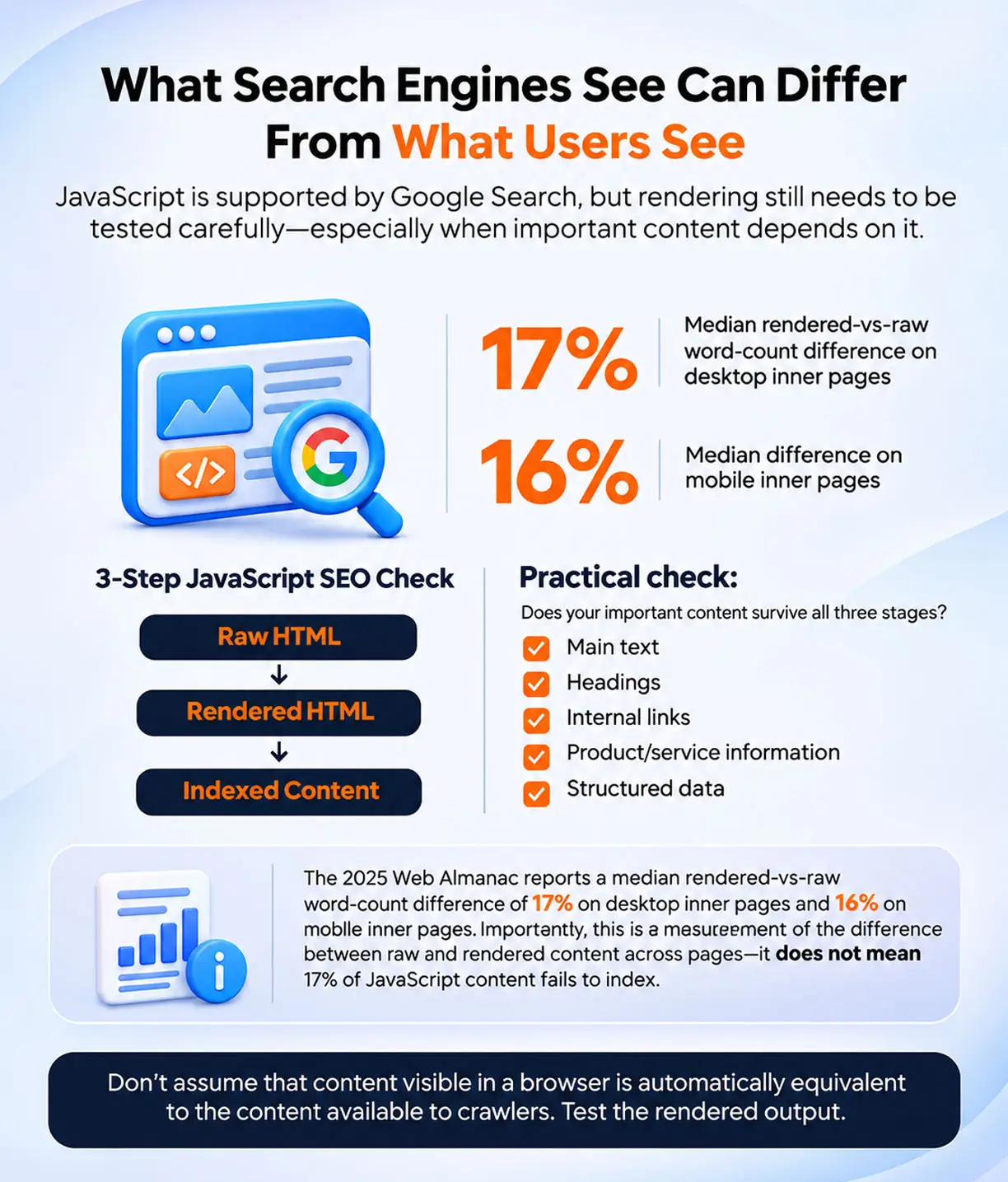
JavaScript-heavy websites present a specific and well-documented challenge for search engine crawlers. When a webpage relies on JavaScript to load its main content, crawlers may not process it the same way a human user sees it in a browser.
JavaScript SEO is an area where development teams and SEO teams often have very different priorities. Developers focus on what the webpage looks like in a browser and how it performs for real users. Crawlers work differently, and content that only loads via client-side JavaScript may not be reliably read during the crawling process.
Important content such as headlines, body text, links, and product descriptions may be invisible to search engines if JavaScript does not execute correctly during a crawl.
Practical steps for handling this problem include:
- Using server-side rendering for critical page content where it is technically feasible.
- Testing pages using the URL Inspection tool in Google Search Console to review the actual rendered output.
- Reviewing the rendered HTML to confirm that all important content is present after rendering completes.
- Keeping key text, internal links, and headings out of JavaScript-only components.
3. Valuable Pages Are Crawled but Not Indexed
This distinction confuses many non-technical stakeholders, and it's worth explaining clearly. A webpage being crawled does not mean it is being indexed. These are two separate steps in the search process, and website indexing issues at the second stage can make even well-crawled pages completely absent from search results.
<Indexing issues tend to come from a small and repeating set of causes:
- Thin content: Webpages with very little substantive content may be automatically excluded from the index.
- Duplicate content: Multiple webpages with the same or very similar content can confuse search engines about which version to index and prioritize.
- Noindex tags: When a page is blocked in robots.txt, search engines cannot read its noindex tag at all — the crawler is turned away before it can process any instructions on the page.
- Crawl budget constraints: On larger websites, search engines may not have the allocated capacity to crawl and index every webpage, leaving some important ones behind
This is a critical focus area within any sensible set of AI SEO best practices. For Google AI Overviews specifically, content must exist in Google’s index before it can be surfaced. Other AI tools such as ChatGPT, Perplexity, and Claude use their own crawlers to fetch content directly from websites and do not depend on a search engine’s index.
4. Poor Internal Linking Makes Important Webpages Hard to Discover
Internal linking rarely gets the attention it deserves during website builds. But the structure of internal links is one of the most significant signals search engines use to determine which webpages are important and how content across a site relates to other content.
Poor internal linking creates several downstream problems that compound over time:
- Orphan pages: Webpages with no other internal webpages linking to them are genuinely difficult for crawlers to find during routine crawl cycles.
- Unclear hierarchy: Without a logical link structure, search engines may struggle to understand how content categories and subtopics relate to one another.
- Inefficient authority distribution: Link equity flows through internal links. When that structure is unplanned, authority ends up distributed poorly across the site
- Deep page burial: Important webpages linked only from deep within the site architecture get crawled less frequently and receive weaker signals.
For businesses working on website optimization for AI search, improving internal linking is one of the most accessible and cost-effective technical fixes available. It doesn't require a full website rebuild but a thoughtful audit of how existing webpages connect to one another and where those connections are missing or broken.
5. Canonical Tags, Duplicate URLs, and Redirects Create Conflicting Signals
This problem is especially common on e-commerce platforms, but it appears across all types of websites—particularly those that have grown or been redesigned over time.
Canonical tags are hints added to a webpage that tell search engines which version of that page is the preferred one. Unlike directives, Google treats these tags as suggestions rather than instructions — meaning it may choose a different canonical than the one specified. When canonical tags are missing, incorrect, or inconsistent with redirect configurations, search engines receive conflicting signals about which version should be treated as authoritative.
Websites dealing with this issue may also notice a “Google chose different canonical than user” status appearing in Google Search Console, which is a clear indicator that the specified canonical is being overridden.
The effects of this confusion can be wide-ranging:
- Link authority split across multiple versions of the same URL, weakening the signal for all of them
- Incorrect page versions being indexed while preferred webpages are ignored
- Crawl waste, where search engines use their allocated crawl capacity on low-priority URL variations
- Redirect chains and loops that result in slower page fetches for crawlers, and redirect loops that cycle through multiple missing or broken pages before arriving at the same destination — or failing to arrive at all
A redirect audit combined with a canonical review is a standard entry point in any serious technical SEO checklist. These issues often explain ranking drops or indexing anomalies that don't have an obvious surface cause.
6. Structured Data Is Missing, Incorrect, or Inconsistent With Page Content
Structured data, which is typically implemented using Schema.org markup, gives search engines additional context about what a webpage contains and what it means. It goes beyond what the text says and signals what type of content is on the page and how different elements relate to each other.
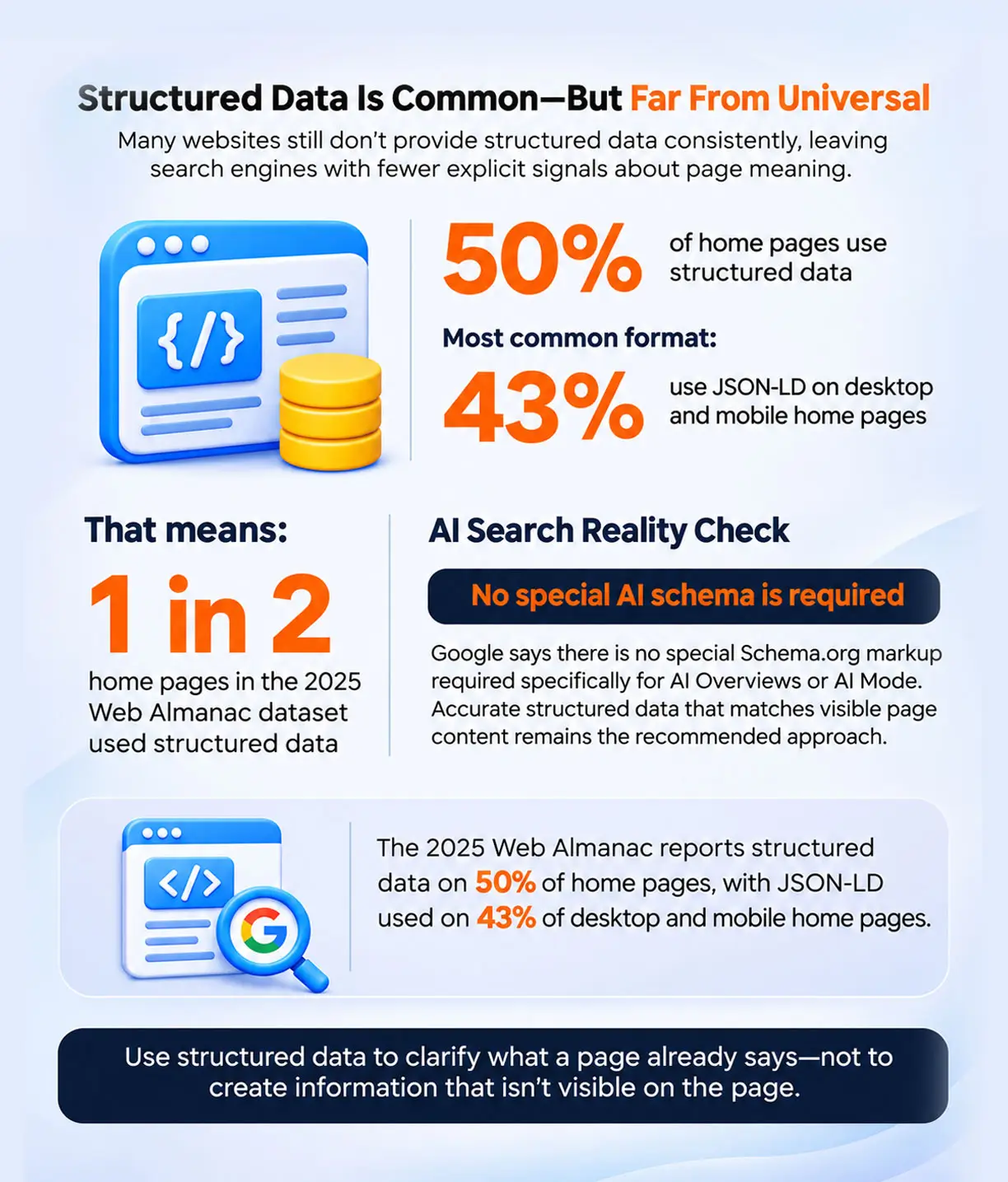
Common structured data mistakes that SEO teams find during audits include:
- Applying review markup to webpages that don't display actual reviews from real users.
- Using article schema on webpages that are clearly product or service pages.
- Leaving required fields empty within a schema type.
- Inconsistencies between what the webpage content says and what the markup claims about that content.
Addressing structured data properly is something SEO and development teams can work on together without rebuilding the website. The validation tools are free to use, the guidelines are publicly available, and getting the markup right genuinely affects how AI tools read and interpret a page.
7. Important Information Is Difficult to Access Through the Website Interface
The final problem is about whether important content on a website can actually be reached by both users and crawlers. Some webpages and sections are structured in a way that makes them difficult to get to—not because of a server error or a blocked URL, but simply because of how the website is built.
Consider content that falls into these patterns:
- Buried behind multiple clicks with no direct, stable URL to reference from outside the webpage
- Hidden inside JavaScript or AJAX-dependent sections that only load after a user interaction such as a click — content structured this way may not be present in the page’s HTML during crawling and can therefore be missed entirely by search engines
- Only available through a site search function with no indexable URL that links to it
- Loaded dynamically in a way that leaves no stable anchor point for crawlers or external links
For website optimization for AI search, this matters significantly. AI-powered search features are designed to answer specific questions quickly and directly. If the content that answers those questions isn't accessible through a stable, indexable URL, there's a reasonable chance it will never be discovered or surfaced in AI-generated results.
How Developers Can Check Whether a Website Is Technically Ready for AI Search
Technical readiness for AI search overlaps substantially with technical readiness for traditional search. The core requirements are largely the same. What helps is having a structured approach to evaluating where a website currently stands, rather than guessing based on surface observations.
A Practical Technical SEO Audit Checklist
A thorough technical SEO checklist covers several interconnected areas. Here's how development and SEO teams can approach a readiness review without leaving important areas unchecked:
Crawl Access
- Review the robots.txt file carefully for unintended blocking rules.
- Confirm that the XML sitemap is submitted to Search Console, up to date, and free of broken or excluded URLs.
- Check for server-level blocking of specific crawlers or IP address ranges.
Indexing
- Use Google Search Console to identify webpages with indexing errors, warnings, or exclusions.
- Look for noindex meta tags that may have been added during development and never removed.
- Review pages flagged as thin or duplicate in Search Console's coverage report.
Page Rendering
- Compare the rendered HTML with the raw HTML for key webpages to identify rendering gaps.
- Identify important content, internal links, or headings that only appear after JavaScript fully executes.
- Test mobile rendering separately. Google indexes and ranks from the mobile version of webpages.
Internal Linking
- Run a site crawl to identify orphan webpages and pages with very few internal links pointing to them.
- Review the click depth of important webpages from the homepage.
- Check anchor text to confirm it accurately reflects the target webpage's topic.
URL Structure and Redirects
- Identify redirect chains, loops, and broken redirect targets.
- Confirm that canonical tags consistently point to the preferred URL version on each page.
- Look for URL parameter variations creating multiple versions of the same content.
Structured Data
- Validate all structured data using Google's Rich Results Test.
- Confirm that schema types match the actual content displayed on each webpage.
- Check for missing required fields within each schema type being used.
Content Accessibility
- Confirm that important content loads and is readable without JavaScript enabled.
- Test whether expandable or tabbed content is accessible to crawlers.
- Review the depth of key content relative to the website's main navigation structure.
This kind of structured review gives teams a clear, prioritized picture of what needs attention before any AI search optimization strategy gets underway.
What Businesses Should Avoid When Optimizing for AI Search
As AI search has become a more prominent topic in marketing, some misleading ideas have taken hold in professional conversations. These ideas can lead businesses to spend time and budget on the wrong things, often at the expense of work that would actually make a difference.
AI Search Does Not Require a Completely Separate Technical SEO System
One of the most persistent misconceptions is that AI search demands a fundamentally different technical approach. Some vendors suggest businesses need specialized AI-ready markup, completely redesigned site architectures, or tools built specifically for AI search. That's not accurate.
The website technical SEO issues that hurt performance in traditional search will do the same in AI-powered search. Crawlability, indexing, and content quality are not requirements that change depending on how results are displayed. They remain the baseline for any page that wants to be found.
Businesses don't need to reinvent their technical strategy for AI search. They need to fix what is already broken and build on a solid foundation.
AI search crawlability is not a new technical discipline separate from what good SEO has always required. It's the same crawling and rendering process that has always determined what search engines can access. What has shifted is that AI tools are more sensitive to content quality, structure, and consistency. That makes existing problems more consequential, not fundamentally different in nature.
Why Website Development and SEO Teams Need to Work Together
One of the most consistent patterns in underperforming websites is a disconnect between the development team and the SEO team. Developers build websites to meet functional requirements. SEO teams review websites after they are already built. By that point, changing fundamental technical decisions becomes time-consuming and expensive.
A more effective approach is to involve SEO thinking from the beginning of a web project—during planning, architecture design, and development—rather than bringing it in as a final pre-launch review.
Technical Search Performance Starts With Development Decisions
Many of the technical website SEO issues discussed throughout this blog originate in development decisions made without SEO awareness:
- Selecting a JavaScript framework without considering its crawling and rendering implications for search engines
- Building URL structures without planning for duplicate content risks from parameters or faceted navigation
- Implementing CMS features without reviewing how they interact with crawlers during indexing
- Creating redirect rules during development without properly documenting or cleaning them up before launch
These aren't failures of SEO strategy. They are outcomes of a process where SEO considerations weren't part of the conversation early enough.
When development and SEO teams work together from the start, the result is a website that performs better from day one. It doesn't require expensive rework later, and it's genuinely prepared for whatever comes next in search, including the continued growth of AI-powered features.
This kind of collaboration is at the heart of AI SEO best practices that go beyond tactics and address the actual infrastructure upon which a website is built.
Fix the Foundation Before Chasing AI Search Visibility
The appeal of focusing on what's new and emerging is understandable. AI search is a genuinely significant development, and the opportunities it represents are real. But businesses that invest in AI search strategies without fixing their technical foundations are likely to find that those investments underperform, often without a clear explanation.
Technical SEO for Google AI Overviews isn't a separate discipline sitting alongside traditional technical SEO. It's an extension of the same technical rigour that has always determined whether a website can be found, read, and trusted by search engines.
The businesses that will perform best in AI-powered search are those with crawlable, indexable, well-structured websites, with accurate structured data, strong internal linking, and content that's genuinely accessible through stable URLs. These are the same characteristics that have always defined technically sound websites.
For teams currently working through a review of technical website SEO issues, the direction is clear: fix the foundation first. The AI search opportunities will still be available once that groundwork is in place.
AI-powered search is changing how results are presented, but not what makes a website readable and trustworthy to search engines. The seven technical problems covered in this blog are all fixable, and doing so costs far less than running an AI search strategy on a website that isn’t ready for it. Businesses that get the technical side right first will be in a genuinely stronger position when they do invest in AI search. That’s the right order of operations and it always has been.
Frequently Asked Questions
Does technical SEO still matter for AI search?
Yes, quite significantly. AI-powered search tools still rely on crawlers to discover and index content before it can be used in generated answers. Without proper technical SEO foundations, pages may not be accessible to crawlers at all, which means they won't appear in AI-generated results regardless of how strong the content is. The fundamentals of technical SEO remain as relevant as ever in an AI-first search environment.
Can technical website problems prevent pages from appearing in Google AI Overviews?
Does Google require special schema markup for AI search?
Can JavaScript-heavy websites appear in AI-powered search results?
How can businesses check whether their websites are ready for AI search?
Request a
Free Quote Today!


