


Table of Contents


Google Ads is not a one-size-fits-all platform. Every industry brings its own audience psychology, compliance requirements, and buying behaviour. A campaign that drives strong results in one sector can produce poor outcomes in another, even when the campaign budget and effort are identical. The differentiating factor is always strategy, specifically whether the campaign is built around how that particular industry operates.
To understand this better, consider two businesses running Google Ads simultaneously. A clothing brand wants fast online transactions, whereas a dental clinic wants new patient bookings. Both are spending money on the same platform, yet their campaign structures, audience expectations, compliance rules, and success metrics are completely different from each other. Therefore, applying a single strategy to both would mean one of them is always working against its own goals.
This blog functions as a practical study of how Google Ads operates across five distinct industries: e-commerce, SaaS, professional services, healthcare, and the B2B vs. B2C divide. For businesses evaluating Google Ads management services, this guide offers the foundational knowledge needed before any campaign decisions are made.
Google Ads for E-Commerce: Making Shopping and Performance Max Work
E-commerce is one of the best-suited industries for Google Ads, and the reason is straightforward. When someone types ‘buy wireless headphones’ or ‘best running shoes online’, they already know what they want. That kind of active purchase intent makes it far easier for an ad to reach someone who is genuinely ready to buy.
Having a product and a budget is not enough on its own. Campaign structure, product data quality, and bidding decisions all directly shape how much return the business sees from its ad spend.
Shopping Campaigns
Shopping campaigns are the most widely used format in e-commerce advertising. When someone searches for a product on Google, a Shopping ad appears at the top of the page with a product image, product name, price, and store name. All of this appears before the user even clicks the ad.
This format is valuable because it allows buyers to judge whether a product suits their needs before visiting the website. Someone who clicks on a product after seeing the image and price is more likely to complete a purchase.
Shopping campaign performance depends almost entirely on the quality of the product feed. (The product feed is a file that contains all product information sent to Google.) If product titles are vague, descriptions are inaccurate, or categories are assigned incorrectly, the ads will either fail to appear or attract the wrong audience.
A strong Shopping campaign requires the following:
- Product titles that reflect the exact language buyers use when searching. For example, Men's Waterproof Hiking Boots will perform far better than an internal product code like Boot XZ-44, because buyers search using descriptive terms and not stock numbers.
- Negative keywords prevent ads from showing on irrelevant searches. A store selling formal dress shoes should exclude terms like ‘casual sneakers’ to avoid spending on visitors who have no interest in formal footwear.
- Product segmentation based on category or profit margin, so that higher-value products receive proportionally more budget rather than every item being treated equally.
- Regular review of search query reports to identify and block irrelevant terms before they consume a significant portion of the budget.
Performance Max Campaigns
Performance Max, commonly called PMax, is a campaign type that runs ads across all of Google's platforms from a single campaign setup. This includes Google Search, YouTube, Gmail, Google Discover, the Display Network, and Google Maps.
PMax uses machine learning to decide where and when ads should appear. Google's system analyzes signals such as which users have previously purchased from the website, which creative assets generate responses, and which search patterns lead to completed transactions. Based on this, the budget is distributed toward the areas expected to produce the best results.
The limitation of PMax is reduced transparency. Unlike standard campaigns, it does not always reveal which specific searches or placements are producing conversions. This is precisely why working with experienced Google Ads optimization services makes a meaningful difference in PMax management. A specialist can read indirect performance signals, adjust audience inputs, and catch where budget is being wasted before it becomes a larger problem.
What consistently improves PMax performance:
- Multiple creative variations across headlines, images, and video formats. Google tests different combinations to find what resonates with different segments. Fewer assets mean fewer testing options and weaker results.
- Audience signals built from buyer data. Providing Google with a list of past customers gives the algorithm a strong starting point rather than having it learn from scratch.
- A clean and regularly updated product feed. Errors or outdated product information can cause Google to serve mismatched ads, which damages both performance and user trust.
- Exclusion lists to prevent PMax from absorbing budget that other campaigns, particularly branded search campaigns, are already managing more efficiently.
Decoding Local Services Ads for Professional Services
Professional services businesses such as law firms, accounting offices, plumbing companies, electricians, and physiotherapy clinics all serve a defined geographic area. For example, a plumbing company in Toronto gains nothing from reaching users in Vancouver. Their advertising strategy must reflect that geographic boundary.
Google Local Services Ads, commonly referred to as LSAs, are designed specifically for this type of business. Unlike standard Google Ads, where a business pays each time someone clicks, LSAs charge only when a verified lead contacts the business directly. This means the business pays for actual inquiries rather than website visits that produce no result.
What Makes LSAs Effective for Local Businesses
LSAs appear at the very top of Google search results, above all paid search ads and organic listings. They display the business name, star rating, hours of operation, and a direct call button. On mobile devices, that call button allows a user to contact the business without visiting the website at all.
This directness is particularly important for urgent service needs. A homeowner with a burst pipe is not going to browse multiple websites. They will call the first credible result they see because their need is urgent. LSAs are built to capture that moment.
Businesses that benefit most from LSAs:
- Operate in service categories supported by Google's approved LSA program. Google maintains an eligible industries list that includes legal services, home improvement, healthcare, and financial services. Businesses outside these categories cannot access LSAs.
- Maintain a strong collection of genuine Google reviews. The star rating is displayed prominently in LSA listings, and Google tends to distribute more leads to businesses with higher ratings, even at equal budgets.
- Respond to incoming leads quickly. Google tracks response time and factors it into lead distribution. A business that responds within minutes will consistently receive more leads than one that takes several hours.
Standard Search Ads for More Specific Targeting
Beyond LSAs, professional services businesses also run standard search campaigns to target more specific queries. LSAs are broad by nature and do not offer much control over which searches trigger the ads. Standard search campaigns fill that gap by letting businesses target precise terms with dedicated ad copy and a matching landing page.
Take a family law firm as an example. Rather than running one broad campaign for the entire practice, they split things up by case type. Divorce cases get their own ad group, child custody matters get another, and property division gets a separate one too. Each ad group points to a landing page that speaks directly to that specific situation. So when someone searches for a divorce lawyer, they land on a page about divorce, not a general “about us” page that covers everything the firm does. People are far more likely to get in touch when the page they land on actually speaks to their problem.
Professional services businesses that work with dedicated Google Ads optimization services consistently see a meaningful improvement in lead quality. Higher-quality leads close at better rates and reduce the overall cost of acquiring each new client over time.
Understanding Healthcare Advertising Compliance and Messaging
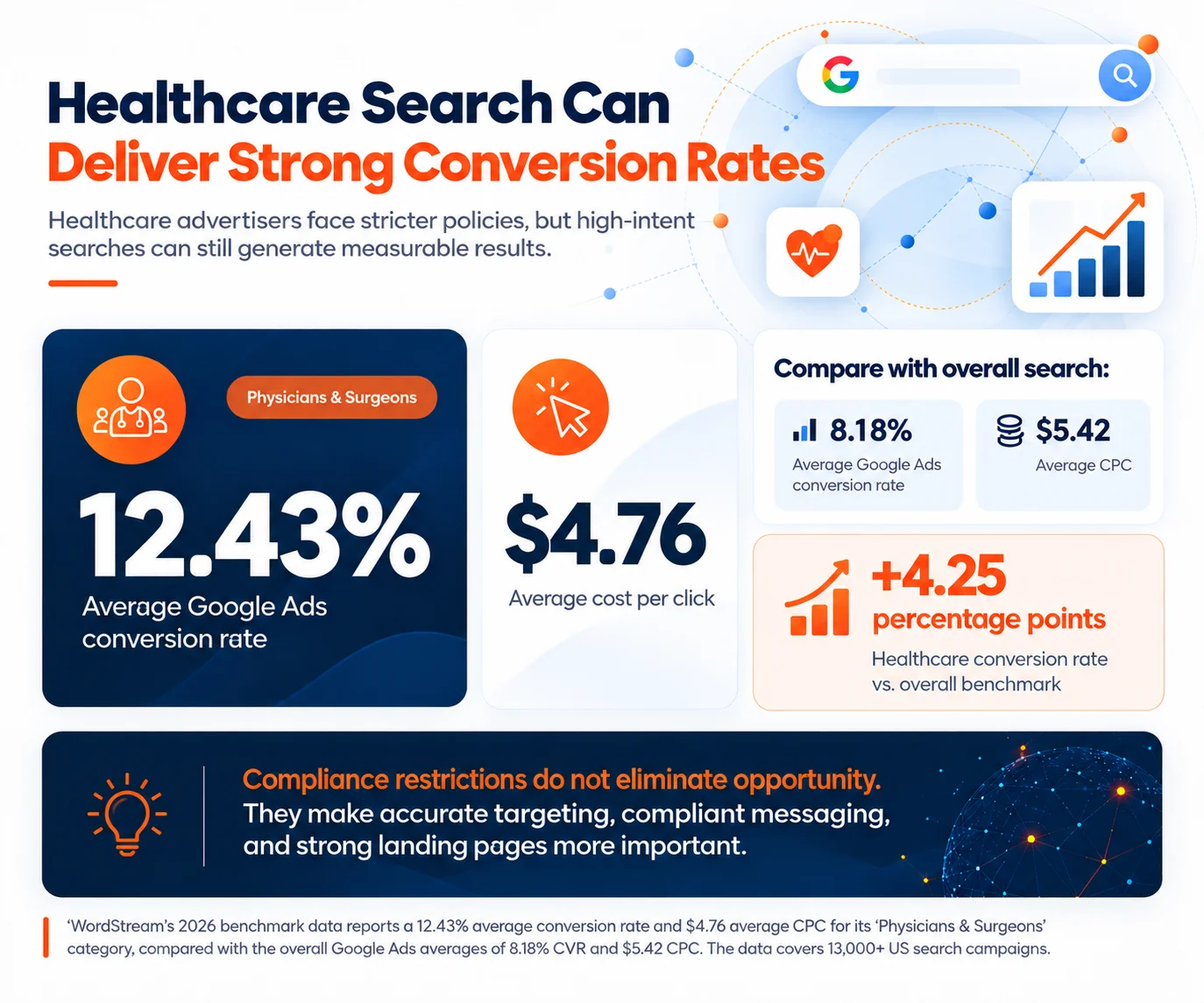
Healthcare is one of the most regulated advertising categories on Google. Medical advertising can directly influence how people make decisions about their health. When someone searches for a treatment or a specialist, they are often in a vulnerable position. For this reason, Google applies specific policies to healthcare advertisers that go beyond what most other industries face.
Understanding these policies is not optional. A healthcare business that violates them may face individual ad disapproval, restrictions on advertising certain services, or, in serious cases, a full account suspension.
Key Compliance Rules Healthcare Advertisers Must Follow
Several areas consistently create problems for healthcare businesses:
- Unverifiable medical claims - An ad cannot directly state that a treatment cures a condition, guarantees recovery, or produces a specific clinical outcome. Instead, ad copy should describe the service being offered and invite users to learn more or book a consultation. ‘Book a physiotherapy consultation for lower back pain’ is compliant. ‘We will cure your back pain in three sessions’ is not.
- Advertising sensitive categories without certification - Google requires businesses in areas such as addiction treatment services, certain pharmaceutical products, and abortion services to complete a formal certification process. Without certification, ads in these categories will be disapproved automatically.
- Retargeting based on sensitive health information - Healthcare businesses cannot retarget users based on which specific health condition pages they visited. A hospital, for example, cannot serve follow-up ads to someone who visited a cancer treatment page. This restriction exists to protect health-related browsing as private information.
- Landing pages that do not match the ad - If an ad says ‘Book an appointment with a physiotherapist’, the landing page must lead directly to a physiotherapy booking page. A mismatch between the ad and the destination is one of the most common reasons healthcare ads are disapproved.
How Healthcare Businesses Can Still Advertise Effectively
Even with these restrictions in place, healthcare businesses have clear pathways to effective advertising. The key is to focus on the service provided and the practical benefits it offers, rather than making promises about outcomes.
Effective healthcare advertising:
- Focuses on specific services rather than general health claims. ‘Orthopedic consultations for knee injuries’ gives potential patients a clear reason to click and is a claim the business can genuinely fulfill.
- Highlights practical access benefits. Patients frequently value same-day appointments, telehealth availability, or evening clinic hours. Advertising these features is both compliant and genuinely useful to the searcher.
- Uses credibility signals such as board certifications, professional affiliations, or years of practice. These give potential patients concrete reasons to choose one provider over another.
Healthcare businesses that partner with professional Google Ads management services benefit from specialists who understand both the compliance requirements and how to structure campaigns that generate patient volume within those boundaries.
B2B vs. B2C Campaign Optimization
Business-to-business (B2B) and business-to-consumer (B2C) advertising require fundamentally different approaches on Google Ads. The difference extends beyond which type of audience is being targeted. It reaches into how those audiences make decisions, how much time they take, and what they need to see before becoming a customer.
How B2C Campaigns Are Structured
B2C campaigns speak to individual consumers, and individual consumers do not take long to decide. Price looks right, the product feels relevant, a friend mentioned it once, and that is often enough. The decision happens fast, sometimes within the same session the ad was seen.
This is why B2C campaigns are built around urgency and clarity. Pricing is displayed openly so the buyer does not have to dig for it. Also, promotions are easy to spot, whether that is a discount, a limited-time offer, or free shipping. Along with this, the call to action is direct and tells the buyer exactly what to do next, whether that is “Shop Now,” “Claim the Offer,” or “Book Today.” Visual presentation carries real weight in this space too. A consumer shopping for a jacket or a skincare product is not sitting down with a spreadsheet. They are scrolling, reacting, and making snap decisions based on how something looks and whether it feels like something meant for them.
Key characteristics of B2C campaigns:
- Shopping and Performance Max campaigns work well here because they put product-level information in front of buyers across multiple Google platforms at once, catching them at different stages of browsing.
- Bidding strategies are built around maximizing conversions or hitting a target return on ad spend, since the priority is driving profitable transactions within the available budget.
- Ad creative leans on lifestyle and emotional themes, because most consumer purchases are driven by how a product makes someone feel rather than a checklist of technical features.
How B2B Campaigns Are Structured Differently
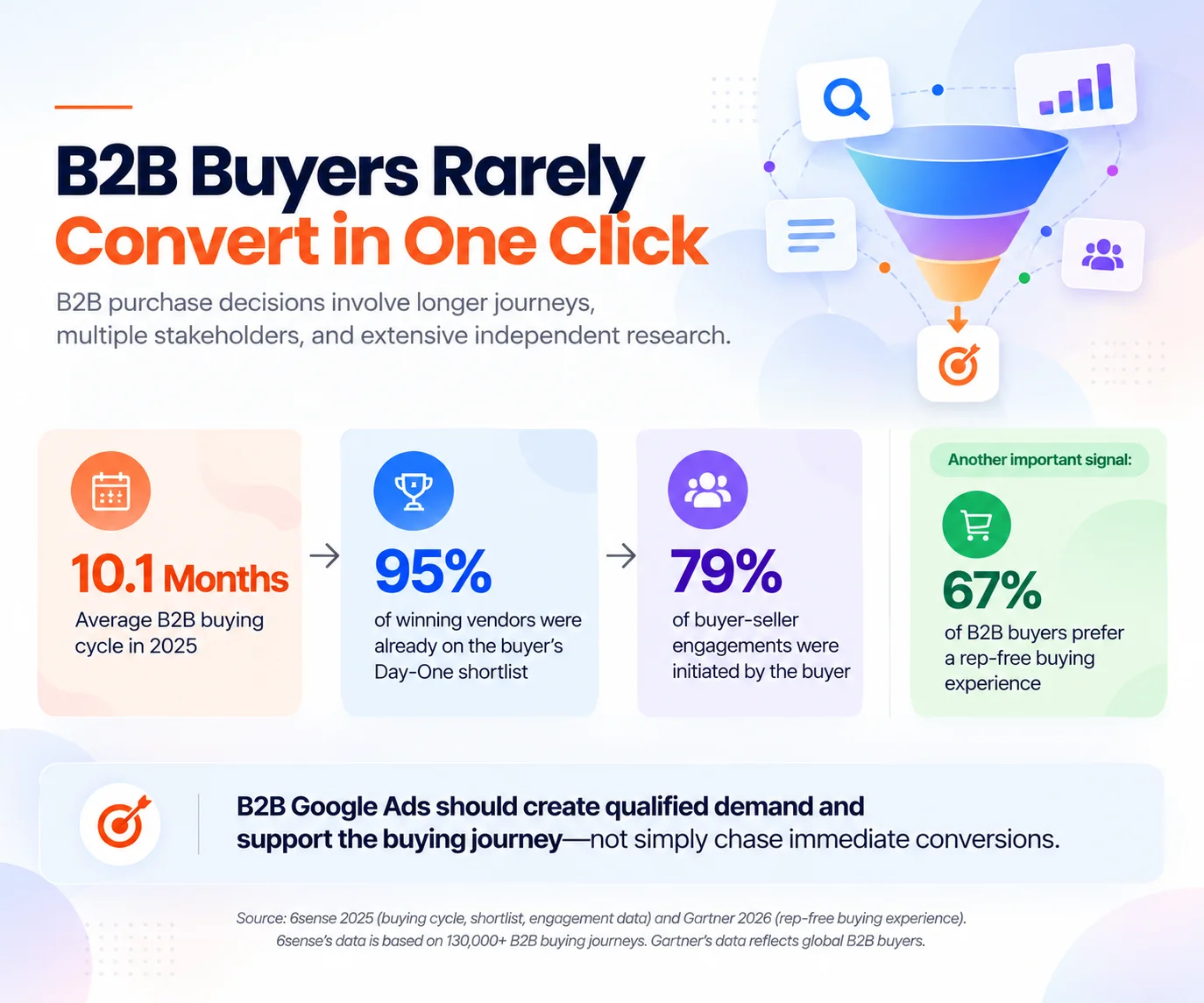
B2B campaigns target businesses and the professionals within them who are responsible for purchasing decisions. These buyers rarely act alone. For instance, a department head identifies the need, an IT team evaluates the solution, and a finance director approves the budget. This process can take weeks or months.
Because of this extended timeline, B2B campaigns focus on lead generation rather than direct conversion. The goal is to get a qualified professional to take a low-commitment action such as downloading a guide, booking a discovery call, or submitting a contact form.
Key characteristics of B2B campaigns:
- Keywords use specific industry terminology. A term like ‘enterprise workforce management software for logistics companies’ attracts the right decision-makers because it reflects the language they actually use when searching.
- Landing pages offer a resource or a consultation rather than a direct product purchase. This approach gives decision-makers a reason to engage without requiring immediate commitment.
- Attribution tracking requires careful setup because the same user may interact with multiple ads over a long period before converting. Last-click attribution, which credits only the final ad a user clicked, often misrepresents how B2B decisions are made.
This is where professional Google Ads optimization services add the most value for the B2B model. Building accurate multi-touch attribution from the start helps businesses understand which campaigns genuinely influence decisions across a long sales cycle.
Understanding Industry Campaign Benchmarks and Expected ROI
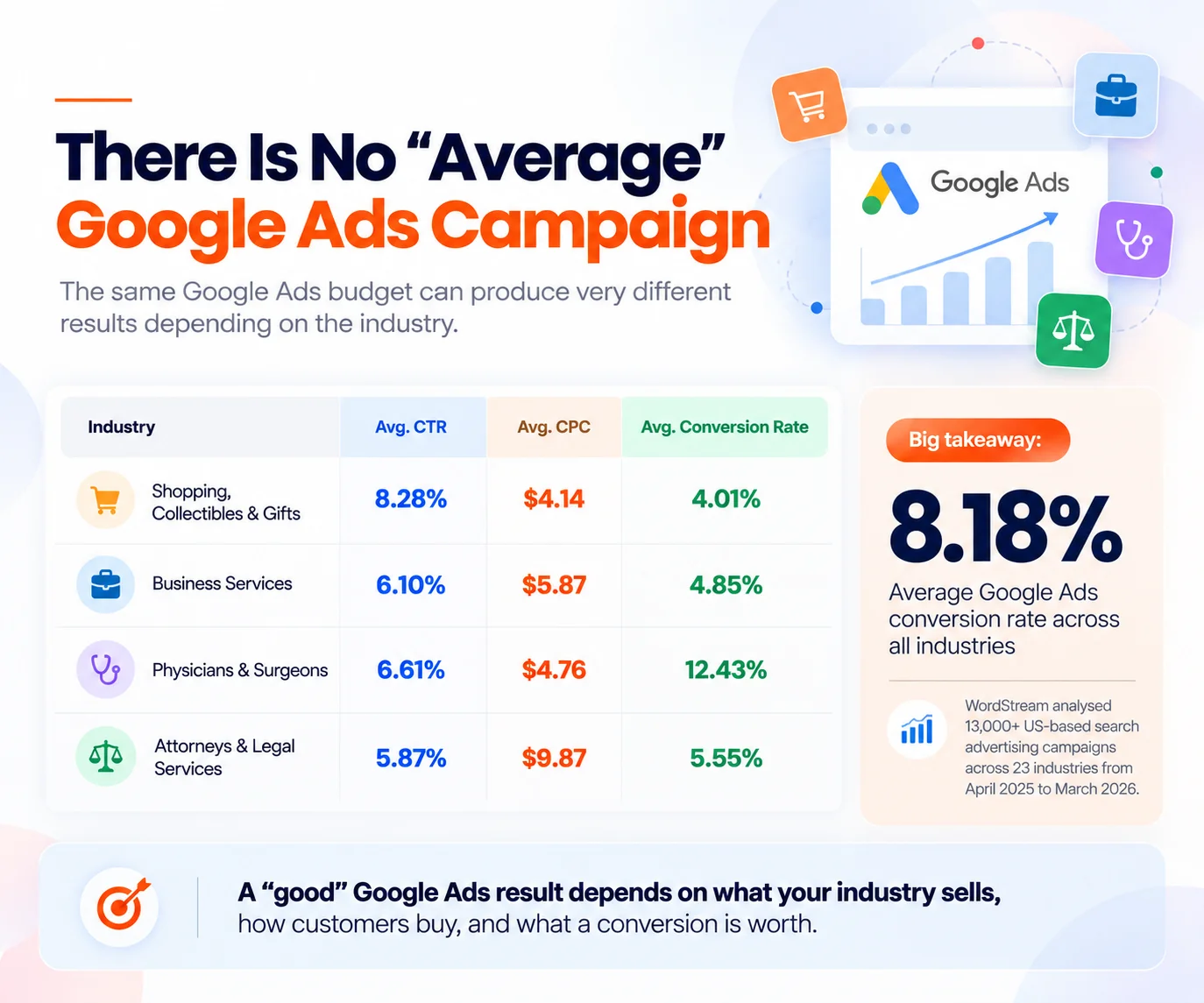
Before committing to a Google Ads budget, most businesses want to understand what return they can realistically expect after running an ad campaign. The challenge is that there is no single benchmark that applies across all industries. ROI depends on factors including market competitiveness, campaign structure quality, landing page relevance, and how effectively the business converts inquiries into customers.
Understanding what to expect by industry helps businesses set meaningful goals from the beginning rather than judging performance against benchmarks that do not reflect their situation.
E-Commerce
For e-commerce businesses, the path from ad click to completed transaction is the shortest of any industry. The entire journey happens online and can be tracked from start to finish. As a result, meaningful performance data often emerges within the first few weeks of a campaign.
The primary factors that shape e-commerce ROI are product page quality, pricing competitiveness, and how well the product feed is maintained. Higher-competition categories face elevated click costs, but strong conversion rates on well-designed product pages can offset those costs.
SaaS
SaaS businesses typically face higher click costs because software keywords attract well-funded competitors. However, the long-term value of a SaaS customer is also substantially higher.
Because customers pay on a recurring subscription basis, the revenue generated over their entire relationship with the business often exceeds the original acquisition cost. This is why SaaS businesses can justify ad spend levels that would appear unprofitable in a single-transaction retail context.
Professional Services Industry and Healthcare
For both industries, the most useful metric is not cost per click or cost per form submission. It is the cost per qualified client or patient.
A law firm that spends a meaningful amount of ad budget to acquire a client with a high case value has produced a strong return. Therefore, measuring success purely through lead volume misses this point entirely.
What Consistently Improves ROI Across All Industries
Regardless of the sector, these factors reliably improve advertising returns:
- Landing pages that directly match what the ad promises, so visitors immediately find what they expected when they clicked. A disconnect between ad copy and landing page is one of the most common causes of poor conversion rates.
- Accurate conversion tracking from the campaign's very first day. Without it, optimization decisions are based on incomplete data, which leads to budget allocation mistakes that compound over time.
- Regular negative keyword maintenance to prevent ad spend from reaching users with no genuine interest in the product or service being advertised.
- Ongoing ad copy testing to identify which messages generate the most qualified responses from each target audience.
Businesses that invest in dedicated Google Ads management services consistently see better results than those managing campaigns without specialist support. The reason is straightforward. Specialists identify problems before significant budget is wasted, build campaign structures that improve over time, and bring industry-specific knowledge that in-house generalists may not have.
Google Ads rarely fails because of budget. It fails because the strategy does not match the industry. E-commerce, SaaS, professional services, and healthcare each come with their own rules, and campaigns that ignore that tend to underperform regardless of how much is being spent. The businesses that get consistent results are simply the ones that build campaigns around how their audience actually behaves. Having the right Google Ads optimization services in place makes that a lot more achievable.
Frequently Asked Questions
1. Can Google Ads produce results for small businesses with limited budgets?
Absolutely. Google Local Services Ads is arguably the most budget-friendly starting point for small local businesses. This is because the charges only kick in when someone actually contacts the business, not just when they click. Keeping the geographic targeting tight also helps. There is no reason to pay for visibility in areas the business does not even serve.
2. Why does Google apply stricter advertising rules to healthcare businesses than to other industries?
3. What is the practical difference between a Shopping campaign and a Performance Max campaign?
4. How long should a Google Ads campaign run before drawing conclusions about its performance?
5. What is the most important step to take before launching a Google Ads campaign?
Request a
Free Quote Today!


