


Table of Contents


AI has transformed how search engines work, and those changes are affecting how businesses get found online every single day. Earlier, SEO experts spent weeks researching keywords, analyzing competitors, and planning content strategies. Currently, AI can complete many of these tasks in just a few hours, thereby helping businesses make faster and more informed decisions.
The way people search online has also shifted. Search engines no longer simply match keywords to pages. They read context, assess intent, and rank content based on how well it serves the reader.
For businesses that depend on organic traffic, this creates pressure to update their SEO strategy and content as search algorithms and user behaviour change. The good news is that AI-powered tools now make it possible for businesses of every size to meet those higher standards without having an enormous internal team.
This blog explores how artificial intelligence is reshaping SEO and helping marketers build smarter, more effective digital strategies.
How AI Is Changing the Way Businesses Approach SEO
The points below cover the specific areas where AI is reshaping search strategy, from how keywords are identified to how content is planned, published, and measured in real time.
1. Smarter, Data-Driven Keyword Research
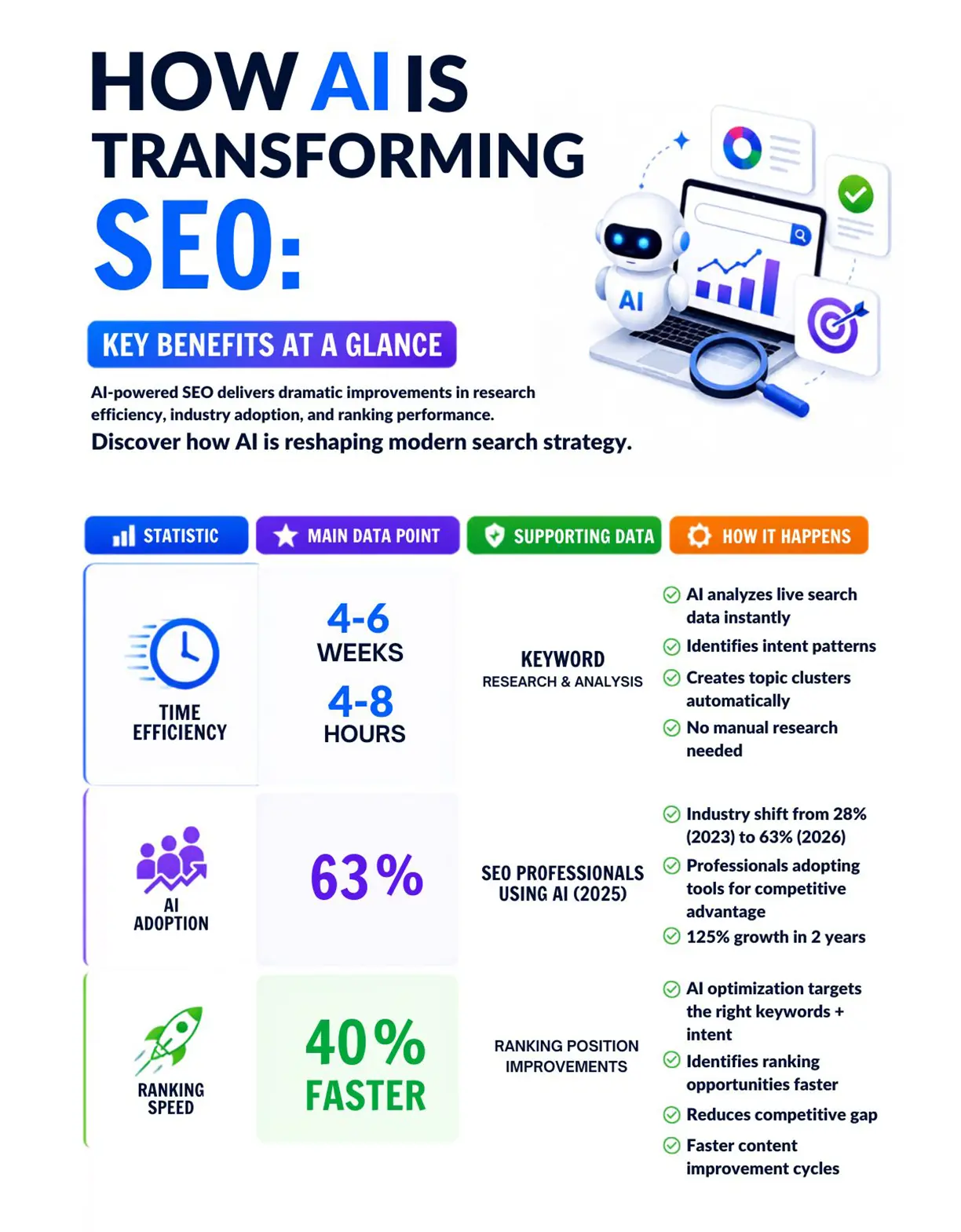
AI has made keyword research faster and far more accurate than traditional approaches ever allowed. Old tools usually relied heavily on static monthly data and basic search volume metrics. AI pulls from live search activity, identifies patterns in how people phrase queries, and surfaces opportunities that manual research would likely miss altogether.
The real value lies in intent. A person looking for "best tile options for small bathrooms" is not just looking for a product name. They wish comparisons, practical guidance, and installation context. AI recognizes these distinctions and helps content teams match their output to what people genuinely need, not what a marketer assumes they need.
AI groups related keywords into topic clusters, which can make content planning far more efficient. Pairing this capability with a reliable search engine optimization service means that every article and page targets real demand. Content is no longer built around guesswork but what actual users are actively searching for, right now, in their own words.
2. Understanding Search Intent at Scale
Not every search is the same, even when the words look similar. A person who types "hardwood floors" might be looking for product options, installation advice, or a local supplier. AI can distinguish between these different motivations and guide content strategy accordingly.
This matters since search engines now evaluate content based on how well it answers the question behind the query, not just whether the keyword appears somewhere on the page. Google's systems use machine learning to assess what searchers expect and whether a given page delivers that.
AI tools can analyze large groups of queries at once and sort them by intent type. This makes it possible to build content that covers a topic with real depth without being repetitive or padded. For content teams managing dozens of pages at a time, this kind of structured insight saves significant hours. Matching content to intent is now one of the most reliable ways to earn and hold rankings over time.
3. AI-Assisted Content Optimization
Developing content that ranks well is not about writing clearly. It requires covering the right depth, addressing the right subtopics, and structuring information in a way that both readers and search engines can process easily. AI tools now assist with all three of these areas at once.
Platforms like Clearscope, Surfer SEO, and MarketMuse analyze top-ranking pages for an assigned keyword and identify patterns in how that content is structured, what topics it covers, and how thoroughly it addresses user questions. A writer can use those insights to produce content that is genuinely more useful than what currently ranks.
Artificial Intelligence may flag thin content and identify gaps in existing pages. This means that teams can improve older articles without starting from scratch. For businesses managing large content libraries, this is a practical and cost-efficient approach. Better content, built with real data behind it, consistently outperforms content created on assumption alone. The research stage alone becomes dramatically shorter.
4. Technical SEO Automation
Technical SEO covers a wide range of elements. Site speed, crawlability, structured data, internal linking, duplicate content, broken links, and mobile responsiveness all feed into how search engines evaluate a website. Manually auditing these elements across a large site takes considerable time and specialized knowledge.
AI changes the business process entirely. Modern audit tools can scan thousands of pages in minutes, flag issues by priority, and suggest specific fixes. Technical problems get found and resolved faster than through any manual review process. For a growing business, that speed matters more with every passing month.
AI can monitor site health on a continuous basis rather than at scheduled intervals. If a page drops in rankings after a site update, or if a crawl issue surfaces after new pages are added, the system catches it quickly. Businesses working with professional SEO services now rely on AI-powered audit tools as a core part of their technical workflow. It has become the standard approach, not an optional add-on.
5. Predictive Analytics and Trend Forecasting
One of the most useful things AI can do for an SEO strategy is look ahead. Traditional analytics tools show what already happened. AI-powered analytics can show what is likely to happen next, which is a fundamentally different kind of value.
By processing historical search data, seasonal patterns, and real-time signals, AI tools identify emerging topics before they peak. A business that publishes strong content early on a rising trend gains a meaningful advantage over one that waits until the topic is crowded with competitors.
For instance, a home renovation company might use predictive analytics to see that interest in a specific flooring material is climbing six weeks before it peaks in search volume. Publishing a well-researched article at that point, rather than two months later, gives the page time to build authority before competition intensifies.
Predictive tools assist with budget planning by showing where keyword opportunities will be most valuable in the coming quarter. That is genuine, data-backed planning.
6. Voice Search and Conversational Queries
Voice search has changed how people phrase their queries. When someone types into a search bar, they tend to use short fragments: "best kitchen tiles." When they speak to a device, they ask a full question, such as: "What tiles work best for a small kitchen renovation?"
These differences carry real weight for SEO strategy. Voice queries tend to be longer, more conversational, and more locally specific. AI tools identify these patterns and help content teams write in a way that captures them naturally and without forcing awkward phrasing into otherwise clean copy.
For instance, building content around direct, specific questions increases the chance of appearing in featured snippets. These are the short answers Google reads aloud in response to voice queries.
Voice search is growing fastest on mobile devices. So, when businesses optimize their content for voice search, they can also improve their mobile search rankings. AI makes it easier to create content that works well for both voice search users and mobile search users, without writing two entirely separate pieces.
7. Link Building and Authority Development
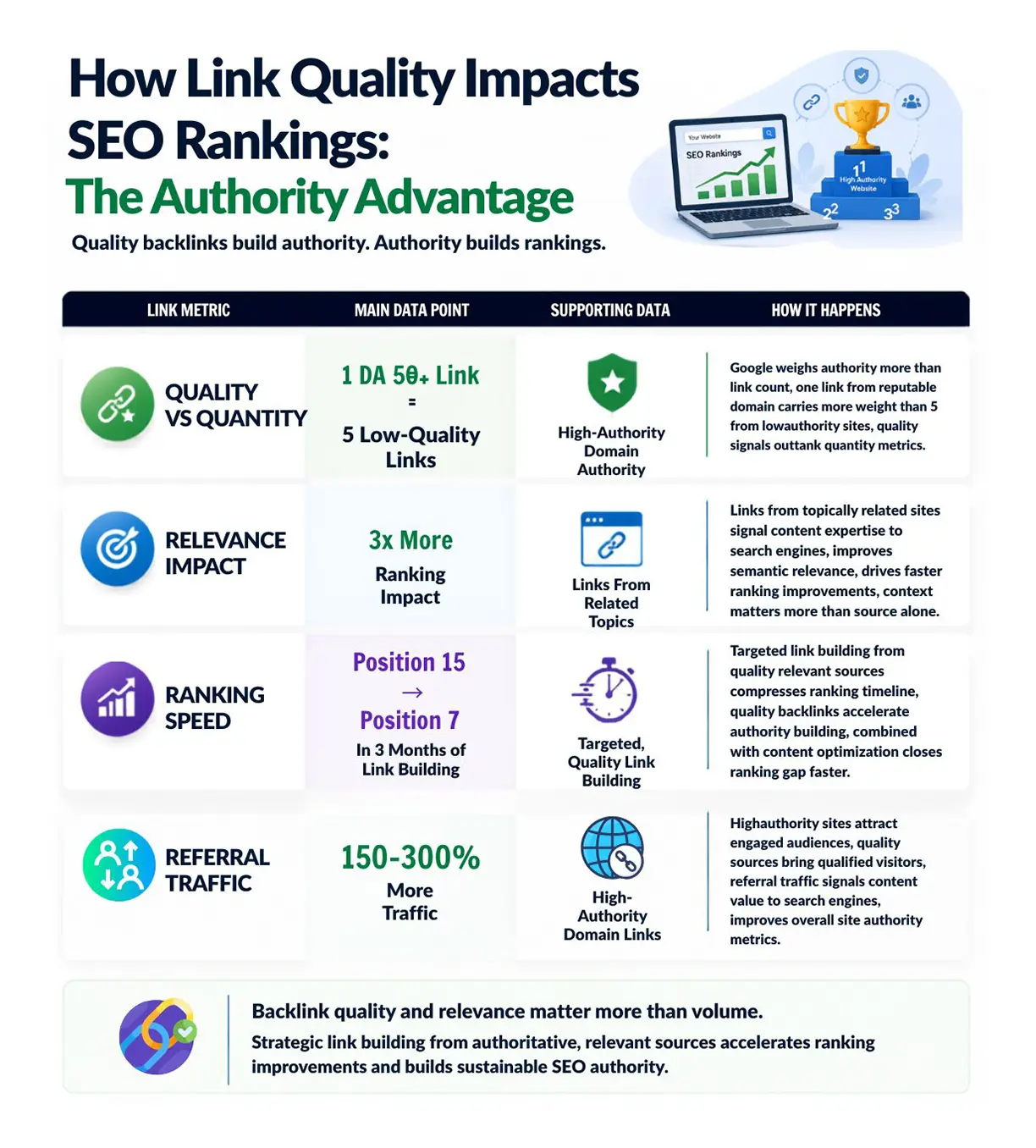
AI tools can scan the web to identify link opportunities, evaluate the quality of potential linking domains, and assess how relevant a particular site is to a given topic. This removes a significant amount of manual prospecting work and allows link-building teams to focus their energy on outreach rather than research.
AI can identify which content on a site is most likely to attract links and flag content gaps that, if filled, would make the site more linkable overall. For any search engine optimization agency managing multiple client campaigns simultaneously, this kind of efficiency allows the team to deliver stronger results without adding to their headcount. It is a meaningful operational gain that compounds clearly over time.
8. Personalized Search and Audience Alignment
Search engines are increasingly personalizing results based on user behaviour, location, device type, and past search history. Two people searching for the same term can see entirely different results. Search engines use AI to deliver these personalized search results, and AI also helps marketers create content that better matches the needs of different audiences.
AI tools analyze data of user behaviour to reveal which content resonates with different audience segments. That information guides both content creation and on-page decisions. For instance, a business serving both residential homeowners and commercial contractors uses AI-driven insights to have separate content for each group. This helps the business address their specific needs without mixing their concerns.
Strong audience alignment is rewarded by search engines. When users stay on a page, read it fully, and visit other pages on the site, it shows that the content is relevant to them. AI makes it easier to develop content that leads to these behavioural signals. Over time, this kind of engagement helps build authority that competitors may find difficult to match quickly.
9. Content Gap Analysis
Even well-established websites have content gaps. These include all the topics that competitors cover and your site does not, questions users ask that go unanswered, and sub-topics that could strengthen existing pages but are now missing. Finding these gaps used to require hours of manual comparison work across multiple competitor sites.
AI tools directly automate that process. Just by comparing the content of your website against top-performing competitor pages, AI identifies where you are underserving your audience and where your competitors are capturing traffic you could reasonably earn instead.
Content gap analysis emphasizes which existing pages need refreshing and not replacing. Older articles that partially cover any topic may be improved with extra sections, updated data, or more detailed explanations. This is even more efficient than writing entirely new content, and it signals to all the search engines that the site is maintained actively.
For instance, a business managing a blog consisting of two hundred articles gains clear value from AI identifying which twenty pages would have the greatest ranking impact if updated.
10. Real-Time Performance Monitoring
SEO is not something a business can set up once and then ignore. Rankings can change as search engine algorithms are updated and competitors publish new content. A page that ranks third today may fall to seventh next month if it is not regularly reviewed and maintained, and this kind of decline can be both common and costly.
AI-powered dashboards offer real-time visibility into keyword rankings, traffic patterns, click-through rates, and user behaviour. Instead of waiting for monthly reports, teams can see what is happening right now and make adjustments accordingly.
For example, if a page's traffic drops after a search engine update, AI can help diagnose the likely cause by comparing the drop against known algorithm change dates and identifying patterns across multiple affected pages. That speeds up the recovery process considerably.
Continuous monitoring signifies all the issues are caught before they become serious problems. A dropped internal link, a slow-loading page, or a sudden metric dip can all be flagged and addressed before significant traffic is lost.
11. AI Overviews and Generative Search Results
Search results pages look different than they did three years ago. AI-generated summaries, called AI Overviews, now appear at the top of many Google searches. These summaries pull content from multiple sources and present an answer directly on the results page before a user clicks on anything at all.
Being cited within an AI Overview drives meaningful exposure even without a traditional top-three ranking. It needs content that is considered to be well-structured, clearly written, and treated by Google as authoritative and trustworthy.
A Semrush study of ten million-plus keywords emphasized the fact that AI Overviews appeared in 13.14% of U.S. desktop searches in the month of March in 2025, and up from 6.49% in the month of January. The results highlight that AI Overviews are becoming a more common part of Google Search. Businesses that create content with clear headings, direct answers, and reliable sources may have a better chance of being included in these summaries.
Choosing affordable search engine optimization services that understand how generative search works is now a practical business consideration. It is not enough to rank well in traditional results. Content needs to be the kind that AI systems genuinely want to surface.
How These AI Shifts Connect to Digital Marketing and Development Services
Search strategy does not exist in isolation. In fact, the way AI is reshaping SEO also affects how websites are built, how digital campaigns are structured, and how the data systems behind a business support better decision-making. The following points show how these connections work in practice.
Digital Marketing Strategy Built Around Real Search Data
Most digital marketing activities and SEO strategy are closely connected. Content created for email campaigns can also be adapted for blog posts. Paid ad copy can show which messages connect with audiences, and that data can help guide organic content decisions. Social media engagement patterns can also reveal which topics are becoming popular before they appear clearly in keyword tools.
A digital marketing service built around integrated thinking connects these channels instead of managing each one separately. AI tools make it easier to track how content performs across platforms and use that information to improve the search strategy on a regular basis.
For instance, a page that performs well in email but ranks poorly in search may need a better structure. A social post that receives strong engagement around a specific topic may show an opportunity to create more detailed content on that subject.
For businesses that want their marketing activities to support each other instead of competing for budget, this connected, data-informed approach can be a more efficient path forward.
Website Development and On-Page Search Performance
A well-designed website is not just one that looks good. For SEO, the structure of a site, the speed at which it loads, how it handles mobile users, and the clarity of its internal linking all carry weight. AI has made it easier to build and test websites that meet these technical requirements from the very start.
AI tools evaluate page speed in real time, flag any accessibility issues, and even test how search engine bots interpret a page's structure. Development teams can identify and correct SEO-related problems before a site goes live, rather than discovering them months later when rankings have already been affected.
A site that loads quickly, works properly across devices, and is quite easy for all the search engines to crawl has a stronger foundation of SEO than one that needs major changes later. Sites built on clean architecture are easier to update and expand as content strategies grow. That long-term flexibility has direct value for any business planning to invest seriously in organic search over multiple years.
AI and ML Development for Data-Driven Decision Making
Businesses that gain the most value from AI-informed SEO usually have the right data systems in place. Machine learning models need clean, structured data to produce useful results. Without this foundation, AI tools may not perform well, no matter how advanced they are.
Custom AI and ML development helps businesses build systems that support better decisions across their digital marketing activities. For instance, a machine learning model created for a specific business can analyze customer search patterns, product performance, and content engagement together. This can help identify where SEO investment is most likely to produce measurable results.
Custom development also helps businesses move beyond generic off-the-shelf tools. Instead of trying to fit a broad keyword platform into a specific business environment, a purpose-built solution can work with the exact data the business uses. For organizations handling large volumes of content and customer data, this can provide more relevant insights than generic platforms over time.
Mobile Performance and Its Connection to Search Rankings
Mobile devices account for the majority of global searches. Google give priority to the mobile version of a website when evaluating rankings. Businesses with mobile experiences that load slowly, display poorly, or frustrate users pay a direct cost in search performance that shows up clearly in traffic numbers.
Strong mobile development addresses both the technical side of this problem and the broader need for mobile-first thinking across all digital products. A mobile app that complements a business's web presence reinforces brand authority and increases the time users spend with content. Both of these factors send positive engagement signals to search platforms.
Mobile apps create valuable opportunities to collect first-party data on how users interact with content and products. That data feeds directly into refining SEO strategy over time. Knowing which features users engage with most, or which search queries bring them into an app, tells a business exactly where to focus its content investment next. For businesses thinking about long-term organic growth, mobile performance is foundational.
Search has changed and is unlikely to return to the way it worked before. The tools, algorithms, and user expectations connected to every query have all developed. Businesses that employ AI-driven SEO strategy can find it easier to earn consistent organic traffic without wasting their marketing budget on methods that no longer match how search works. This doesn’t mean every business needs to rebuild its marketing strategies from scratch. Many improvements can be made step by step. However, getting them right requires reliable data, the right tools, and people who understand how search works today. Sourcedesk brings together technology and digital marketing to help businesses build the systems, sites, and strategies needed for modern search visibility.
Frequently Asked Questions
1. What is AI-driven Search Engine Optimization strategy?
2. How does AI improve keyword research for businesses?
3. What are AI Overviews in Google Search?
4. Can small businesses benefit from AI SEO tools?
5. How does AI affect the content creation process?
6. Does AI replace human SEO professionals?
Request a
Free Quote Today!


