Small and medium-sized businesses (SMBs) often face distinct challenges in expanding and adapting to growing demands. Inexpensive, off-the-shelf software solutions may not provide the flexibility or scalability needed to support the evolving needs of these businesses. Custom software development services can fill this gap, enabling businesses to create software that meets their specific requirements and scales with them as they expand.
This blog will delve into the significant advantages of custom software development for SMBs, focusing on how these solutions provide the flexibility and scalability needed for sustained growth. By the end, it will be easy to understand how custom software is a strategic and lucrative business decision that drives long-term success.
What Is Custom Software Development?
Custom software development involves designing, developing, and implementing software that is built to address the specific requirements of a business or industry. Unlike mass-market, off-the-shelf solutions, custom software is crafted to meet a company's exact needs, ensuring that every function serves a unique purpose.
For SMBs, choosing custom software development and consulting services allows them to create solutions that integrate directly into their existing workflows and processes. This personalized approach enables the software to not only address immediate challenges but to adapt to evolving business needs over the long term.
9 Key Benefits of Custom Software Development for SMBs
Here are nine significant benefits that custom software development can offer small and medium-sized businesses, with a focus on scalability, flexibility, and operational efficiency.
1. Built to Address Business-Specific Needs
Custom software is built to serve a company’s unique requirements. Unlike off-the-shelf solutions designed to serve a wide audience, custom software focuses on solving the unique challenges faced by an individual business.
For example, a manufacturing business might require a system that integrates procurement, inventory management, and production scheduling. Pre-built software may not support such detailed integration, but custom software can easily be designed to connect these critical components. Therefore, this offers a solution that suits the specific operations of the business.
Moreover, by opting for a custom solution, SMBs get systems aligned with their exact needs, eliminating inefficiencies caused by software that was not made for them specifically.
2. Improved Efficiency and Lower Operating Costs
Custom software can help businesses automate day-to-day tasks, significantly reducing manual efforts and human mistakes. For example, a business might rely on manual data entry to generate invoices, monitor sales, or update customer information. With a custom system, these processes can be automated, reducing time spent on administrative tasks and any corrections of manual errors.
Consider a small retail business that implements custom software to manage inventory and orders. Their system can automatically track and update stock levels, provide sales reports, and even trigger reorder alerts, saving hours of labour each week.
Furthermore, by minimizing manual input and improving accuracy, custom software reduces operational costs and enhances operational efficiency. This also allows employees to focus on more complicated tasks that foster business growth.
3. Scalability for Growing Businesses
As a business grows, its software requirements will naturally expand. What works for a small operation may not suffice as the business grows in its scale and complexity. Custom software solutions are built with an objective to scale, ensuring that the existing systems can handle increased data, more users, and evolving business processes without compromising performance.
For instance, a SaaS provider may start with a small customer base. But as it expands, it realizes that it needs a software platform that can accommodate thousands of new users. Its existing system must be capable of integrating new features and supporting higher volumes of traffic. Custom software development ensures that the system can scale as the business grows, allowing for smooth transitions during periods of rapid expansion.
In fact, businesses that implemented custom software solutions reported that they were able to scale their operations more effectively, particularly in handling increased customer demands.
4. Better Integration with Existing Systems
In many cases, businesses already have systems in place for various functions like accounting, marketing, sales, research and development, and customer management. Custom software development allows these systems to be integrated into a unified platform, allowing smoother communication and data sharing across all departments.
For example, a company using both a CRM system and an accounting tool can integrate them so that customer data flows seamlessly into invoicing software, reducing duplication of efforts.
This integration can also eliminate the need for manual data transfers, improving accuracy and reducing administrative overhead.
5. Enhanced Data Security and Compliance
As some businesses deal with data, especially customer information, securing that data becomes increasingly important. Custom software can be designed with high-level safety features, including multi-factor authentication and role-based access controls.
For example, a healthcare provider managing patient records must comply with regulations such as HIPAA. Dedicated custom software can be built to meet these strict security requirements. This safeguards patient data with secure storage and limits access to authorized personnel.
Off-the-shelf software may not provide the level of security needed for sensitive data, and its compliance with industry-specific regulations may be lacking. Custom solutions, however, can be built to meet all relevant standards, ensuring that businesses stay compliant and protect their customers' data.
6. Full Ownership and Control Over the Software
With custom software, businesses retain full ownership and control over their solution. This means that they are not reliant on vendors for updates or changes. Businesses can choose when and how they want to update the system, ensuring that it continues to meet their evolving needs.
For example, a business can modify its custom software to reflect changing business processes, customer needs, or new regulatory requirements. In contrast, off-the-shelf software often requires businesses to adapt to the vendor's update schedule, which may not always align with the company’s needs.
Having full ownership means that the business can continually evolve its software as necessary, with complete control over its features and functionality.
7. Enhanced Customer Experience
Custom software provides businesses with the flexibility for a personalized customer experience. Whether it's a mobile app, a custom e-commerce platform, or a customer portal, businesses can design features that directly enhance their customer experience.
For instance, an online retailer might implement a customized shopping experience that considers their customers’ browsing and purchase history. Custom software allows businesses to offer features like personalized recommendations, discount alerts, and faster checkout options—elements that off-the-shelf platforms might not fully support.
In fact, according to Forbes, 81% of customers respond well to such personalized experiences, such as when the companies know who they are and their past purchases.
8. Gaining a Competitive Edge
Custom software can give businesses a unique edge in their market. By having software solutions designed that directly address specific customer needs or business operations, companies can differentiate themselves from those competitors that use readymade software.
For example, a custom-built inventory management system can provide real-time insights into a business’s stock levels, which helps them make quicker decisions than competitors relying on outdated inventory tracking methods.
9. Long-Term Cost Savings
Although custom software requires a higher upfront investment compared to generic solutions, the long-term savings often outweigh the initial costs. This is because custom software eliminates ongoing subscription fees and licensing costs that come with off-the-shelf software.
Furthermore, with custom solutions, businesses no longer need third-party support services, which can be expensive over time. For example, businesses using off-the-shelf software may face additional costs for support, upgrades, or licensing renewals, which are not a concern with custom solutions.
Key Features of Scalable Custom Software Solutions
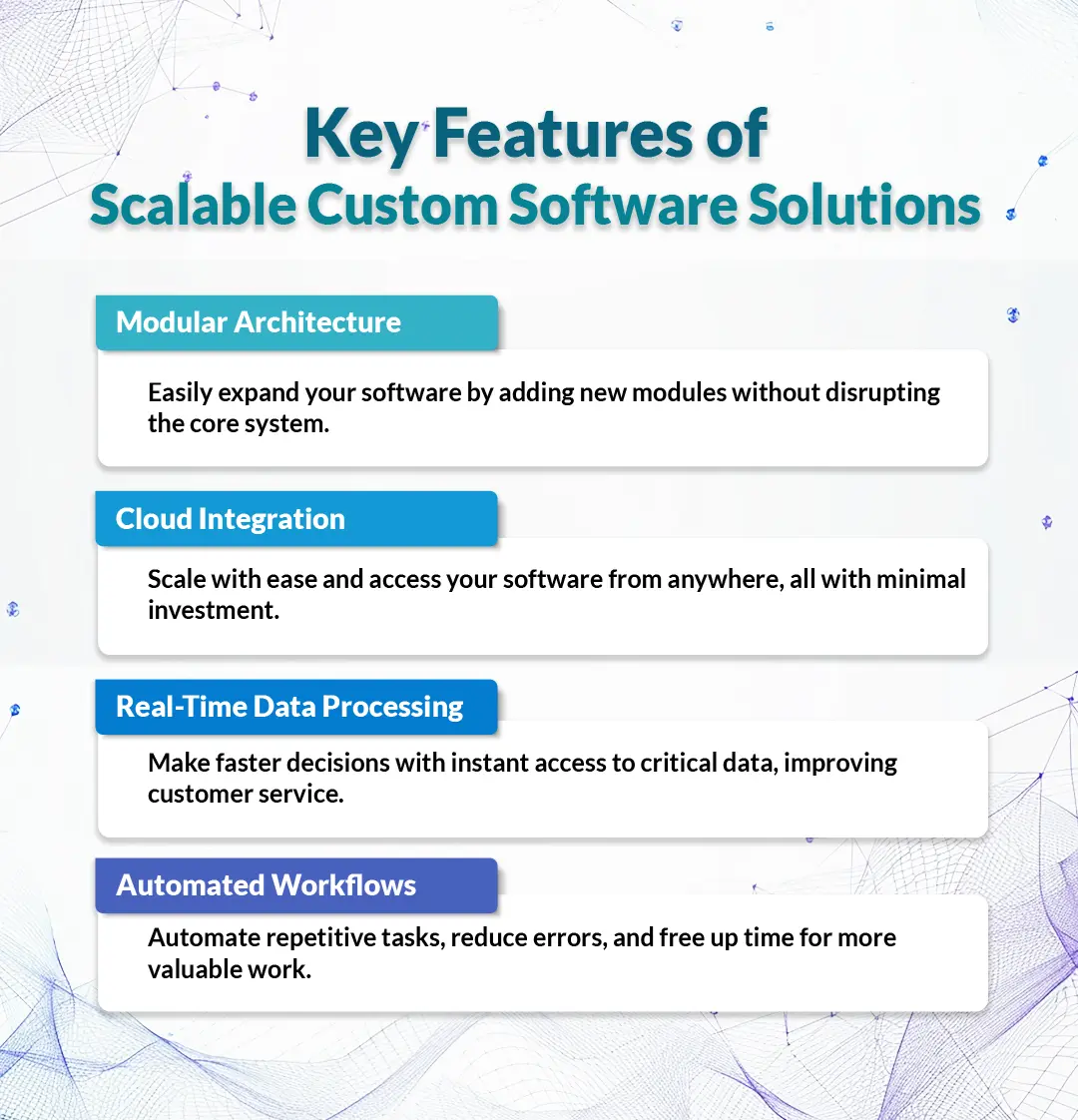
The following features of developed custom software solutions help to scale business operations and optimally improve the user experience.
1. Modular Architecture
Modular architecture is a key feature of scalable custom software. This approach allows businesses to expand their software by adding new modules or functionalities as needed. Moreover, developers can independently develop and update each module, making it easier to scale and maintain.
For example, a business that starts with a basic customer management module can later add features such as inventory tracking, order management, or financial reporting without affecting the core system.
2. Cloud Integration and Support
Cloud technology plays a pivotal role in scaling custom software. With cloud integration, businesses can access their software from anywhere and scale their infrastructure with minimal investment.
For example, a small e-commerce business may transition from an on-premises system to a cloud-based platform to support increasing traffic. This ensures that its system remains fast and responsive even as demand grows.
3. Real-Time Data Processing
Real-time data processing allows businesses to receive and analyze data as it is generated. This enables a speedier decision-making process and improves customer service. Moreover, it is particularly important for industries that require timely information, such as e-commerce, financial services, and logistics.
For instance, a custom-built logistics software solution can track shipments in real-time, providing instant updates on delivery status. This helps in the optimization of the supply chain operations that keep customers informed. Real-time data processing ensures that businesses stay competitive and responsive to market changes.
4. Automated Workflows and Task Management
Custom software can automate many business processes, including repetitive tasks and workflows. Automation helps reduce human error, enhances efficiency, and is not time-consuming. This allows the team to utilize their time on more important tasks that contribute to the overall business success.
For example, an automated workflow for processing customer orders can reduce the time spent on manual entry, approve orders automatically based on predefined rules, and even trigger notifications for order updates. It helps businesses to grow their operations without hiring additional resources.
Comparison Between Custom Software vs. Off-the-Shelf Software
The table below shows the major differences between custom and off-the-shelf software, providing a clear view of how each option caters to different business needs.
| Factors of Analysis |
Custom Software Solutions |
Off-the-Shelf Software |
| Cost |
High initial investment but lower long-term costs |
Lower initial cost, with ongoing subscription/license fees |
| Customization |
Fully customizable to meet specific business needs |
Only partly customizable to meet specific business needs |
| Scalability |
Built to scale with the business |
Limited scalability; may require upgrades for growth |
| Flexibility |
More flexible and can be personalized according to business needs |
Less flexible and is restricted to predefined features |
| Implementation Time |
Longer development time due to unique specifications |
Quick deployment; ready to use immediately |
| Integration |
Can be seamlessly integrated with existing systems |
May require additional software for integration |
| Support & Maintenance |
Requires ongoing support from the development team |
Vendor-provided support; dependent on the software provider |
| Updates & Upgrades |
Custom updates as needed, tailored to business changes |
Regular updates from the vendor, sometimes at extra cost |
| Security |
Enhanced security features tailored to the business's needs |
Generic security may not comply with specific regulations |
| User Experience |
Optimized for the specific workflow of your business |
General user experience; not tailored to business needs |
| Compliance |
Can be designed to meet specific industry regulations |
Often lacks specialized compliance features for specific industries |
| Ownership |
Full ownership and control over the software |
Limited ownership; subject to the vendor’s terms and conditions |
When to Choose a Custom Software Solution
Custom software is a solid choice for businesses with unique needs or complex workflows. For example, if a business operates in a niche industry or requires software to integrate with existing systems in a specific way, custom development is the best option. This type of customization is also ideal for businesses that expect to expand their operations and require solutions that can grow with them.
The key benefits of custom software include:
- Flexibility.
- Better ROI over time.
- The ability to create solutions that can scale as the business grows.
Off-the-shelf software is often more suitable for businesses that need quick solutions with basic functionalities. This type of software is generally more affordable and can be deployed immediately, making it an appropriate choice for small-scale businesses with limited resources and budgets.
However, off-the-shelf solutions often come with limitations in terms of their customization and scalability. They may not address the business's specific needs, and scaling as the company grows can be difficult.
How to Choose the Right Custom Software Development Partner
Let’s look at the factors to consider when selecting the right custom software development partner for your business:
1. Expertise and Industry Knowledge
When partnering with a custom software development and consulting services provider, it is essential to choose a company with experience in your specific industry. A development partner familiar with your business’s challenges can provide solutions that meet your needs more effectively. Industry experience also ensures that the partner understands specific regulations and requirements that could impact the development process.
2. Scalability of Solutions
Ensure that your chosen partner can deliver scalable solutions that can grow with your business. As your company expands, your software should be able to accommodate increasing demands and more complex features. A good development partner will design solutions with scalability in mind, ensuring long-term sustainability.
3. Cost Transparency and Support
Look for a partner who provides clear pricing models and offers ongoing support after the software is deployed. The transparent pricing policy ensures that no hidden charges are attached, while ongoing support and maintenance ensure the efficacy of the system and its updation.
Custom software is a strategic tool for driving a business’s growth, increasing its efficiency, and improving customer satisfaction. For small and medium-sized businesses, investing in custom software development provides a solid foundation for scaling their operations and addressing the unique challenges of a dynamic market. When businesses choose to engage custom software development services, they are investing in their future, ensuring that they have the right tools to succeed in an increasingly competitive world. By working with the right software development partner, SMBs can unlock the potential of their operations and remain adaptable as they grow.


