


Table of Contents


Chatbots are indispensable business tools, widely used to communicate with users, automate repetitive tasks, and improve customer interaction. Their ability to provide instant, on-demand support is transforming how businesses engage with customers across sectors such as retail, healthcare, finance, and entertainment.
As businesses increasingly adopt chatbot solutions, understanding the factors that influence their development costs is essential for making informed decisions about implementing them.
While the benefits of chatbots are clear, their development costs can vary significantly. The complexity of building a chatbot from scratch, its features, the platform it's deployed on, and its integration with existing systems all play critical roles in determining its price.
Let’s break down the various factors that affect the cost of AI chatbot development services. For businesses considering the development of a custom chatbot or evaluating outsourcing alternatives, this guide delivers key insights to support effective budget planning.
What Are Chatbots and How Do They Work?
Chatbots are software applications designed to replicate human conversation through text or voice interactions. These intelligent systems enable businesses to engage with users in real time and automate tasks such as answering queries, processing transactions, and providing information.
Chatbots are generally classified into two primary categories: those that operate on predefined rules and those powered by artificial intelligence.
- Rule-Based Chatbots: These bots follow predetermined rules and respond to specific commands or inputs. They are straightforward, easy to develop, and less expensive than more advanced models. An example of these chatbots is a website chatbot in e-commerce sites that responds with a preset answer when a user asks, “Where can I track my order?”
- AI-Driven Chatbots: They leverage capabilities like machine learning and natural language processing (NLP) to interpret queries and generate replies that closely mirror natural human conversation. They are more complex and typically cost more than the rule-based chatbots. For instance, a customer support chatbot that understands “I haven’t received my package yet” and provides a personalized update, rather than relying on fixed commands.
Chatbots are commonly used in industries such as customer service, e-commerce, healthcare, and travel. An AI-driven chatbot in a customer service context can handle thousands of queries simultaneously, improving response times and customer satisfaction.
Role of Chatbots in Business Strategy in Enhancing Efficiency and Customer Experience
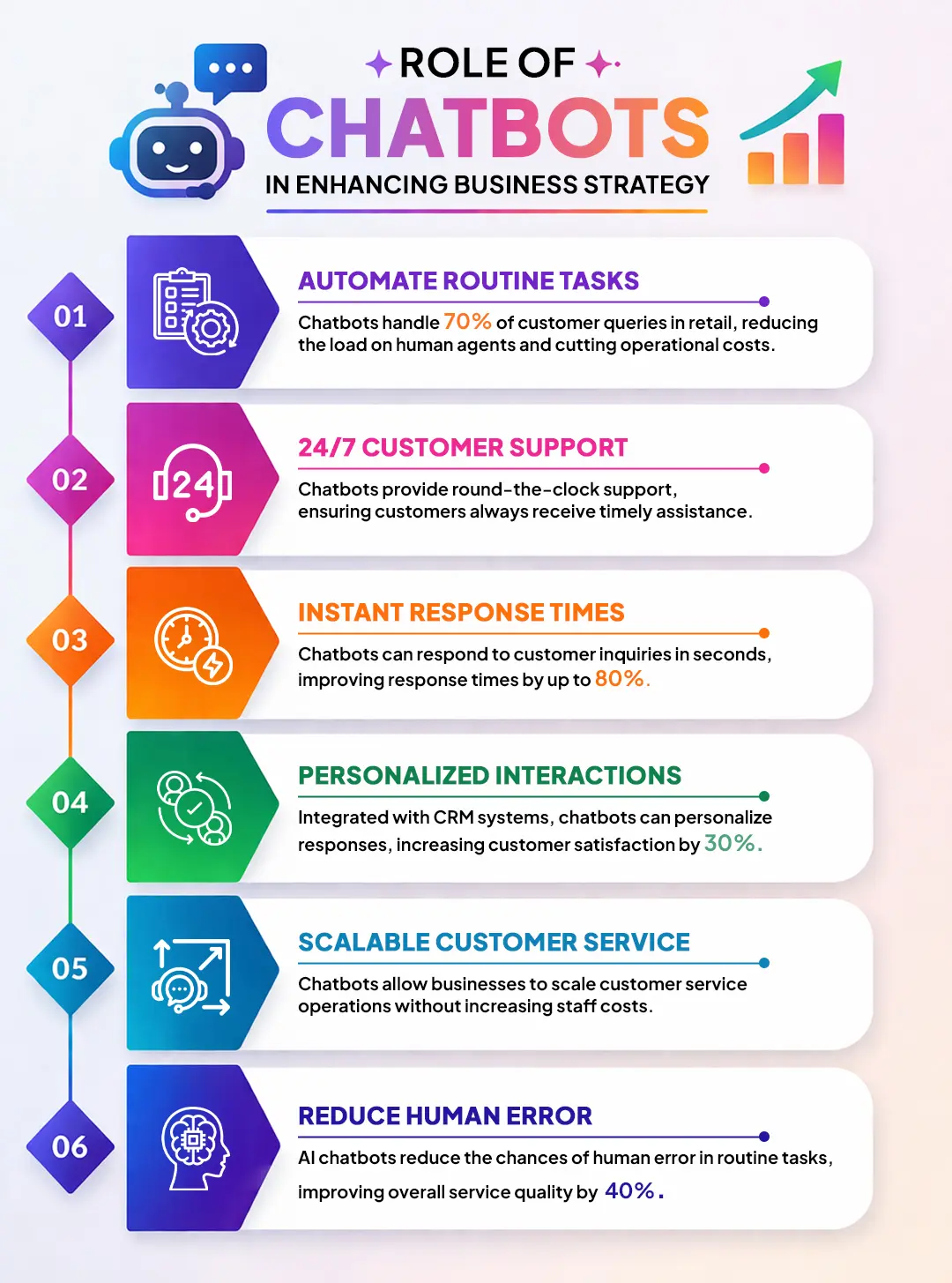
As businesses across industries, such as healthcare and e-commerce, strive to deliver exceptional customer service while controlling costs, AI-driven chatbots offer an effective solution. These bots not only automate routine tasks and answer customer queries instantly, but they also manage a high volume of interactions without increasing the need for human resources.
For example, in retail, a chatbot can handle up to 70% of customer inquiries, allowing human agents to focus on more complex issues. This not only reduces customer service costs but also speeds up response times and improves overall efficiency.
Chatbots are available 24/7, ensuring customers receive immediate assistance that boosts their satisfaction and engagement. Also, by integrating with CRM systems, chatbots can offer personalized responses based on user data, making interactions more relevant and effective.
In short, chatbots help businesses scale without a proportional increase in operational costs, streamline customer service, and improve the overall user experience.
8 Factors Influencing AI Chatbot Development Services Costs
AI chatbot development costs can vary widely depending on several technical and business factors. Understanding these key elements helps organizations plan budgets more effectively and choose the right approach for their needs.
1. Complexity of the Development Project
The complexity of the chatbot is one of the primary determinants of its development cost. A simple chatbot designed to handle set questions is far more cost-effective to build than an advanced AI-driven solution that can interpret natural language and connect with multiple systems.
Here are the primary differences between basic and advanced chatbots:
- Basic Chatbots: These employ rule-based systems with a limited set of responses. The development time and cost are lower because they do not require advanced features.
- Advanced Chatbots: AI-driven chatbots that utilize machine learning algorithms to enhance their functionality come with higher costs. That’s because these chatbots require more development time, a deeper understanding of user intent, and integration with other tools like CRMs or ERPs.
For instance, a customer service chatbot for a small business might only need basic responses. In contrast, a chatbot for a global enterprise that handles sales, customer service, and internal communications would require greater sophistication and integration, significantly increasing development costs.
2. Chatbot Features and Functionalities
The features and functionalities incorporated during development and deployment influence a chatbot's costs. Some common features include:
- Text-Based Conversations: The most basic form of chatbot interaction.
- Voice Recognition: Chatbots that allow users to speak to the bot rather than typing.
- Multilingual Support: Offering users the option to interact in multiple languages.
- Sentiment Analysis: AI-powered bots that understand the emotions behind user messages.
Also, the inclusion of advanced features such as natural language processing (NLP), machine learning algorithms, and AI capabilities generally increases the cost of chatbot development. For example, a chatbot application development service incorporating NLP and AI will require more time for bot training and may involve higher resource utilization, increasing the overall cost.
3. Development Time
The more time a chatbot takes to develop, the higher the cost. Development time is influenced by factors such as the chatbot's complexity, the number of features, and the platform on which it will be deployed.
- Basic Bots: Simple bots typically require a shorter development cycle and cost less.
- Complex Bots: Bots that integrate with multiple systems, use machine learning, or require a sophisticated user interface (UI) will take longer to develop and therefore cost more.
If a business needs the chatbot developed within a tight deadline, the development cost may increase due to the accelerated pace of work.
4. Chatbot Platform and Deployment
The platform where the chatbot is deployed, such as a website, mobile app, social media platform, or messaging service, plays a role in determining its cost. Each platform requires its own approach to integration, design, and functionality.
- Website Bots: Simple and less expensive to develop since they don't require integration with external platforms.
- Mobile or Social Media Bots: Require integration with mobile apps or social media services like Facebook Messenger or WhatsApp, which can increase development costs.
For example, developing a chatbot for a mobile app requires additional coding for app compatibility, which will likely increase the cost compared to a simple website chatbot.
5. Design and User Experience
The user interface (UI) and user experience (UX) design play an essential role in a chatbot's success. A well-designed interface with an intuitive UX can significantly improve how users interact with the bot. While a simple design may reduce development costs, a more complex and aesthetically pleasing design will increase them.
For example, businesses that require custom-designed user flows, avatars, and animations to create a more engaging experience will incur higher costs than those using standard templates.
6. Integration with Existing Systems
Developing chatbots that must connect to existing business tools such as CRM platforms, ERP systems, or internal databases typically incurs higher costs due to the additional integration requirements. These integrations require additional development time, expertise, and testing to ensure smooth data exchange between systems.
For example, connecting a chatbot to a customer database so it can fetch order details or user information makes interactions more helpful, but it also adds to development effort and ongoing maintenance.
7. AI and Machine Learning Features
Building an AI-powered chatbot involves using natural language processing (NLP) and machine learning algorithms, which are more complex and thus more expensive to develop. They require continuous training with large datasets and an advanced understanding of user intent, which increases costs.
Bots built with pre-trained AI models are less expensive to develop than custom-built bots, but they may not deliver the level of personalization businesses require. Businesses looking to implement custom AI models will incur higher costs, especially when factoring in ongoing training and optimization.
8. Maintenance and Updates
Once a chatbot is deployed, it requires regular maintenance and updates. Over time, bots may need improvements, bug fixes, and new features to keep up with user expectations and business needs.
Businesses should consider the long-term costs of maintaining and updating their chatbots. Some chatbot development service providers offer maintenance packages that can increase overall costs but ensure the chatbot remains functional and effective.
Custom Chatbots vs. Pre-Built Solutions: Which Is More Cost-Effective?
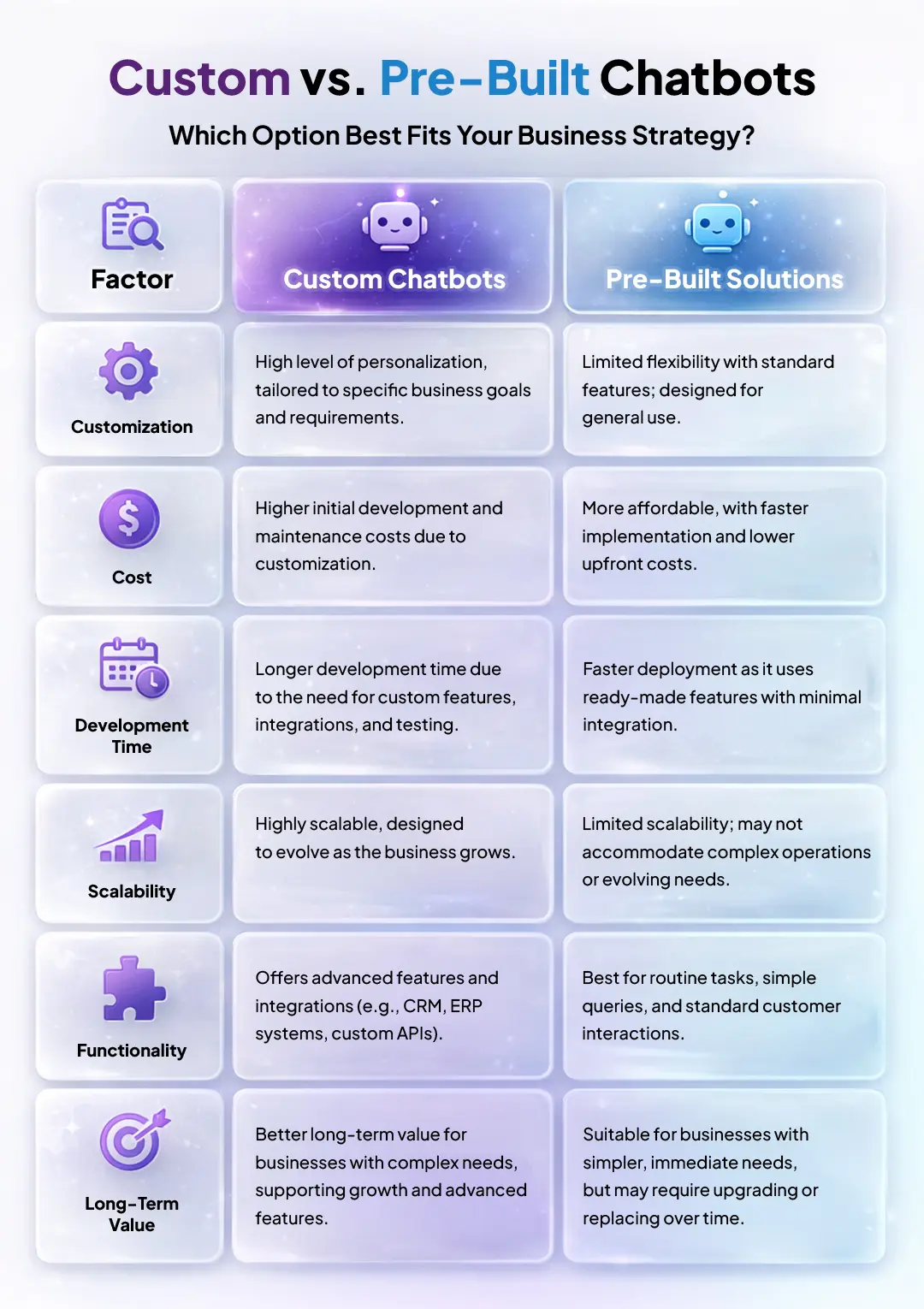
When evaluating custom chatbots and pre-built solutions, the better option depends on the level of functionality a business requires and its plans for scaling over time. Custom chatbots are created to align with specific goals, allowing greater control over features, integrations, and overall performance. This level of personalization often leads to higher development and maintenance costs, but it ensures the solution can grow alongside the business and support more complex operations.
In contrast, pre-built chatbots offer a more budget-friendly and faster way to implement automation. They come with standard features that work well for handling routine queries and simple interactions. However, their limited flexibility can become a constraint for businesses with evolving or advanced needs.
From a cost perspective, pre-built options are suitable for those seeking a quick, economical setup. At the same time, custom chatbots deliver greater value in the long run for businesses that need tailored capabilities and scalability. The decision ultimately comes down to balancing immediate budget considerations with future requirements.
Estimated Cost Ranges for Outsourced Chatbot Development
The cost involved in a chatbot development depends on its complexity, features, and the level of customization required. Below is an estimated cost range for different types of chatbot development services, along with the key components that influence pricing for AI-powered chatbot solutions.
Basic Chatbot Development: $2,000-$10,000
Basic chatbots are designed to handle simple tasks, such as answering frequently asked questions or assisting with basic inquiries. These are rule-based chatbots that follow pre-programmed scripts and are typically limited in functionality. The development cost for such chatbots is relatively low due to their straightforward design and minimal integration requirements.
The important components included in the cost of development of a basic chatbot are:
- Bot Design: Simple text-based interface with a predefined set of responses.
- Development Time: Shorter development cycles, typically taking between a few days and a couple of weeks.
- Platform Deployment: Limited to basic platforms like websites or messaging apps.
Mid-Level Chatbot: $10,000-$50,000
Mid-level chatbots are more advanced than basic bots and can handle more complex queries, integrate with third-party systems like payment gateways, and provide a more personalized experience. These bots often incorporate machine learning and natural language processing (NLP), enabling them to understand and process a broader range of user inputs.
The cost of a mid-level chatbot holds the following components:
- Bot Design: A more refined user interface with features like buttons, quick replies, and smoother conversation flow.
- NLP and AI Integration: Basic use of NLP to work with a vast amount of queries and give more accurate responses.
- System Integration: Linking the bot with systems like CRM, ERP, or e-commerce platforms for tasks such as user login or order tracking.
- Testing and Quality Assurance: Making sure the chatbot works properly across different platforms and scenarios.
- Development Time: Usually takes around four to sex weeks, based on complexity and integrations.
Advanced AI Chatbot: $50,000-$150,000+
Advanced AI-powered chatbots leverage sophisticated technologies like machine learning, deep learning, and advanced NLP to deliver highly personalized, context-aware interactions. These bots can understand complex sentences, learn from user interactions, and adapt their responses to new information. They are often used in industries like healthcare, finance, and e-commerce, where real-time, intelligent assistance is critical.
At an advanced level, the cost of developing a chatbot includes the following components:
- Advanced AI and Machine Learning Integration: Development of machine learning models that allow the bot to improve over time based on data. This includes the cost of training models on large datasets, which can significantly increase overall costs.
- Natural Language Processing (NLP): A significant investment in NLP technology, enabling the bot to understand context, intent, and nuances in user language, as well as support multiple languages.
- Deep System Integration: Integration with various business systems like CRM, ERP, customer support tools, and databases. This might involve building custom APIs and ensuring seamless data exchange between systems.
- Personalization Capabilities: Advanced chatbots can analyze user data and provide customized responses, recommendations, and content. Developing these capabilities involves advanced algorithms and more complex logic.
- Continuous Learning and Monitoring: Implementing a continuous learning framework where the bot learns from each interaction and improves over time. This may also include ongoing updates and tuning to ensure the bot remains effective.
- Multi-Channel Deployment: Integration across multiple platforms, including websites, mobile apps, social media channels (WhatsApp, Facebook Messenger), and voice assistants like Amazon Alexa or Google Assistant.
- Security Features: Depending on the use case, especially in sectors like finance or healthcare, security and compliance requirements, such as data encryption and GDPR compliance, can increase overall costs.
- Development Time: The development cycle for an advanced AI chatbot typically takes eight to twelve weeks or more due to the system's complexity, integration requirements, and the time needed to train machine learning models.
Additional Cost Considerations for AI Chatbot Development
Beyond initial development, there are several ongoing and hidden costs that businesses should account for when planning an AI chatbot investment.
- Maintenance and Support: Ongoing costs for maintaining the chatbot after launch, including bug fixes, updates, performance monitoring, and improvements and may cost around $400-$1,500 per month for hosting and updates.
- User Testing and Feedback: Testing the bot with real users to gather feedback and make necessary improvements. The more advanced the chatbot, the more rigorous the testing process.
- Scalability: If the chatbot needs to handle large volumes of interactions, additional infrastructure such as cloud hosting or server costs may increase overall costs.
How to Evaluate a Potential Outsourcing AI Chatbot Development Partner
When selecting an outsourcing partner for chatbot development, focus on the following key factors:
- Expertise in AI and Chatbot Development: It is important to ensure that the company has strong knowledge of AI technologies, including machine learning and natural language processing (NLP), to build intelligent, scalable chatbots.
- Relevant Experience: Choose an AI chatbot development company with experience in your industry or similar use cases. This will help them better understand your specific challenges and deliver a tailored solution.
- Past Projects and Portfolio: Review the company’s portfolio to evaluate their ability to handle projects similar to yours. Look for successful deployments with measurable results.
- Client Reviews: Look for client testimonials to understand the company’s reliability, ability to meet deadlines, and quality of solutions.
- Support and Maintenance: Check whether the company provides ongoing support and maintenance to keep the chatbot functioning smoothly and to adapt it to future needs.
By evaluating these factors, businesses can select a chatbot application development service provider that aligns with their goals and has the expertise to deliver a high-quality chatbot solution.
When planning a chatbot development project, it is crucial to consider the features that will bring the most value to the business and align with the budget. A well-developed chatbot can deliver substantial ROI by improving customer service efficiency, enhancing user engagement, and driving business growth.
Frequently Asked Questions
What are the typical costs for a basic chatbot?
A basic chatbot, typically rule-based and designed to handle simple inquiries, usually costs between $2,000 and $10,000. This cost covers the development of a simple, text-based interface with predefined responses and their deployment on platforms such as websites or messaging apps.
The lower cost is due to the lack of advanced features like AI or machine learning. The final cost is influenced by factors such as the level of design, the complexity of functionality, and the extent of required integrations.
How much does it cost to develop an AI-powered chatbot?
Is it more cost-effective to use pre-built or custom chatbots?
How long does it take to develop a chatbot?
What features increase the cost of chatbot development?
Can I integrate my chatbot with existing business systems?
What ongoing costs should I expect after my chatbot is deployed?
Request a
Free Quote Today!


