


Table of Contents


Generative AI is a working part of how many businesses are operating their customer service, product development, finance, and operations. It’s not a future technology but a current one.
According to EY, the global generative AI market was valued at US$13.7 billion in 2023 and is expected to grow to US$165 billion by 2032, at a compound annual growth rate of 34.6%. The growth is happening now, and businesses that wait too long to adopt it risk falling behind those that are already moving.
Most organizations, however, find it hard to act on this without outside help. They know generative AI can deliver real value to them, but figuring out where to start, which tools to use, and how to build the right team is not straightforward. Many run pilot projects that go nowhere or invest in platforms that do not fit their needs. The gap between interest and results is real, and it costs time and money.
This is where generative AI consulting companies make a huge difference. They bring technical knowledge, hands-on experience across industries, and a clear process for making AI work inside a real organization.
As per Harvard Business Review reports, consulting is not being replaced by AI. Instead, it is changing, with firms now focusing more on strategic problem-solving and less on basic information gathering. That shift makes them more useful to organizations trying to get AI right.
In this post, we discuss how generative AI consultancy companies allow organizations to take advantage of gen AI for their growth, so you can make an informed decision about how to move forward.
How Consultancies Drive Generative AI Growth for Organizations
Generative AI consulting services bring a structured, experienced approach to what is often an overwhelming process. Here are seven ways they make a meaningful difference.
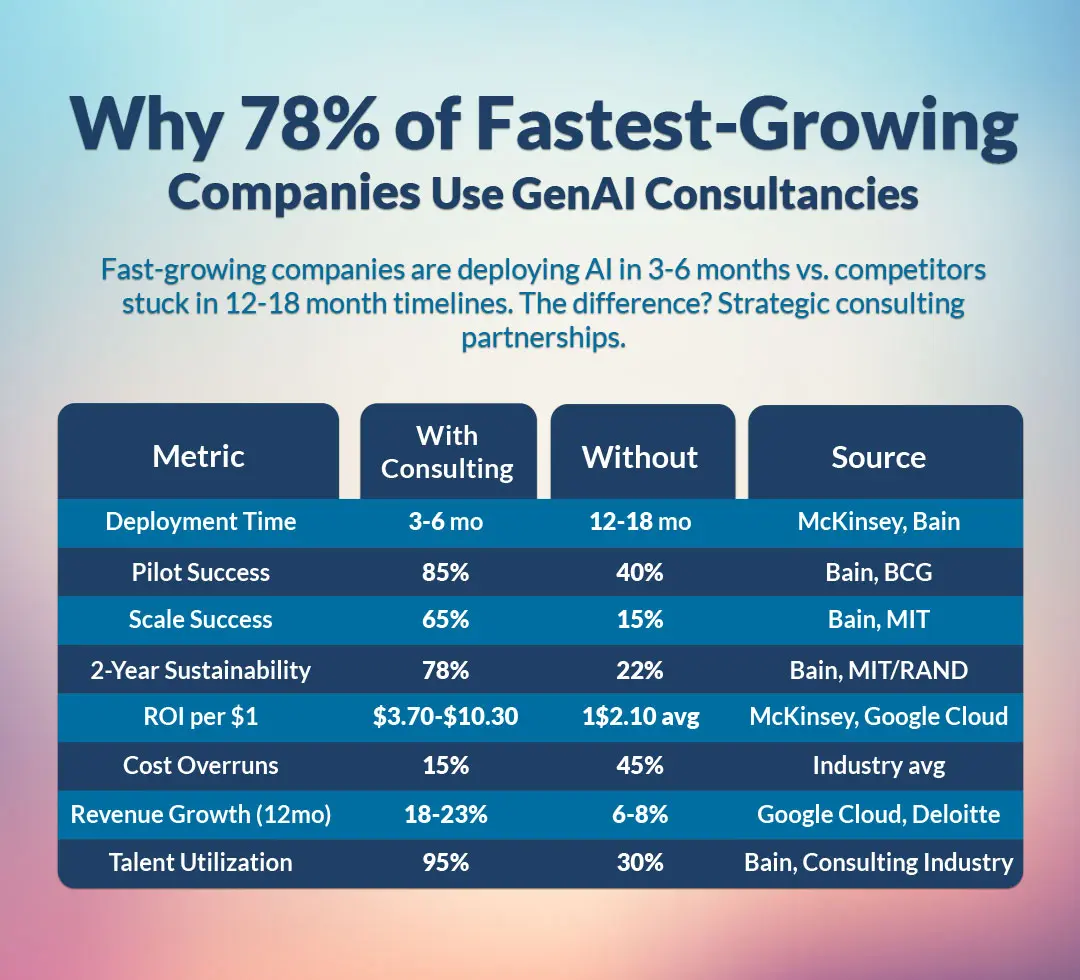
1. Building a Clear AI Strategy Grounded in Business Reality
One of the most common mistakes organizations make is jumping straight into AI tools without having a clear plan. They pick a popular platform, run a few experiments, and then wonder why the results disappoint.
Generative AI consultancies fix this by starting at the foundation: understanding what the business actually needs before recommending any technology.
According to EY, the key question for the consulting industry is whether a generative AI solution can reshape business models and unlock new realms of value through better customer experiences and unprecedented growth.
Answering that question for any specific organization requires honest assessment, not hype. Consultancies assess current workflows, identify processes that would genuinely benefit from AI, and map out a realistic roadmap with measurable outcomes.
A well-built strategy keeps teams focused on high-value use cases. Recent BCG research confirms that leading companies prioritize an average of 3.5 AI use cases compared with 6.1 for underperformers and, thus, anticipate more than double the return on investment.
2. Closing the Data Readiness Gap
Generative AI is only as good as the data behind it. Organizations often discover too late that their data is scattered, inconsistent, or poorly labelled, and that their infrastructure cannot support modern AI systems.
As InData Labs notes, organizations need to assess their data infrastructure, identify gaps, and design scalable data architecture before launching any AI initiative. Consultancies carry out thorough readiness assessments, pinpointing where the problems are and what must happen before any model goes into production.
Also, they establish data governance frameworks that keep information accurate, accessible, and secure over the long term. A sound governance strategy does not stop at policies. It also defines clear, measurable standards covering the cost-value ratio of AI decisions, who is responsible for what, and how issues like response time and model bias are tracked.
Having these metrics in place from the start gives leadership ongoing visibility into how their AI systems are performing, rather than relying on guesswork once the system is live.
3. Selecting the Right Tools and Models Without Getting Burned
The AI market is crowded and moves fast. Large language models, retrieval-augmented generation systems, image generators, fine-tuned domain models—the options are genuinely overwhelming, even for technically inclined leaders.
Consultancies cut through that noise by evaluating tools based on fit rather than popularity. They assess whether a commercially available foundation model is sufficient or whether a more purpose-built approach is required.
They also look at vendor reliability, security posture, integration complexity, and total cost of ownership over time. EY's perspective is clear: consulting firms must help clients determine the best fit, timing, and pace for adopting AI technologies and then extend the reach of what has been proven to work.
Consultancies can run structured pilot programs to validate performance before a significant budget is committed. They ensure the organization retains ownership of its data and outputs—a legal and competitive consideration that is often overlooked in the enthusiasm of early adoption.
4. Managing Workforce Change and Building Internal Capability
Technology does not operate in a vacuum. When generative AI enters an organization, it changes how people work—and not everyone feels ready for that. Without proper support, resistance builds quietly and adoption stalls.
Consultancies design change management programs that address the human side of AI adoption directly. They create upskilling plans tailored to different roles and establish clear communication about what AI will and will not change.
As BCG's research shows, the biggest barrier to AI return on investment is not the technology—it is people and process. BCG's 10-20-70 principle makes this concrete: top-performing organizations put only 10% of AI effort into algorithms and 20% into data and technology. The remaining 70% goes entirely to people, processes, and cultural change.
5. Establishing AI Governance and Responsible Use Frameworks
Using generative AI responsibly is not simply a matter of good intentions; it requires deliberate structures. Organizations operating without proper governance frameworks face real risks, including biased outputs, data privacy breaches, regulatory violations, and reputational damage. Consultancies help establish the policies, oversight mechanisms, and accountability structures that keep AI use safe and ethical.
The ethical implications of generative AI can be effectively managed through robust governance frameworks, transparent decision-making processes, and continuous evaluation to ensure responsible development and deployment.
Consultancies monitor the evolving regulatory environment. Requirements around algorithmic transparency and data sovereignty are already reshaping how organizations in finance, health care, and retail must operate.
InData Labs points out that compliance requirements like GDPR, HIPAA, and CCPA must be built into an AI strategy from day one. Treating them as an afterthought almost always leads to penalties, delays, and setbacks that are hard to recover from.
6. Reshaping the Consulting Model Itself—and What That Means for Clients
The consulting industry is not just helping clients adopt AI. It is also adopting AI itself, and that evolution directly benefits the organizations it serves.
According to Harvard Business Review, AI is making it possible to automate tasks traditionally handled by junior consultants, such as research, modelling, and analysis. This is freeing up experienced advisors to focus on higher-order strategic work.
This shift is giving rise to a leaner, more capable consulting model, with specialist roles such as AI facilitators, engagement architects, and client leaders who cultivate trusted relationships with senior executives. For organizations, this means consultancies are better positioned than ever to deliver fast, high-quality analysis and to help interpret AI outputs in ways that connect directly to business action.
Plus, traditional firms that adapt to this model become more indispensable, not less. That’s because the demand for expert human judgment grows alongside the volume of AI-generated information.
7. Measuring Impact and Refining AI Investments
Knowing whether AI is actually working requires the right metrics, and setting those up is harder than it sounds. Most organizations track basic efficiency figures but miss the broader picture, like revenue effects, customer satisfaction shifts, employee productivity trends, and strategic positioning.
Consultancies design measurement frameworks that capture value across multiple dimensions. They also build review cycles into the process so that strategies are updated as technology and market conditions change.
The companies investing in generative AI consulting benefit not just from the initial strategy, but from the ongoing ability to adapt and optimize.
BCG research shows that GenAI investment is expected to grow 60% over the next three years, but only one in four executives currently reports significant returns. For instance, the organizations that do see strong results are those that track financial KPIs rigorously and adjust their priorities based on what the data shows, rather than assumptions made at the outset.
How AI Consulting Connects to Real Engineering Capability
A strategy without the engineering to back it up is just a plan on paper. Growth through generative AI ultimately depends on having real technical capability to build, deploy, and maintain the systems that deliver it. Here is where consulting partnerships connect to actual execution.
1. Custom AI Development Aligned to Business Workflows
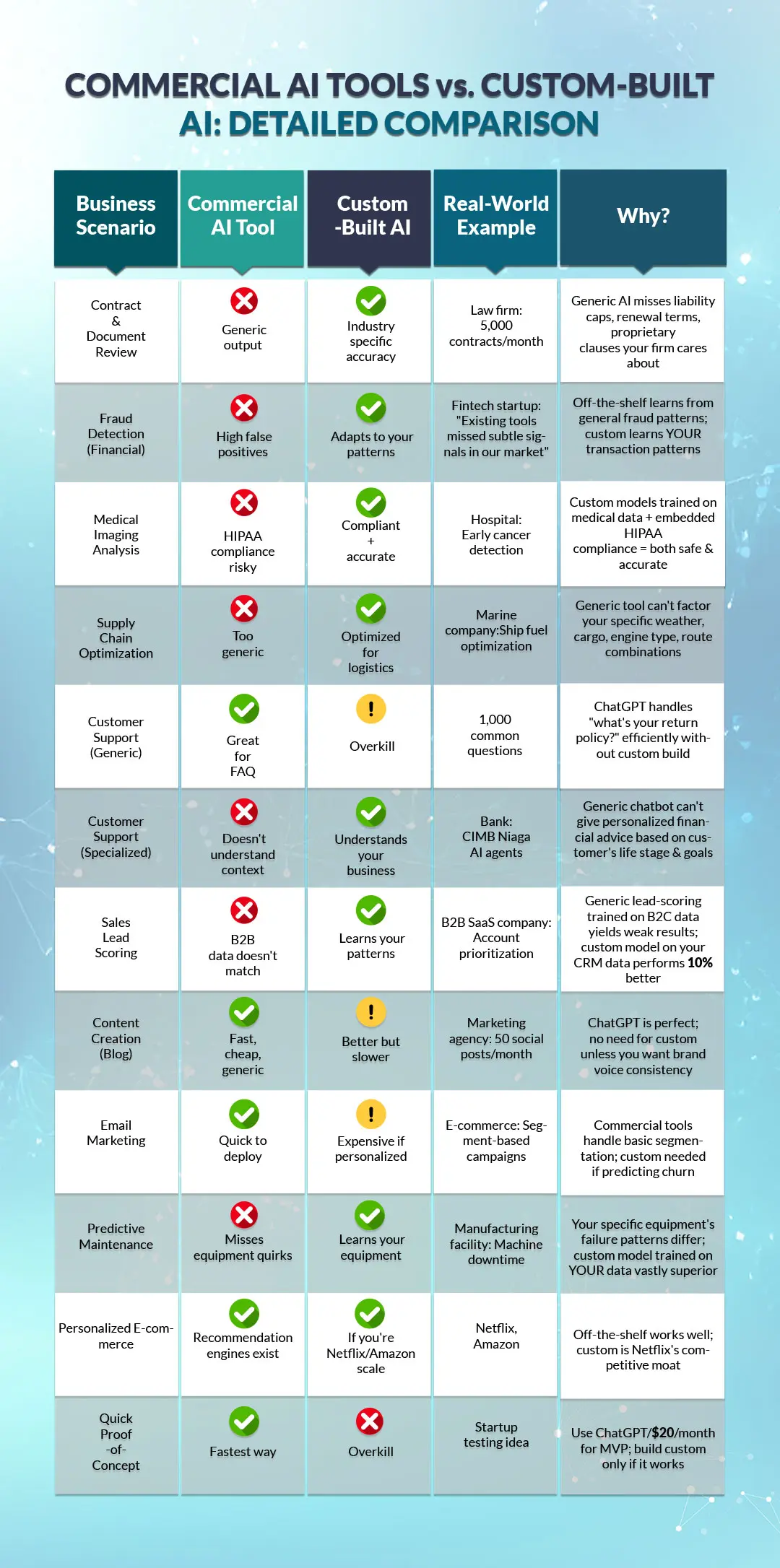
Commercially available AI tools are useful starting points, but they are rarely sufficient for organizations with complex workflows. A consultancy that works closely with a company's development teams can design and build custom AI applications that address the precise problems a business faces, rather than forcing operations to fit the constraints of a generic product.
This kind of tailored development is particularly valuable for organizations that handle large volumes of unique documents, proprietary data, or industry-specific processes. Furthermore, custom-built solutions can be designed to grow with a business, scaling as needs change without requiring a complete rebuild.
For instance, an organization that processes thousands of contracts each month can benefit far more from a purpose-built AI review tool than from a general writing assistant. Custom AI development ensures that the AI reflects the organization's own standards, terminology, and quality requirements rather than those of a third-party vendor.
2. AI/ML Integration with Legacy Systems and Enterprise Platforms
One of the most practical barriers organizations face is connecting new AI capabilities to older infrastructure. Legacy systems hold enormous amounts of institutional data and process history, but they were not built with AI in mind.
Pulling that data out, cleaning it, and routing it through modern AI pipelines requires both engineering depth and careful project management. AI development services that specialize in this kind of integration use API-first architectures and middleware solutions that bridge old and new without requiring full system replacements.
This approach protects existing investments while opening up new capabilities. It reduces disruption to daily operations during rollout, which matters enormously for large organizations where downtime is costly.
What this means in practice is that connecting large language models to existing systems—whether a CRM, ERP, or internal knowledge base—through retrieval-augmented generation pipelines and prompt engineering requires specialized expertise and a structured approach.
Rushing this step is one of the most common reasons AI integration projects run into trouble after deployment.
3. Mobile and Web Platforms That Bring AI to End Users
Generative AI creates the most value when end users—employees, customers, and partners—can access it through well-designed, reliable interfaces. An AI engine in the background is only useful if the surface it connects to is intuitive, fast, and built to handle real-world usage.
Engineering teams that deliver AI-powered mobile as well as web platforms do the hard work of translating powerful back-end capabilities into clean user experiences. In fact, they optimize for performance on every device, integrate real-time AI outputs without lag, and ensure that interfaces adapt as underlying models improve.
EY research highlights that AI-enabled solutions have delivered measurable gains for organizations. That includes a 20% improvement in recruitment efficiency and a 35% reduction in employee turnover in some deployments.
For example, organizations serving diverse customer bases across retail, health care, and logistics need platforms that scale reliably and maintain quality under heavy load, requirements that demand real engineering rigour.
4. Predictive Analytics and Intelligent Automation Across Functions
Generative AI is one piece of a larger intelligence picture. The organizations seeing the strongest returns pair it with predictive analytics, machine learning models, and intelligent automation. This covers the full cycle of generating insights, forecasting outcomes, and taking action with minimal manual effort.
Generative AI consulting companies that understand this broader picture help organizations think beyond the chatbot or content generator. They find out where automation can absorb repetitive tasks, where predictive models can sharpen decision-making, and where generative AI can accelerate creative and analytical work.
Building these interconnected systems requires expertise across multiple AI disciplines—from natural language processing and computer vision to reinforcement learning and anomaly detection.
Embracing generative AI in consulting allows organizations to streamline workflow, enhance operational efficiency, provide valuable insights for informed decision-making, and easily adapt to changing business environments. That kind of broad, compounding value is only possible when strategy, engineering, as well as ongoing support work together.
Generative AI growth for organizations is not something you achieve by downloading the right tool or running a one-time pilot. It is a deliberate process that requires sound strategy, strong data foundations, honest governance, and genuine engineering capability. Consultancies bring the experience and structure that organizations need to close the gap between ambition and real, measurable results. Sourcedesk works with organizations that want both the strategic clarity and the technical depth to make AI work in the real world—from custom application development and legacy integration to mobile platforms and predictive intelligence. If you are ready to move past the experimentation phase and build something that grows your business, taking the next step is worth it.
Frequently Asked Questions
Q1. What does a generative AI consultancy do for an organization?
A generative AI consultancy helps an organization move from curiosity to results in a structured, low-risk way. In practice, this means starting with an honest assessment of where the business stands today by looking at data quality, existing workflows, internal skills, and technology infrastructure.
From there, the consultancy builds a clear roadmap that identifies which AI use cases will deliver the highest return, in what order, and at what pace.
The key is helping clients recognize the immense potential of generative AI, helping them find the best fit for their specific context, and then building out that capability responsibly.
Beyond strategy, consultancies also support tool selection, integration, workforce upskilling, governance design, and ongoing measurement. The best partnerships do not end at delivery — they stay involved to refine and improve as the AI landscape and the organization's needs both continue to evolve.
Q2. How do I know if my organization is ready to work with a generative AI consultant?
Q3. How long does it typically take to see results from a generative AI consulting engagement?
Q4. What are the biggest risks of adopting generative AI without consulting support?
Q5. How do consultancies help organizations scale generative AI beyond the pilot stage?
Q6. How should an organization choose the right generative AI consulting partner?
Request a
Free Quote Today!


