


Table of Contents


When businesses want quick wins from digital marketing, they often turn to pay-per-click (PPC) advertising as their first choice. A retail business launching a new product line, for instance, can run a paid search campaign and start receiving targeted traffic within the same day—something that would take weeks or months through organic search alone.
What makes PPC particularly compelling in today's competitive digital landscape is the level of control it gives advertisers. Businesses can decide exactly who sees their ads, when those ads appear, how much they spend per day, and which geographic areas they target.
That degree of control is difficult to find in almost any other marketing channel. When managed correctly, PPC does not just drive traffic faster. It drives the right traffic, from the right people, at a cost that makes business sense.
What PPC Advertising Is and How It Works
Pay-per-click advertising is built on a simple exchange. A business creates an ad, sets a budget, and only pays when someone clicks on it. Those ads can appear in Google search results, across social media feeds, or on thousands of websites within display networks, wherever the target audience happens to be.
What makes this model financially attractive is that businesses are not paying just to be seen. Every dollar spent corresponds to an actual visitor who made a conscious decision to click. That is fundamentally different from traditional advertising, where a business pays for audience reach whether anyone responds to the message or not.
Why Speed Gives PPC a Clear Edge Over Other Digital Marketing Strategies
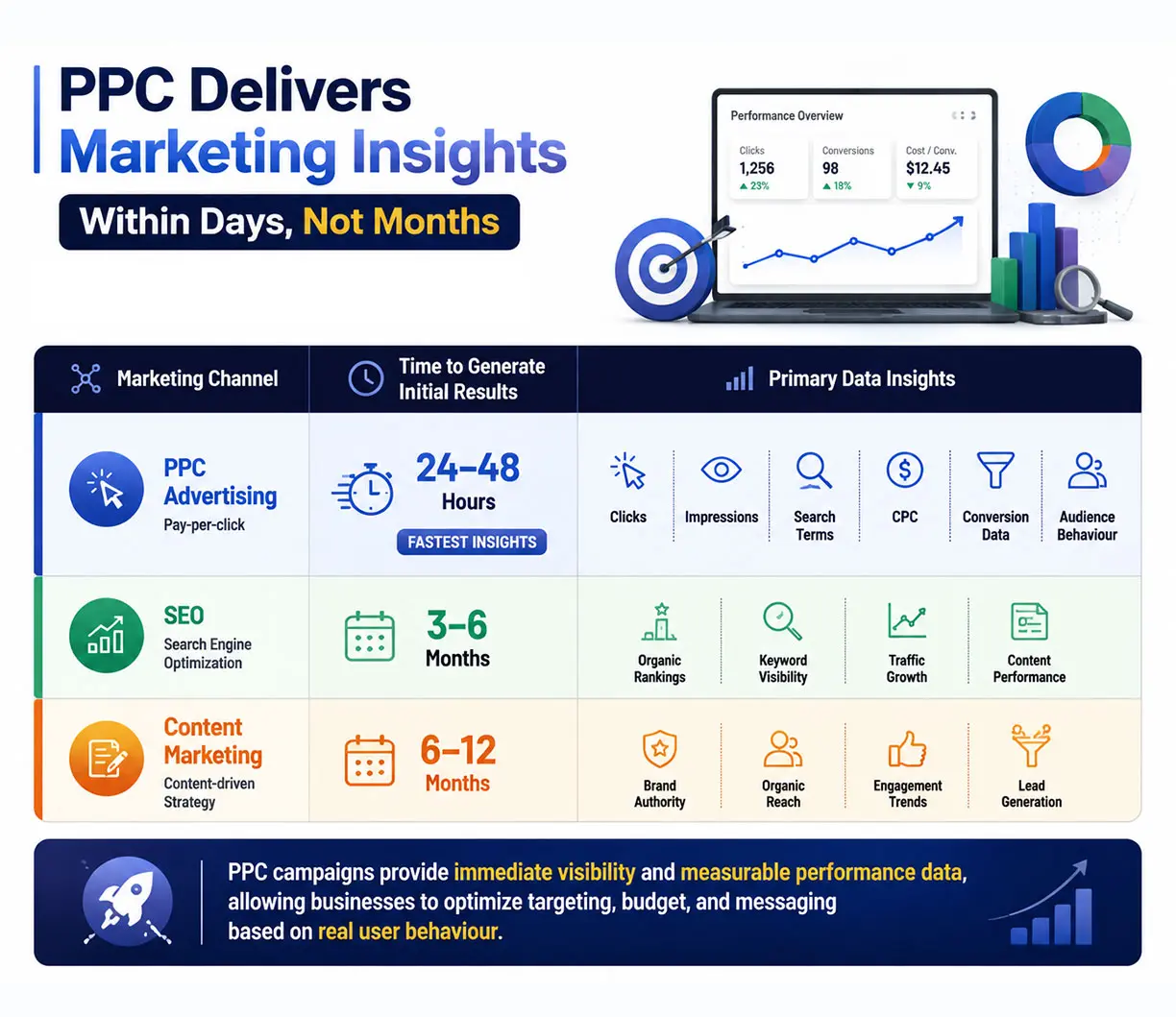
SEO is a long game by nature, where businesses invest heavily in content, build backlinks over months, and wait before they see meaningful search rankings take hold. PPC bypasses that waiting period entirely and places an ad in front of the target audience from day one.
With paid search campaigns, an ad can go live within hours of being created. The moment a campaign is approved by the platform, it starts competing for placement in relevant search results. That immediacy is something organic strategies cannot replicate, regardless of how well they are executed.
This speed advantage is particularly valuable in situations such as:
- Product or service launches where early visibility drives initial sales momentum.
- Seasonal promotions tied to specific calendar windows or shopping events.
- Businesses entering a new market and needing rapid brand awareness to compete.
- Event-driven campaigns with a strict deadline that organic rankings cannot meet.
Why Budget Activation Works in Real Time
Another reason why PPC produces fast results is that campaign budgets activate the moment a campaign goes live. There is no waiting period between launching a campaign and receiving data. Businesses start collecting clicks, impressions, and conversion information right away, and that data feeds directly back into campaign decisions.
This feedback loop is one of the most underappreciated advantages of paid advertising. Campaigns can be adjusted in real time based on what is working and what is not, making PPC one of the most responsive and agile marketing channels available.
How PPC Drives Targeted Traffic at Scale and Why It Matters
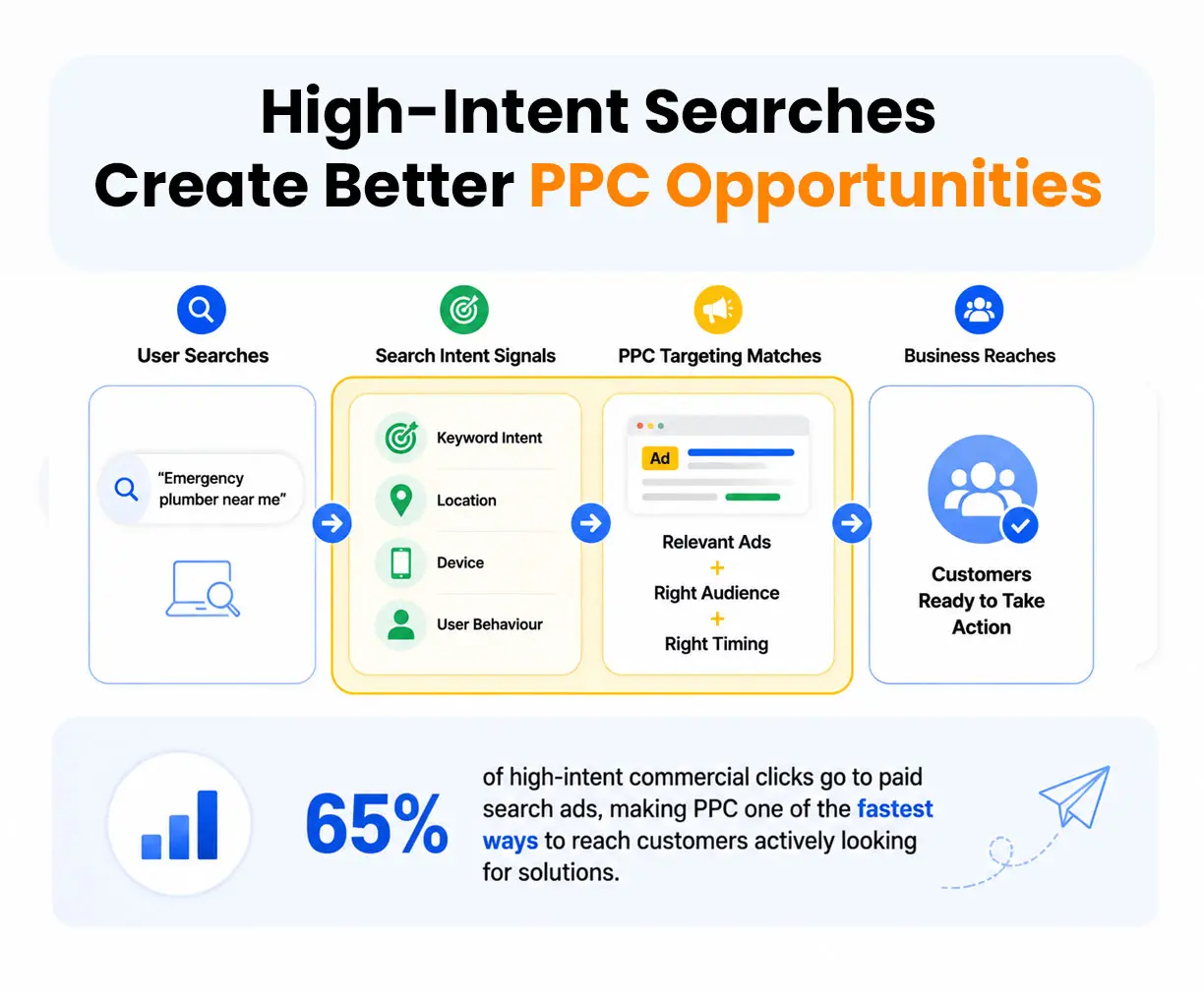
Getting traffic is one thing, but getting the right traffic from people who are already looking to buy is what separates a profitable PPC campaign from one that simply burns through budget.
Keyword Intent as the Foundation of Paid Search
One of the strongest arguments for pay-per-click advertising services is the ability to target users based on search intent. When someone types "emergency plumber near me" or "best accounting software for startups," they are already in buying mode and ready to act.
PPC places a business's ad directly in front of that person at that exact moment of intent. This kind of targeting is far more precise than most other advertising formats, which reach broad audiences regardless of their readiness to buy.
Keyword targeting in PPC works across three main levels:
- Broad match reaches a wider audience with searches related to a keyword, capturing more volume
- Phrase match targets searches that include a specific phrase in a recognizable order
- Exact match restricts appearances only to searches that match a keyword very closely
Understanding these match types helps businesses manage spend more efficiently while still capturing the high-intent traffic that drives conversions.
How Audience Targeting Extends Beyond Keywords
Modern PPC goes well beyond just keyword targeting. Platforms like Google Ads and Microsoft Advertising allow advertisers to layer demographic, geographic, device, and behavioural filters on top of their existing keyword strategy.
This added layer of control means a campaign is not just reaching people who searched the right words. It is reaching the specific type of person most likely to convert, based on who they are and where they are.
Why Landing Pages Are Just as Important as the Ads Themselves
Driving clicks is only part of what makes a PPC campaign successful. What happens after the click determines whether the campaign delivers meaningful results or simply consumes budget without producing returns.
A well-designed landing page created specifically for a campaign is significantly more effective than sending visitors to the website homepage, and the reason is the relationship between messages. Whenever the message of an ad campaign matches the one on the landing page, web users will think they came to the right place. Through this sense of continuity, they will make a move from just browsing to taking action.
High-converting landing pages consistently include several important elements:
- A clear headline that directly reflects the ad's core promise or offer
- Specific, tangible benefits rather than vague marketing language
- A single, focused call to action that tells the user exactly what step to take next
- Social proof in the form of testimonials, star ratings, or recognizable client names
- Fast loading speed, particularly on mobile devices where users have less patience
Businesses working with a team offering PPC campaign management services will often find that landing page strategy is built into the overall campaign plan from the start, rather than treated as a secondary concern.
How to Measure PPC Performance and Understand What the Numbers Mean
Traditional advertising channels like television, radio, and print offer very limited insight into what actually produces results. PPC works in the opposite way, with every click, impression, and conversion tracked and available for review at any time.
This transparency is what fundamentally separates PPC from older advertising formats. Businesses can see exactly where their money went, what it produced, and which parts of the campaign need adjustment. That accountability makes it far easier to justify ongoing investment and demonstrate marketing ROI to stakeholders.
The Key Performance Indicators Worth Monitoring Consistently
Understanding which metrics matter most helps businesses assess whether their investment is performing at the expected level.
Click-Through Rate (CTR) measures how often people click an ad after seeing it in search results. A higher CTR generally signals that the ad copy and targeting are well matched to what the audience is searching for.
Conversion Rate is the percentage of clicks that result in a desired action, whether that is a purchase, a form submission, or an inbound call. This is arguably the single most important indicator of campaign effectiveness because it measures what the traffic does after arriving.
Cost Per Acquisition (CPA) tells businesses how much they are spending to acquire each new customer or lead. Keeping CPA in line with the actual value of a conversion is central to running a profitable PPC campaign over the long term.
Quality Score is a metric Google assigns to each keyword based on ad relevance, expected CTR, and landing page experience. An increase in quality score can reduce the cost per click while simultaneously improving ad placement in results pages.
Return on Ad Spend (ROAS) expresses the revenue generated for every dollar invested in advertising. Many businesses use ROAS as the primary benchmark for deciding whether a campaign is worth scaling or restructuring.
Businesses that invest in professional PPC advertising services benefit from having these metrics monitored on an ongoing basis, with proactive adjustments made before small inefficiencies become expensive problems.
Understanding the Most Common Reasons PPC Campaigns Fail to Deliver Expected Results
Even businesses with reasonable budgets sometimes find PPC disappointing, and the cause is rarely the platform itself. It usually comes down to one of a handful of avoidable mistakes that compound over time if you don’t have consistent management in place.
The Issue with Excessively General Keyword Targeting
When the keywords used are overly broad, the ads reach customers who do not want to buy what the brand is selling. Hence, money is wasted on clicks which cannot result in sales and other conversions.
Good negative keyword management is an essential skill in PPC. It stops unwanted keywords from activating ads and ensures ads are shown to the audience most likely to take a significant action in response to the advertisement.
The Cost of Weak or Generic Ad Copy
An ad that says the same thing as every competitor in the same space will consistently struggle to earn clicks. Strong PPC ad copy speaks directly to the user's specific problem and makes a clear, compelling case for why this particular solution is worth choosing over the alternatives.
The most effective ads tend to be specific and concrete. An ad that reads "Same-Day Plumber — Fixed Pricing, No Surprises" gives the user a tangible reason to click, rather than an ad that says "Quality Plumbing Services" without any meaningful differentiation.
The Impact of Sending Paid Traffic to Generic or Unrelated Pages
When someone clicks an ad for a specific service and lands on a homepage with no clear connection to that service, the bounce rate climbs, and conversions drop sharply.
Every campaign benefits from a corresponding landing page that matches the ad's specific message or offer directly.
Why Unmanaged Campaigns Decline in Performance Over Time
PPC is not a passive strategy that can take care of itself without any management. PPC campaigns which are neglected for weeks will experience a decline in performance, as bids, competing companies' strategies, and search patterns change. Continuous management is not an option; it is the differentiating factor between successful campaigns and unsuccessful expenditures.
This is precisely why many growing businesses choose to partner with a pay-per-click management agency rather than managing campaigns internally alongside other marketing responsibilities. The ongoing optimization work is where most of the long-term value is actually generated.
How PPC and SEO Work Better Together Than They Do Apart
Some marketers treat PPC and SEO, or search engine optimization services, as competing priorities that require choosing one over the other. In practice, they work considerably better as a coordinated pair than as standalone strategies running in isolation.
PPC delivers immediate visibility while SEO builds organic authority over time. Data gathered from paid campaigns—like which keywords convert, which audiences respond most strongly, and which messages resonate—can directly inform and sharpen an SEO content strategy. The relationship runs productively in both directions.
Strong organic rankings for branded and category terms also reduce the risk of competitors capturing traffic through paid ads in the spaces a business should naturally own. Businesses that invest in both channels consistently see stronger overall performance than those focused exclusively on one approach at the expense of the other.
This is an important consideration for any business deciding how to distribute the budget of digital marketing activities effectively. Pay-per-click advertising services are not a substitute for organic search strategy. They work alongside it to cover the full customer journey from awareness through to conversion.
What Businesses Should Look for When Choosing a PPC Partner
Choosing the right team to manage paid campaigns has real financial consequences. The wrong partnership leads to wasted budgets and missed opportunities, while the right one accelerates growth in a measurable and repeatable way.
Several qualities consistently distinguish strong PPC management from average or poor performance.
- Transparency in Reporting: Any agency offering PPC campaign management services should provide clear, regular reporting that shows exactly what the budget produced and how performance is trending over time. Vague summaries and unclear attribution are warning signs worth taking seriously.
- Relevant Industry Experience: An agency that has managed campaigns in a business's specific sector will understand the competitive landscape, typical CPAs, and what messaging tends to connect with that audience.
- Consistent Testing Culture: Strong PPC management never stops experimenting with ad copy, audience segments, bidding strategies, and landing page variables. Campaigns that stop testing almost always stop improving.
- Clear, Plain-Language Communication: An agency that cannot explain its strategy in straightforward terms either lacks confidence in what it is doing or is not doing enough work to justify explaining it.
- Account Ownership Held by the Client: Businesses should always retain full ownership of their ad accounts. Some agencies operate accounts in their own names, which means clients lose all historical campaign data if they decide to change providers later.
Performance in PPC is measurable in real time, which means campaigns can be adjusted quickly based on actual data rather than assumptions. When a campaign proves profitable, increasing the budget tends to produce results in a predictable and proportional way. For businesses that want faster, measurable growth from their digital marketing investment, PPC advertising services offer a clear path forward. The speed, precise targeting, and transparent performance data make paid search one of the few channels where businesses can see exactly what their money is doing and make smarter decisions because of it.
Frequently Asked Questions
1. How quickly can a PPC campaign start generating results?
Most PPC campaigns begin generating traffic within 24 to 48 hours of launch, once the ad platform has approved the ads. That said, meaningful data for optimization purposes usually takes at least one to two weeks to accumulate, as smaller data sets can lead to premature conclusions about what is and is not working.
2. What distinguishes PPC advertising from display advertising?
3. How much should a business budget for PPC advertising?
4. Is PPC a suitable strategy for small businesses with limited marketing budgets?
5. How does partnering with a specialist agency improve PPC campaign outcomes?
Request a
Free Quote Today!


