Choosing an American custom software development service partner is not a small business decision. The company a business decides to hire may shape their product, their overall customer experience, internal workflow, and even their future prospects. A good team can turn a rough idea into a working platform. A weak team can leave you with missed deadlines, poor code, rising costs, and a product that is hard to maintain.
Many businesses start by searching for the best custom software development company in the USA. That is a good first step, but a polished website, a long list of services, or a few big client logos do not always prove that a company is the right fit for a specific project.
This guide explains seven important things to check before hiring a partner for an American custom software development service. It also covers red flags, cost ranges, contract points, legal issues, and common questions buyers ask before starting a project.
Let’s get started.
What Makes USA-Based Software Development Companies Worth Considering?
The USA has a strong software development market. Many companies there work with startups, growing businesses, and large enterprises. They are used to building products that need strong planning, clean design, secure code, and long-term support.
A USA-based team can also understand the specific business needs of companies operating within the U.S. faster, as they are more familiar with the domestic market and regulatory environment. They are more familiar with the domestic users, their buying habits, privacy rules, and the industry-specific standards (e.g., tech, finance, healthcare) that businesses must comply with.
This can save time during the project planning phase, helping define goals, timelines, and resources more effectively. It also reduces confusion during the development process, ensuring that the software or product aligns with user needs and regulatory requirements.
Benefits of Hiring USA-Based Firms
Working with a USA-based software company can make the project easier to manage. Some key benefits include:
- Clearer communication: There are fewer delays in explaining goals, changes, and feedback because of the same time zone, cultural alignment, and a shared understanding of local business practices and expectations.
- Familiarity with U.S. laws: Contracts, data privacy, and compliance issues are easier to handle.
- Stronger market understanding: The team already knows what U.S. users expect.
- Access to skilled talent: Many U.S. firms work with experienced developers, designers, and project managers.
- Easier in-person meetings: This helps when the project needs workshops or detailed planning sessions.
- Current technical knowledge: Many teams stay updated on cloud platforms, security practices, AI tools, and modern app development.
Common Pitfalls to Avoid During the Hiring Process
Hiring a USA-based company does not always mean that the hiring organization will get better results. One still needs to check the company carefully. Watch out for:
- Very high rates without clear value: A higher price should come with better planning, quality, and support.
- Hidden subcontracting: Some firms may pass work to outside teams without telling you.
- Rigid contracts: Some contracts make every small change expensive.
- Weak technical depth: A nice demo does not always mean the code is strong.
- Poor project visibility: You should know what is being worked on and when it will be done.
- No clear support plan: The company should explain what happens after launch.
The main goal is to carefully evaluate potential custom software development service providers, as not every domestic firm is worth the cost. The seven checks in this guide will help every business owner choose a team that can support their business and deliver real value.
7 Factors To Consider Before Signing a Contract with a Custom Software Development Company in the US
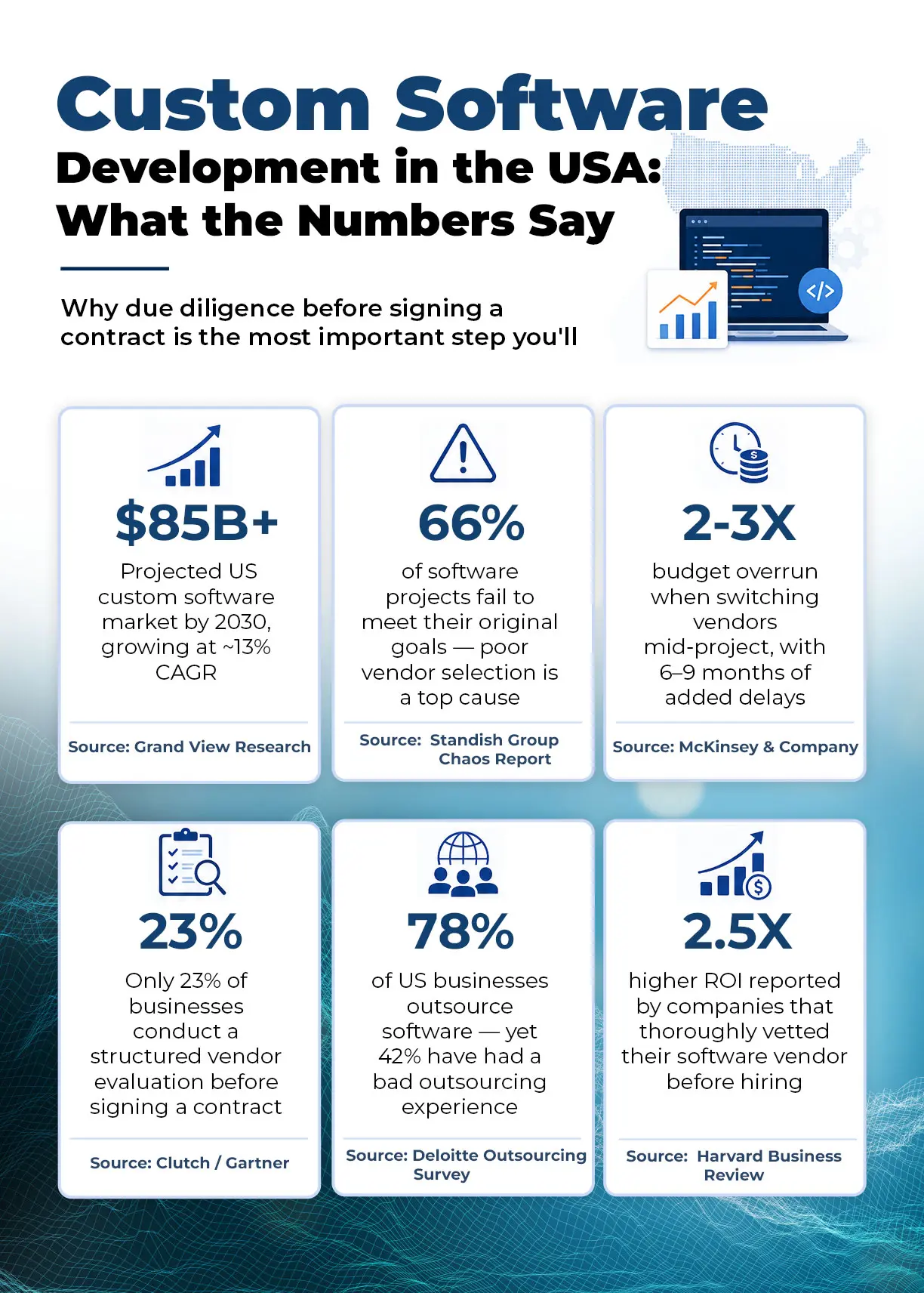
Let's explore each of these seven factors in detail to understand how US-based businesses can make strategic decisions in choosing the ideal custom software development company.
Verify Their Technical Expertise and Portfolio
A company may claim strong technical skills, but those claims need proof. A reliable American vendor should be able to show past work, explain its role, and describe the results clearly. If the answers sound vague, the buyer should be careful.
Review Real Case Studies and Success Metrics
Case studies should show more than screenshots, explaining what problem was solved and what changed after launch.
Look for:
- Clear project goals.
- Real business results.
- Recent work.
- Live product links or demos.
- Details about the company’s role.
Useful success metrics may include faster processing, fewer errors, higher user adoption, or lower operating costs. Old or unclear case studies are not enough to prove current skill.
Key Tech Stacks for a Specific Business Project
The right tech stack depends on the project. A mobile app may need Swift, Kotlin, Flutter, or React Native. At the same time, a data-heavy platform may need Python, PostgreSQL, AWS, or Azure.
A good vendor should explain why a certain stack fits the project. The answer should be simple and practical. Strong teams do not list every tool just to impress. They focus on what supports stable, scalable, and cost-effective custom software development solutions.
Red Flags to Watch Out for in Portfolios
Some portfolios look polished but reveal very little. Buyers should watch for:
- Stock images instead of real product screens.
- Client logos with no project details.
- No live links, demos, or walkthroughs.
- Old case studies with outdated tools.
- Same design style across many projects.
- Website-only work when the project needs complex software.
- No clear results or success metrics.
If several of these signs appear, the company may not have the depth needed for the project.
Assess Their Industry Experience and Niche Focus
Industry experience helps a vendor understand the project faster. A company that has worked in the same field will know common user needs, risks, workflows, and compliance concerns.
Does Their Experience Align with Your Sector?
The customer seeking custom software development services should ask which industries the custom software development service provider serves most often. A provider with deep experience in a few sectors may be more useful than one that claims to serve every market.
For example:
- Fintech projects may need payment security and fraud checks.
- Healthcare projects may need HIPAA knowledge.
- Education platforms may need student privacy controls.
- Logistics software may need tracking and routing experience.
The right partner should not learn the basics at the client’s expense.
Client Testimonials from Similar Businesses
Testimonials should come from similar businesses, not only large brands. A startup should look for feedback from other startups. An enterprise should look for enterprise-level proof. Reference calls can help confirm how the vendor handles delays, scope changes, and support.
Case Study Deep Dive
The customer seeking software development and consulting services should ask the vendor to explain one relevant project in detail. Useful questions include:
- What was the goal?
- What changed during the project?
- Was the budget managed well?
- What happened after launch?
Strong providers of software development and consulting services will answer honestly and clearly.
Evaluate Their Development Process and Methodology
A clear process keeps the project on track by controlling timelines, costs, feedback, testing, and launch planning.
Agile vs. Waterfall: Which Fits Your Needs?
The hiring company should ask the software development and consulting service provider how they manage development. Agile works well when the project may change during the build. It breaks work into short cycles, so the client can review progress often. Waterfall may work when the scope is fixed from the start. It is less flexible, so it may not suit apps that require frequent updates or are subject to rapid changes.
A good American provider of software development and consulting services should suggest the right method after understanding the project, not before.
The client should be able to see progress at any time. Common tools include Jira, Asana, ClickUp, Linear, Trello, and GitHub Issues.
The buyer should check for:
- Shared task boards.
- Regular updates.
- Clear bug tracking.
- Sprint reviews or demos.
- Written notes on blockers.
Note that silence from the development team during development is a warning sign.
Post-Launch Support Structure
Launch is not the end of the project. Bugs, updates, and user requests may come later.
The buyer should ask:
- Is support included?
- How fast are critical bugs handled?
- Is there a monthly support plan?
- Will the same team support the product?
- Are response times written into the contract?
A clear support plan reduces risk after launch.
Check Team Composition and Expertise Levels
A software project needs more than developers. It may also need a project manager, a UI/UX designer, a QA tester, a DevOps engineer, and a technical lead. The right size of team depends on the project’s size and complexity.
Developers, PMs, Designers: What Is the Right Mix?
The company looking for tailored software development solutions should ask who will work on the project and what each person will handle. A mid-sized project may need a:
- Technical lead
- Front-end developer
- Back-end developer
- UI/UX designer
- QA tester
- Project manager
One person handling too many roles can slow the project and increase mistakes. Therefore, the hiring company should also check each person’s experience levels, not just their job titles.
Remote vs. Onsite Capabilities
Remote work is common and can work well with the right communication and project management processes. The company should have clear systems for meetings, code reviews, updates, and file sharing.
The buyer should also ask:
- Where is the team located?
- Is any work outsourced?
- Can the team join onsite sessions if needed?
Turnover Rates and Retention
High turnover can hurt project quality. When team members leave, knowledge is lost. Strong providers of software development and consulting services keep teams stable and plan backups when needed. The buyer should ask if the same people can stay on the project from start to finish.
Understand Pricing Models and Total Cost Transparency
Pricing related to hiring a custom software development service in the US should be clear before the contract is signed. The buyer of these services should know what is included, what costs extra, and how changes will be billed.
Fixed-Price vs. Time & Materials
Most custom software development companies use one of these pricing models:
- Fixed price: Best for small projects with a clear scope. The cost is agreed up front.
- Time and materials: Best for projects that may evolve in scope, features, or requirements over time. The client pays for actual hours worked.
- Hybrid model: Best for phased work. The first phase may have a fixed cost, while later updates are billed hourly.
A good provider of software development and consulting services should explain which model fits the project and why.
Hidden Fees to Watch For
Companies looking for personalized software development solutions should ask for a detailed quote, not one large number, as extra costs may include:
- Hosting setup
- Third-party tools
- API charges
- Extra design revisions
- Weekend or urgent work
- Travel or onsite meetings
- Post-launch support
The contract should also explain change orders, clarifying how extra work is approved, priced, and added to the timeline. Clear pricing prevents later billing disputes.
Review Contracts, IP Rights, and Legal Compliance
A contract should protect the hiring company, the vendor, the product, and the data. It should be reviewed carefully before signing.
Essential Contract Clauses
It is non-negotiable to check for clear terms on:
- Source code ownership.
- Design and asset ownership.
- Confidentiality.
- Payment milestones.
- Change requests.
- Acceptance criteria.
- Termination terms.
- Data protection.
- Post-launch support.
The contract should state that the client owns the custom work after payment. It should also explain how the project will be handed over if the partnership ends.
USA-Specific Regulations
Software may need to follow different rules based on the industry. These may include HIPAA for healthcare, CCPA for California user data, GLBA for finance, and FERPA for education.
A provider of software development and consulting services should understand which rules may apply. The buyer should also ask about accessibility, security, and SOC 2 readiness if enterprise clients are involved.
Reference Checks
Before signing, the hiring business should speak with past clients and ask the following questions that are helpful in making an informed decision:
- Was the project delivered on time?
- Did the budget stay under control?
- Was support available after launch?
- Would they hire the vendor again?
Repeated concerns from references should not be ignored.
Gauge Communication, Culture, and Responsiveness
Since the vendor will be involved for weeks or months, it's important to assess communication early on. Slow replies, unclear answers, or poor follow-ups during the sales process can lead to bigger issues down the line.
The buyer should ask which tools the team uses for updates and daily communication. Common options include Slack, Microsoft Teams, email, Jira, Asana, and ClickUp.
Key things to check:
- How fast does the team reply?
- Are updates clear?
- Are meetings useful?
- Are action items shared after calls?
- Is there one main contact person?
Cultural Fit
A good vendor should understand the business, not just the feature list. The team should ask about users, goals, pain points, and long-term plans.
A strong provider of software development and consulting services should also handle questions calmly. If the team becomes defensive during early talks, the working relationship may become difficult later.
Response Time Mentioned in the Service Level Agreement (SLA)
Response times should be written in the contract. It is important to ask for clear terms, such as:
- Normal questions: within 24 hours
- Urgent project issues: within 4 hours
- Critical post-launch bugs: within 1–2 hours
Clear response rules help avoid confusion when problems need fast attention.
Red Flags to Watch Out for When Choosing
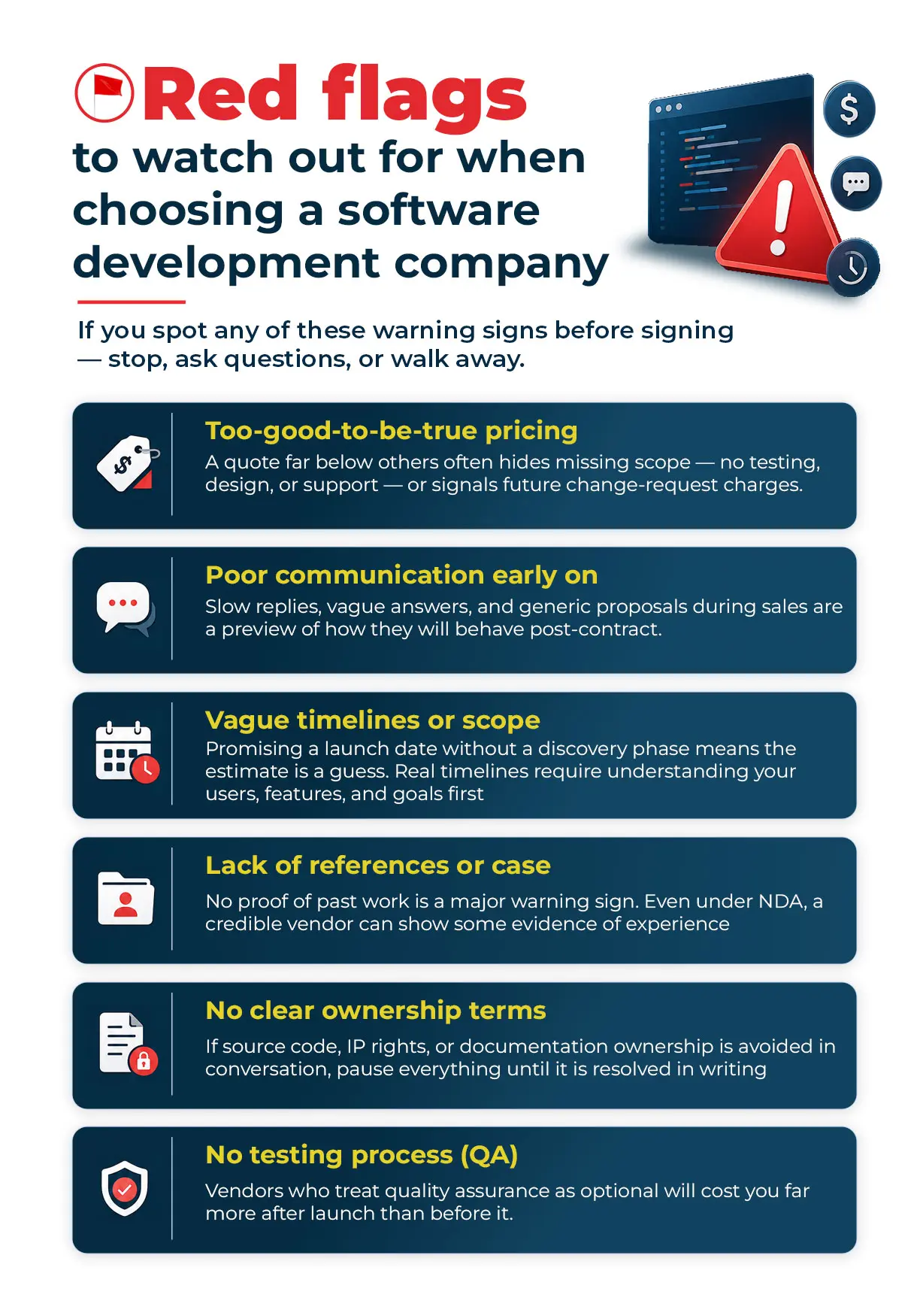
Selecting the ideal custom software development service also includes understanding some warning signs that may appear before the contract is signed. Do not ignore them.
Too-Good-to-Be-True Pricing
If one quote is far lower than every other quote, ask why. The vendor may have misunderstood the scope of the project. They may be leaving out testing, design, project management, or support. They may also plan to charge more later through change requests. Low pricing is not always bad, but unclear pricing is dangerous.
Poor Communication Early On
If the company is slow, vague, or disorganized during sales, it may be worse after the deal closes. Missed calls, unclear answers, and generic proposals are warning signs. A professional custom software development service should communicate clearly from the first meeting.
Vague Timelines or Scope
Be careful if a vendor promises a launch date without understanding the project. Real estimates require a discovery phase. The company should ask about users, features, integrations, data, compliance, workflows, and goals before giving a serious timeline.
Lack of References
A candidate who cannot provide references, case studies, or proof of past work may not be ready for your project. There may be valid reasons for confidentiality, such as not being allowed to disclose details of work done for previous clients. However, they should still be able to show some evidence of their experience.
No Clear Ownership Terms
If the vendor avoids questions about source code, IP rights, or documentation, pause the process. You need to know what you will own after the project ends.
No Testing Process
A vendor that treats quality analysts (QA) as optional is risky. Bugs are easier and cheaper to fix before launch than after users find them.
Choosing the right software partner in the US becomes easier when the company seeking software development assistance follows a clear checklist. Before signing, the client should review the candidate’s technical skills, industry experience, development process, team structure, pricing, contract terms, and communication style. A reliable custom software development service should offer clear answers, proof of work, fair pricing, strong support, and full ownership terms. Taking time to check these points early can prevent delays, budget issues, and poor-quality software later.


