


Table of Contents


Selecting an artificial intelligence (AI) and machine learning (ML) development partner has become one of the more consequential decisions a business can make in the current technology landscape. For many businesses, it can shape how they work, how they serve customers, and how they use data for years.
Nowadays, every company seems to claim it can build smart systems, automate work, improve decisions, or help you move faster. Some of those companies are genuinely skilled, whereas others know how to sound impressive but may not be ready to handle a serious AI or machine learning project.
This is why business leaders need to look beyond mere sales pitches. A good AI/ML development service provider should not simply write code. A proficient team understands the business, studies business-specific data, and builds systems that a company can actually use. On the contrary, the wrong partner will waste your budget, delay plans, and leave business owners with a model that looks good in a demo but fails in real life.
This guide explains the most important questions to ask before signing a contract with an AI/ML development company in the USA. These questions will help you understand how a vendor thinks, how experienced the team really is, and whether they can support your business beyond the first version of the product.
What Is AI/ML Development in Simple Terms?
AI/ML development is the process of building software that can learn from data and use that learning to make predictions, find patterns, automate tasks, or support better decisions. AI is the broader idea of making software act in ways that seem intelligent. Machine learning is a part of AI. It focuses on systems that improve by learning from data instead of being programmed with every possible rule.
For example, a normal software system may be told, “If a customer has not ordered in 90 days, mark them as inactive.” A machine learning system may look at thousands of past customers and learn which signs usually come before a customer stops buying. It might consider order history, support tickets, website behaviour, location, seasonality, and many other factors. Then it can predict which customers are most likely to leave.
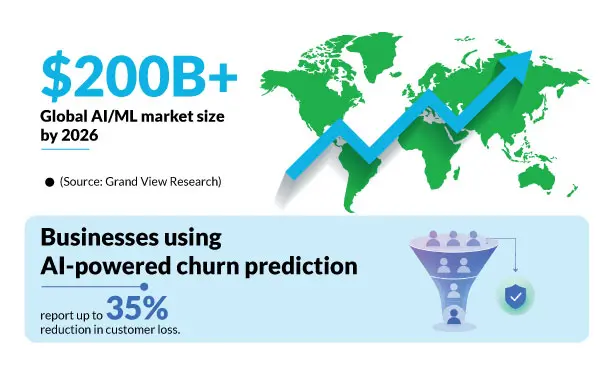
AI/ML development services can provide a myriad of solutions. Common examples include chatbots, recommendation engines, fraud detection tools, demand forecasting systems, customer churn prediction, computer vision software, natural language processing tools, generative AI applications, and predictive analytics dashboards. Each type of business and project has different needs, so it is important to choose a company that understands the specific use case.
Ask These 8 Questions Before Signing a Contract with an AI/ML Development Company
The best time to avoid problems is before the contract is signed. Once the project starts, misunderstandings become harder and more expensive to fix. The questions below will help you understand whether a company is a good fit for your project, your budget, your data, and your long-term goals.
1. Do They Understand the Business Problem Before Talking About Technology?
A serious AI/ML development company will not begin by pushing a specific tool, model, or platform. They will first try to understand the specific business problem. This is one of the clearest signs of dealing with a thoughtful partner rather than a team that only wants to sell development hours.
Good vendors ask practical questions. Some are like: What problem are you trying to solve? Who is affected by it? How is the work done today? What happens if the problem is not fixed? What result would make the project worth the investment? These questions may sound basic, but they are essential.
Many AI projects fail because the wrong problem was chosen. A company may build a model that is technically impressive but not useful in daily work. For example, a model may predict which customers are likely to leave, but if your team has no process for contacting those customers quickly, the prediction does not create much value. The issue is not the model but that the business process was not considered.
A strong development partner will connect the technical solution to real business action. They will ask what your team can do with the prediction, alert, recommendation, or automation once it is produced. They will also ask about limits such as budget, staff capacity, compliance rules, customer experience, and existing software.
2. How Can You Verify Their Real AI Development Experience?
Almost every AI/ML development company says it has experience. The real question is whether that experience matches your project. A polished website, a few logos, and broad claims are not enough. You need proof that the team has handled similar problems before.
Business owners can start by asking for specific project examples. Do not only ask whether they have worked in your industry. Instead, ask whether they have solved problems with similar data, similar technical difficulty, and similar deployment needs. A company that built a basic chatbot may not be the right fit for a complex fraud detection system, while one that created a small proof of concept may not have experience running models at enterprise scale.
The way they answer will tell you a lot about their experience. Experienced teams usually speak in clear, concrete details, explain trade-offs, and the course of work that changed in their past projects. Whereas less experienced teams often speak in general terms and avoid specifics.
What Certifications or Credentials Should an AI/ML Development Company Have?
Certifications can indicate a company’s technical and operational maturity. Here are the key certifications and credentials to consider:
- Cloud Certifications (e.g., AWS Certified Machine Learning, Google Cloud Professional Machine Learning Engineer, Microsoft Azure AI Engineer)
- Platform Partnerships (e.g., AWS Partner, Google Cloud Partner, Microsoft Solutions Partner)
-
Security and Compliance Certifications:
- SOC 2 Type II
- ISO/IEC 27001
- HIPAA (for healthcare projects)
- GDPR and CCPA readiness
- Academic Credentials that include graduate degrees, published research, or open-source contributions for advanced projects.
While certifications are helpful, it is important to thoroughly evaluate the company's experience, technical expertise, and ability to communicate effectively.
3. How Do They Evaluate Their Technical Capability?
Good technical teams can explain trade-offs in simple language. They can tell why a complex model may not always be better than a simpler one and explain why model accuracy alone may not be the right success measure. They can also describe how they would handle missing data, biased data, changing data, and unusual cases.
Production experience is especially important here. Building a demo is easier than building a system that works every day in a real business. A production AI system may need data pipelines, APIs, user interfaces, cloud infrastructure, logging, monitoring, security controls, version tracking, and rollback plans. The vendor should understand all of these pieces.
Business owners can ask about MLOps, which refers to the practices used to manage machine learning systems after they are built. A capable company should know how to track experiments, manage model versions, monitor model drift, retrain models, test updates, and recover from failures. If the vendor only talks about model training and not about deployment or maintenance, that is a warning sign.
4. What Engagement Models Does the AI Development Company Offer?
The engagement model affects cost, flexibility, risk, and control. Before signing, make sure to understand how the company charges and how the project will be managed.
A fixed-price model means the vendor agrees to deliver a defined result for a set price. This can work when the scope is very clear. For example, a small proof of concept with limited features may fit this model. The challenge is that AI projects often change once the team studies the data. If the data is weaker than expected or the first model does not work well enough, the scope may need to change. In a fixed-price contract, this can lead to disputes or rushed work.
A time-and-materials model means business owners pay for the actual time the team spends in production. This allows more flexibility, which is useful for AI/ML projects where discovery is part of the work. The downside is that costs can grow if the project is not managed carefully. To reduce this risk, ask for regular progress reports, budget tracking, sprint planning, and clear approval points.
A hybrid model combines both approaches. For example, the vendor may offer a fixed-price discovery phase followed by time-and-materials development. This can be a practical structure because the first phase helps both sides understand the problem before committing to full development.
Some vendors may offer outcome-based pricing, where payment depends partly on business results. This is less common in AI development because results can be affected by many things outside the vendor’s control, such as sales execution, customer behaviour, or internal adoption. It can work for narrow use cases, but the terms must be very clear.
The best vendors do not force one model on every client. They explain the pros and cons and help you choose based on your goals, project clarity, internal team strength, and risk tolerance.
5. What Does the Onboarding Process Look Like?
Onboarding is the first stage after choosing an AI/ML development service provider. It may not sound exciting, but it can decide whether the project starts smoothly or becomes messy from the beginning.
A good onboarding process usually starts with discovery meetings. These should include business leaders, technical teams, operations staff, and the people who will use the final system. If only executives are involved, the vendor may miss important details about daily work. If only technical staff are involved, the business goal may not be clear enough.
Data assessment should happen early. The team needs to know what data exists, where it is stored, who owns it, how clean it is, and what restrictions apply. Sometimes companies discover that important data is missing or difficult to access. It is better to find this out early than halfway through development.
In addition to this, project governance should also be set during onboarding. This means deciding who approves changes, who attends meetings, how often updates are shared, how risks are reported, and what happens when decisions are delayed. In short, AI/ML projects need regular communication because the work often involves uncertainty, which clear governance can prevent.
6. What Ongoing Support Do They Provide After Launch?
AI/ML development does not end when the system goes live. In many ways, launch is only the start of the next phase. The system must be watched, improved, updated, and supported.
Model monitoring is one of the most important support services. A model can lose accuracy when real-world data changes. This is called model drift. For example, customer behaviour may change after a price increase, a new competitor, a seasonal shift, or a change in the economy.
A good vendor will monitor both technical and model-specific metrics. Technical metrics include uptime, response speed, error rates, and system availability. Model metrics may include prediction patterns, input data changes, confidence scores, accuracy checks, and alerts when behaviour looks unusual.
Retraining is another key part of support. Many models need to be updated with new data. The right retraining schedule depends on the use case. A recommendation system may need frequent updates. A predictive maintenance model may need updates less often. The vendor should help you decide the right schedule and explain who is responsible for retraining.
Post-launch support given by a professional AI/ML development company includes bug fixes, security patches, dependency updates, and infrastructure maintenance. AI systems use libraries, APIs, cloud tools, and data pipelines that change over time. If these are not maintained, the system can become unreliable or insecure.
7. How Do They Handle Data Security and Confidentiality?
AI/ML projects often require access to sensitive data. That may include customer records, financial information, healthcare data, employee details, product data, operational data, or confidential business documents. Before sharing anything, you need to know how the vendor protects it.
The contract should clearly cover policies like data ownership, confidentiality, permitted use, breach notification, data retention, and deletion after the project ends. The vendor should not be allowed to use your data for unrelated purposes unless you specifically agree. Be careful if a vendor wants broad rights to reuse your data, train its own products on it, or share it with third parties.
Operational security matters too. A company may have good tools but weak habits. Ask how they secure employee laptops, how they handle staff departures, how they train team members on security, and whether they have an incident response plan. If something goes wrong, then you need to know how quickly they will tell you and what steps they will take.
8. How Do They Measure Model Performance and Business Success?
Many vendors talk about technical metrics such as accuracy, precision, recall, F1 score, and area under the curve. These metrics can be useful, but they do not always tell the whole story. A model can score well on a technical test and still fail when it comes to helping the business.
Before the project starts, ask how success will be measured. A good vendor will connect model performance to business results. For a churn prediction project, success may mean reducing customer loss. For a fraud detection system, it may mean lowering fraud losses without blocking too many legitimate customers. For a document automation tool, it may mean reducing manual review time while keeping errors low.
The vendor should also help you set a baseline that shows how the current process performs before the AI system is added. Without a baseline, it is hard to prove improvement. For example, if your team currently reviews invoices in three days and the new system reduces that to one day, the value is clear. If no one measured the old process, the result is harder to defend.
The team should also explain how performance will be tracked after launch. Real-world results may differ from test results. Users may behave differently than expected and data may change. The model may need adjustment. Success measurement should continue after deployment, not stop at launch.
A mature AI/ML development company will not hide behind technical scores. On the contrary, it will help business owners to understand whether the system is creating real value.
Who Owns the AI Model and Data After the Project Is Complete?
Ownership should be clearly defined in the contract. Key points to address include:
- Data Ownership: Your company should retain ownership of all provided data, including raw, cleaned, and confidential information. The contract should specify ownership of any new datasets created from your data.
- Model Ownership: If the model is custom-built for a business, then owners or dedicated team members should own it or at least have full usage rights. Some vendors may retain ownership and license the model to you. Make sure this is clear before signing.
- Code Ownership: Custom code created for a project generally belongs to that particular business owner, but vendors may use their own frameworks or reusable tools. Also, clarify what can be modified or used after the project ends.
- Model Outputs: Ensure the contract specifies ownership of the system's outputs (e.g., predictions, recommendations, reports).
- Lessons Learned: Vendors can apply general experience, but they should not use your confidential data or proprietary processes for other clients or competitors.
Ensure that all ownership and usage rights are explicitly covered in the contract to avoid future disputes.
Understanding the Difference Between an AI Development Company and a Software Development Company
AI/ML development companies and traditional software development companies have different focuses. It is important to understand the differences to make sure you pick the right partner for your project. Here’s a simple comparison to help you understand their key differences:
| Basis of Difference | AI Development Company | Software Development Company |
|---|---|---|
| 1. Core Nature of Output | Builds systems that learn from data and produce variable results. | Builds systems with fixed logic that produce the same output every time. |
| 2. Primary Skill Composition | Focuses on data scientists, machine learning engineers, and researchers. | Focuses on software engineers, developers, and QA testers. |
| 3. Approach to Problem Framing | Explores if a problem can be solved using available data. | Gathers specifications and builds based on requirements. |
| 4. Dependence on Data | Heavily relies on quality and quantity of data for results. | Doesn't need prior data; works with defined business rules. |
| 5. Development Lifecycle | Iterative and experimental, with multiple model tests before production. | More linear, with design, development, testing, and deployment phases. |
| 6. Testing and Validation Methods | Validates using metrics like precision, recall, and fairness. | Uses unit tests and clear pass/fail criteria for code. |
| 7. Tooling and Technology Stack | Uses specialized tools such as TensorFlow, PyTorch, scikit-learn, Hugging Face, MLflow, Weights & Biases, feature stores, vector databases, and GPU-optimized infrastructure for training and inference. | Uses general-purpose stacks built around languages like Java, Python, JavaScript, C#, and frameworks such as React, Angular, Spring, .NET, and Django, paired with relational or NoSQL databases. |
| 8. Infrastructure Requirements | Requires high-compute environments, often involving GPUs or TPUs for training, scalable inference servers, and pipelines for data ingestion, feature engineering, model serving, and monitoring drift over time. | Requires standard cloud or on-premises infrastructure, with web servers, application servers, and databases. Compute requirements scale with user load rather than with model training cycles. |
| 9. Maintenance and Post-Launch Behaviour | Demands continuous monitoring, periodic retraining, and active management of model drift, since real-world data patterns shift over time and degrade model accuracy if left unattended. | Requires bug fixes, security patches, and feature updates, but the core logic remains stable until intentionally changed. A deployed application can run for long periods without performance degradation on its own. |
| 10. Predictability of Outcomes | Outcomes are uncertain until data is explored. | Outcomes are predictable once requirements are clear. |
| 11. Risk Profile | High technical risk as models may not perform as expected. | Lower risk, as the problem is usually well understood. |
| 12. Pricing Structure and Cost Drivers | Pricing depends on data preparation, experimentation, and compute needs. | Pricing depends on feature scope, complexity, and developer time. |
| 13. Compliance and Ethical Considerations | Must address bias, fairness, and explainability. | Focuses on data privacy and security compliance, but no ethical concerns about outputs. |
| 14. Type of Talent and Compensation | Talent is highly paid, with data scientists and ML engineers in demand. | Talent is more widely available, with standard software development skills. |
| 15. Long-Term Client Relationship | Relationships often extend to ongoing model monitoring and updates. | Relationships often end after delivery, with lighter maintenance. |
How Much Does It Cost to Hire an AI/ML Development Company in the USA?
The cost of hiring an AI/ML development company in the USA can vary a lot. It depends on the project size, data quality, technical needs, and the company’s experience.
Smaller firms or independent experts may charge $75 to $125 per hour for basic AI work or small projects. Mid-sized companies often charge $150 to $250 per hour. Larger firms and top consulting companies may charge $300 per hour or more.
For projects, a small proof of concept may cost $25,000 to $75,000. A full production-ready AI system can cost $100,000 to $500,000 or more. Very large enterprise projects may cost much more, especially if they need heavy data work, strong security, and long-term support.
However, the exact price depends on what business owners need and how complex the project is.
What Hidden Costs Should Business Owners Look For?
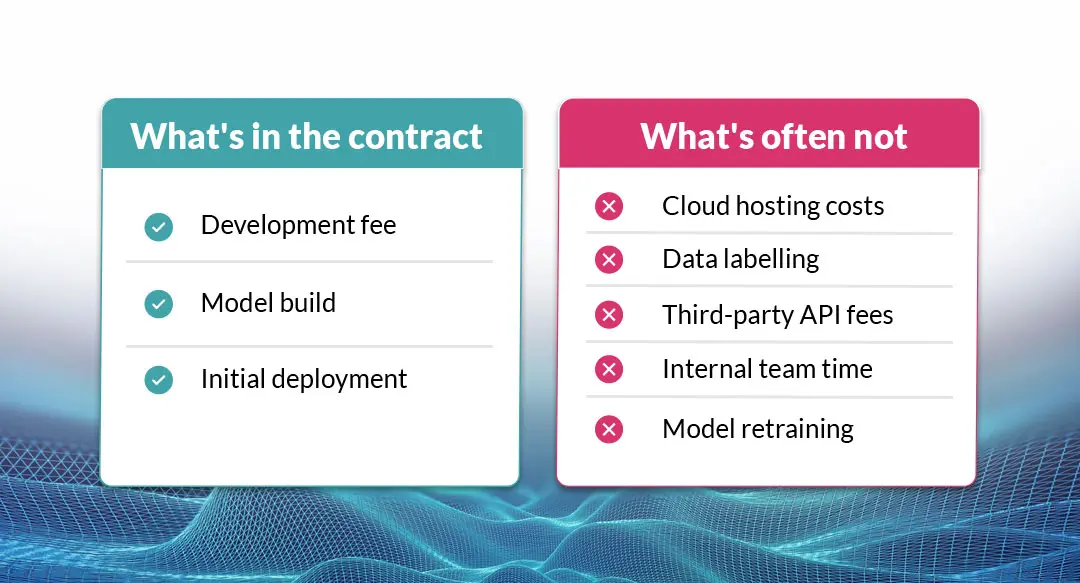
AI ML projects often include additional costs beyond the contract price. Key hidden costs to watch for include:
- Cloud Infrastructure Costs: Expenses for powerful computers, storage, hosting, APIs, and model inference. Clarify whether cloud costs are included or billed separately.
- Data Preparation: Costs for cleaning, organizing, and labelling data, especially for large or messy datasets.
- Third-Party Tools and APIs: Recurring fees for external services, such as paid model APIs, data providers, or security tools.
- Internal Time: Costs for employee involvement in meetings, data access, testing, and training.
Ensure the vendor outlines all potential costs, including development, cloud usage, data labelling, maintenance, and support, to avoid surprises later.
What Red Flags Should You Watch for When Choosing an AI Development Company?
It is recommended to watch for these warning signs:
- Promises of Specific Accuracy: Avoid vendors who guarantee high accuracy without understanding the data and business problem. True experts explain that performance depends on evidence.
- Avoidance of Past Failures: If a vendor claims everything always goes smoothly, they may not be sharing the full story. Every project has challenges.
- Vague Answers: Be cautious if the vendor cannot answer specific questions clearly, such as handling model drift or data security.
- Hidden Subcontracting: Watch out for vendors who outsource most of the work to unknown teams. Make sure you know who is doing the work and where they are located.
- High-Pressure Sales Tactics: Be wary if the vendor pushes for quick decisions or warns of rising prices. AI projects need careful planning.
- Unclear Contract Terms: Avoid vendors who resist clear terms on data ownership, confidentiality, or support responsibilities.
- Lack of Post-Launch Support: Be cautious if the vendor treats the launch as the end of your partnership. AI systems require ongoing monitoring and maintenance.
- Poor Communication: Slow or disorganized communication during the sales process can indicate problems later on. Strong communication is crucial for project success.
Choosing the right AI/ML development company is critical for a business’s success. The ideal partner will bring technical expertise, understand the business needs, explain risks clearly, and offer ongoing support. By asking the eight key questions in this guide, businesses can ensure they select a vendor that aligns with their goals, protects data, and delivers measurable results. A careful evaluation upfront will help avoid costly mistakes and ensure lasting value from AI and machine learning investments.
Frequently Asked Questions
1. What should I look for when hiring an AI/ML development company?
Look for a company that understands your business problem before suggesting a technology. The team should have experience with similar projects, strong technical skills, clear communication, good security practices, and a realistic view of what AI can and cannot do. Ask for references, examples of past work, and details about the people who will work on your project. Also, check whether they offer support after launch, because AI/ML systems need monitoring and updates over time.
2. Should I hire a local AI development company or work with a remote team?
3. Do AI/ML development companies charge hourly or per project?
4. What happens if the AI model does not perform as expected after delivery?
5. Is it safe to share my business data with an AI development company?
Request a
Free Quote Today!


