


Table of Contents


The potential of AI software is extensive, and developing it from scratch allows businesses to unlock its full capabilities. With custom AI solutions, companies can expand their operations, automate daily tasks, and gain deeper insights into customer behaviour. Moreover, building AI software dedicated to specific business goals not only solves immediate problems but also positions organizations for long-term success.
This guide outlines the steps involved in developing AI software from the ground up. The approach of building it from scratch gives businesses the tools to create efficient and powerful AI-driven solutions.
Let’s understand how beneficial it is for a business looking for an AI software development company to bring their AI vision to life.
Understanding the Need for AI Software
AI is evolving rapidly, with applications spreading across fields such as healthcare, finance, and logistics. Companies that integrate AI solutions into their processes, such as R&D and marketing, are making unprecedented gains, including better user experiences and fewer operational errors. These solutions not only help strengthen their market position but also enable restructuring operations and the delivery of more personalized experiences to their customers.
The Importance of AI in Today’s Tech Landscape
AI isn’t just a trend—it is now a transformative force in the tech landscape. Companies are harnessing their power to automate tasks, make forecasts, and enhance strategic decision-making. For instance, Netflix uses AI to personalize programming recommendations for its users, while the car company Tesla uses AI to drive its autonomous vehicles. These real-world examples highlight the potential AI holds for businesses aiming to stay ahead of the curve.
However, developing custom AI software requires both expertise in machine learning (ML) and a deep understanding of the specific problem that the software will solve. It involves a systematic set of steps to build the solution from scratch, delivering the desired results.
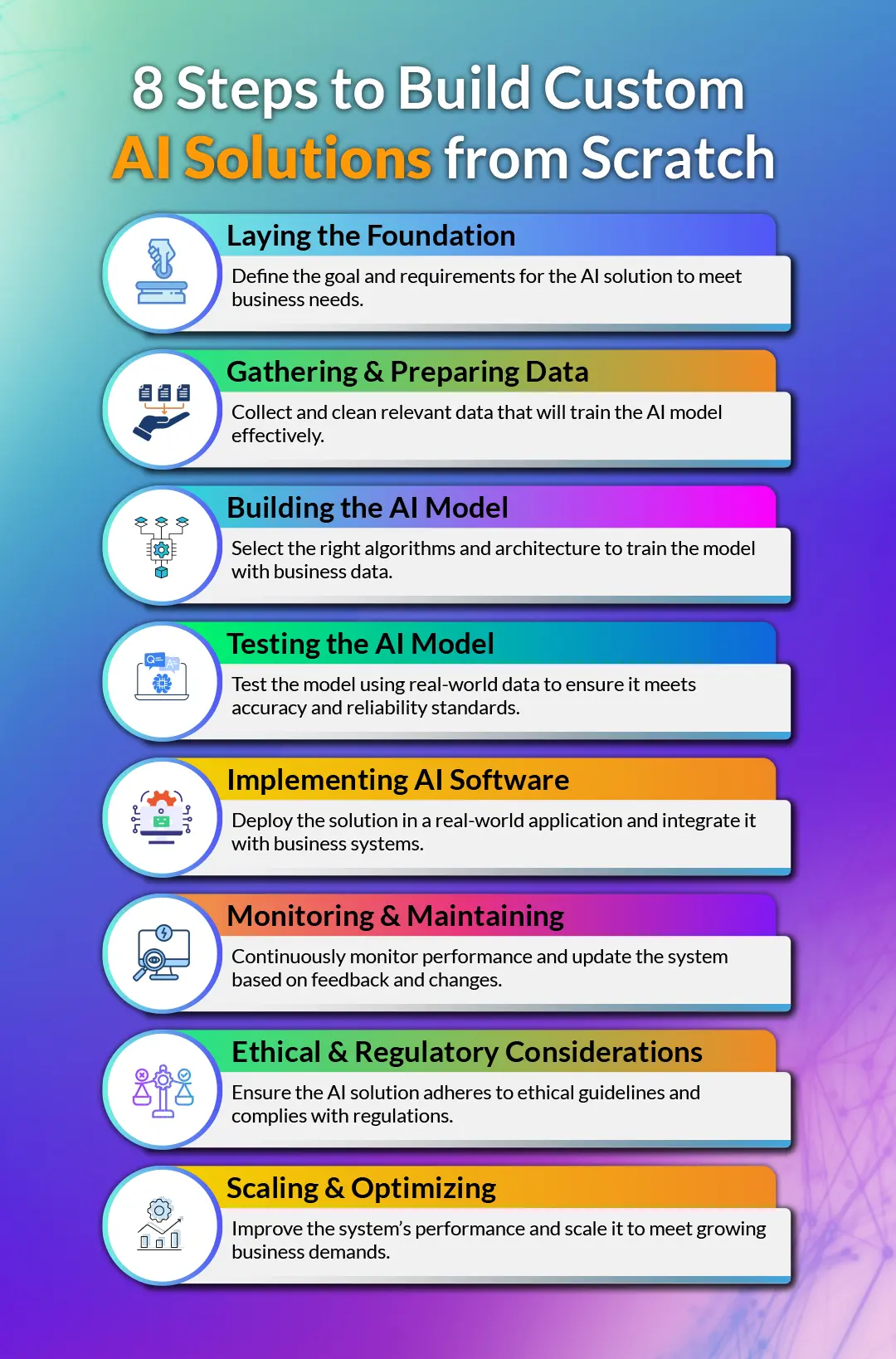
8 Steps to Build Custom AI Solutions from Scratch
Building custom AI solutions from scratch requires a systematic approach for the end product meets your specific business needs. These steps involve everything from problem definition and selecting the right algorithms for data collection, model training, and deployment.
Step 1: Laying the Foundation for Custom AI Software
Before starting to code, developers need to lay the fundamentals for AI development. This includes choosing the right development environment, selecting appropriate machine learning and AI algorithms, and understanding them to use them effectively.1. Choosing the Right Development Environment and Tools
Custom AI software development requires the right tools and environment to deliver an efficient, scalable solution. Some of the most popular development frameworks include TensorFlow, PyTorch, and Keras. These tools provide pre-built models, libraries, and functions to speed up development. Furthermore, many AI software development companies use cloud services such as AWS, Azure, and Google Cloud for scalability and flexibility.
Popular AI Development Frameworks and Libraries
- TensorFlow: A popular open-source library that supports deep learning and machine learning tasks.
- PyTorch: It is known for its adaptability and ease of use, particularly in research and prototyping.
- Scikit-learn: It is used for machine-learning algorithms and data preprocessing.
Essential Development Tools for AI Projects
- Jupyter Notebooks: An open-source web application used for creating and sharing documents with live code.
- Anaconda: A Python package manager that streamlines the development process for AI projects.
- GitHub: A tool for managing code versions and enabling collaboration between developers.
2. Grasping the Fundamentals of Machine Learning and AI Techniques
AI software development relies on various algorithms, with machine learning being a central component. Machine learning helps models learn from data. Some common machine learning algorithms are supervised and unsupervised learning, and reinforcement learning.
Supervised vs. Unsupervised Learning
- Supervised learning involves training models with labelled data (e.g., classifying images).
- Unsupervised learning involves training models with unlabeled data (e.g., clustering similar data points).
Reinforcement Learning: A Brief Overview
Reinforcement learning involves training models through rewards and penalties. It is used in systems such as self-driving cars and game AI, where agents learn by interacting with their environment.
Step 2: Gathering and Preparing Data
Data is the fuel for AI. The quality and quantity of the data directly affect the performance of the AI model.
1.Data Collection and Sourcing
Businesses can source data from open datasets, customer interactions, sensors, or other third-party vendors. It is essential to understand what data—open or custom—one needs based on their problem and how to access it.
Open Datasets vs. Custom Datasets
- Open Datasets: Many public datasets are available for AI training. For example, websites like Kaggle offer thousands of datasets across various domains.
- Custom Datasets: When specific data isn’t publicly available, businesses may need to create or purchase datasets.
2. Data Preprocessing Techniques
Once data is collected, it must be cleaned and prepared for model training.
- Cleaning Data for AI Training
Cleaning data includes removing duplicates, handling missing values, and correcting errors in the dataset. This phase can significantly influence the model's overall effectiveness. - Data Normalization and Transformation
Data normalization ensures that all features are on a similar scale, improving the model's efficiency. Transformation techniques such as log transformations can also help with scaling data.
3. Labelling Data for Supervised Learning
For supervised learning, data must be labelled, which means assigning a target value to each input in the dataset. For instance, labelling images as “dog” or “cat” is a typical example of image classification.
Step 3: Building the AI Model
With data in hand, it is time to start building the AI model as planned.
1. Selecting the Right Algorithm for the AI Application
Picking the right algorithm is essential for achieving success in any custom AI project. Depending on their business needs, developers might opt for algorithms like neural networks, support vector machines, or random forests. A AI development service provider can offer better guidance in selecting the algorithm that best aligns with your business objectives.
Understanding Model Types (Neural Networks, Decision Trees)
- Neural networks are commonly applied to deep learning tasks such as natural language processing.
- Decision trees, on the other hand, are employed for classification tasks and provide models that are straightforward to interpret.
Pros and Cons of Each AI Algorithm
Each algorithm has its strengths and weaknesses. Neural networks are excellent for complex tasks but require a lot of data and computational power. Decision trees, on the other hand, are easier to understand and faster to train.
2. Training the Model: Techniques and Best Practices
Training an AI model requires feeding it data and splitting it into training, validation, and test sets to evaluate its performance.
- Training set: Used to train the model
- Validation set: Used to fine-tune the model’s hyperparameters
- Test set: Used to evaluate the final model’s performance
In this phase, cross-validation plays a significant role in assessing a model’s performance by splitting the dataset into several subsets, which helps prevent overfitting.
3. Overfitting and Underfitting: How to Prevent These Pitfalls In This Phase
Overfitting happens when a model is too focused on the training data, making it perform poorly on new data. Underfitting occurs when the model is too simple to capture important patterns in the data.
Step 4: Testing the AI Model
Testing is a crucial phase in the development of AI software as it helps ensure the model’s reliability before deployment.
1. Evaluation Metrics for AI Model Performance
The assessment of the machine learning models performance is done using metrics such as accuracy, precision, recall, and the F1 score. Let’s understand individually what these metrics do:
- Accuracy measures the overall correctness.
- Precision measures how many positive predictions were correct.
- Recall measures how many actual positive cases the model identified.
- The F1 score is calculated as the harmonic average of precision and recall.
2. Stress Testing the AI System
Stress testing involves pushing the AI model to its limits to see how it behaves under different conditions. For instance, how does the model perform with large datasets or when new data is added. These real-world scenarios are created to check their real-time compatibility.
For example, a chatbot should be tested on diverse customer queries to ensure it responds appropriately.
Step 5: Implementing the AI Software in a Real-World Application
After building the AI model, it is time to make it operational.
1. Building the Interface and User Experience
A good user interface (UI) and experience (UX) are pivotal so that users can communicate seamlessly with the AI software effectively. This interface should be intuitive, responsive, and easy to navigate. For instance, Google Assistant uses voice-based UI, while Siri uses text and voice commands.
Moreover, user experience should be optimized to ensure customers can get the most out of their AI system.2. Integrating AI with Existing Systems
For AI to work within a business, it needs to integrate with existing systems. APIs and microservices offer seamless integration by allowing AI software to interact with databases, third-party services, and other applications.
3. Deploying the AI Software for Production Use
Once the software is ready, it needs to be deployed into production. This involves setting up servers, ensuring security, and automating deployment. Also, as AI systems grow, they need to handle more data and users and can use cloud platforms like AWS or Google Cloud that provide scalable infrastructure.
Step 6: Monitoring and Maintaining Your AI Software
AI software isn’t a “set it and forget it” solution. It requires constant monitoring and maintenance to enable its ongoing effectiveness.
1. Setting Up AI Model Monitoring
Monitoring involves tracking how well the AI model performs over time. Metrics and alerts should be set up to notify teams of any performance dips or issues. Also, real-time monitoring tools detect and respond to any issues with the AI model immediately.
2. Handling Model Drift and Updating the AI System
Models can degrade over time, especially when they encounter new data patterns. To ensure that the AI model stays up-to-date, regular retraining is essential. For example, Google’s DeepMind regularly updates its models to ensure they perform well with new data.
7: Ethical and Regulatory Considerations in AI Development
Ethics is a significant part of AI development, and businesses must develop AI that is fair, transparent, and unbiased.
1. AI Ethics: Ensuring Fairness and Transparency
AI systems must be built with fairness in mind. Algorithms must not discriminate against any group, and their decisions should be explainable. Moreover, AI systems can sometimes learn biased patterns from data.
2. Data Privacy and Security in AI
AI systems frequently deal with sensitive information, so businesses must adhere to privacy regulations like GDPR and take necessary measures to ensure secure data handling.
Step 8: Scaling and Optimizing Your AI Software
As operations grow, it becomes imperative for the existing AI systems to adapt to them. This optimization ensures that the system remains fast and efficient.
1. Optimizing AI Algorithms for Speed and Efficiency
AI models can be computationally expensive. Techniques like model pruning and quantization can reduce the resource consumption of AI algorithms.
2. Scaling AI Systems for Growing Applications
As AI systems handle more data and requests, they need to scale. Technologies like containerization and microservices help in managing this growth. As AI systems process more data and handle more requests, they must scale effectively.
Containerization involves packaging applications and their dependencies into isolated units called containers, ensuring they run consistently across various environments. Microservices, on the other hand, break down applications into smaller, self-contained services that can be developed, deployed, and scaled independently.
Factors to Consider During the Pre-Development Phase
Before diving into development, it is essential to lay a solid foundation. This phase involves understanding the problem, choosing the right AI technology, and considering ethical angles.
1. Defining the Problem You Want to Solve
The first step before starting any in any AI project is to clearly define the problem that a business wants to solve. AI is not a one-size-fits-all solution. Whether businesses are aiming to automate customer service, optimize logistics, or create a recommendation system, understanding the problem thoroughly is essential for success.
2. Identifying the AI Technology That Fits Your Needs
AI technologies vary significantly, and depending on the specific challenge, developers may require tools like machine learning, natural language processing (NLP), computer vision, or other specialized techniques. In addition to this, selecting the right AI technology can drastically impact the outcome of the project. For this reason, working with a custom AI development company can help businesses make the right choice by matching technology to business goals.
3. Evaluating Available Data for AI Training
Data is the backbone of any AI system. Building a custom AI model involves a huge amount of high-quality data to learn from. If you don’t already have access to sufficient data, you will need to source it or even create datasets through surveys or partnerships. This data will be used to train the AI model.
4. Understanding the Ethical Considerations in AI Development
AI ethics is a significant concern for businesses today. Issues like bias in AI models, privacy concerns, and ensuring fairness in decision-making processes are all important. Ethical considerations must be incorporated at every stage of AI development. For example, IBM Watson Health aims to ensure ethical AI by adhering to strict guidelines on fairness and transparency in its AI tools.
5. Defining Clear Business Objectives
Before embarking on the development of AI software, it is crucial to define clear business objectives. Whether it is increasing sales, improving customer satisfaction, or enhancing operational efficiency, having a clear set of goals ensures that the AI software aligns with the overall business strategy.
Clear objectives also help guide decision-making during the development process and help businesses measure actual success. This is why working with a custom AI development company can help clarify and refine these goals to make sure AI is not just a technology implementation but a means to drive business growth.
6. Establishing a Strong Development Team
Building AI software requires a diverse set of skills, from data scientists to software engineers to domain experts. Therefore, assembling a strong development team is critical. For businesses without the internal resources to build the team, outsourcing to an AI software development company can provide access to experienced professionals specialized in this domain who can help ensure the project is completed efficiently and with the right expertise.
Developing AI software is a comprehensive process that involves careful planning, choosing the right algorithms, and continuously monitoring and optimizing the system. Moreover, as AI is evolving rapidly, businesses must keep up with new trends and advancements to stay competitive. With the right approach and expertise, building AI software can lead to groundbreaking innovations.
Frequently Asked Questions
1. What skills are required to develop AI software?
Developing AI software requires expertise in programming languages like Python and R, knowledge of machine-learning algorithms, and proficiency in data analysis and manipulation. Additionally, familiarity with AI frameworks like TensorFlow, PyTorch, and Keras is essential. Experience in cloud services (AWS, Google Cloud) and version control systems (e.g., Git) also helps.
In short, effective AI software development requires sharp analytical abilities, a problem-solving mindset, and the tenacity to manage and interpret large volumes of data.
2. How long does it take to develop AI software?
3. What are the costs involved in building AI software?
4. Can small businesses develop AI software on a budget?
5. What are the main challenges in AI software development?
6. How do AI models learn from data?
7. What are the ethical concerns in AI development?
Request a
Free Quote Today!


