


Table of Contents


Choosing how to build a mobile app sounds simple at first. At a surface level, it may look like a choice between two platforms and one launch plan, but the decision affects cost, performance, user experience, maintenance, and future updates. Then the real questions start showing up. Should a business build separate apps for iOS and Android? Should it use a shared framework to launch both versions together? Is the extra cost of native development actually worth it? Will cross-platform apps still perform well in 2026?
These questions matter because the development approach affects almost everything that comes after launch. It influences development cost, release speed, maintenance effort, hiring needs, scalability, and overall user experience.
There is no single answer that works for every business. Some products genuinely benefit from native app development. Others work perfectly well with cross-platform mobile app development.
This guide explains the practical differences between the two approaches in a straightforward way. It covers performance, cost, timelines, frameworks, long-term maintenance, and business use cases. The goal is not to push one option over the other but to help businesses make an informed decision based on their product requirements, budget, and growth plans.
Whether someone is exploring mobile app development services for the first time or planning a large-scale digital product, understanding the difference between native and cross-platform development has become essential in 2026.
Understanding the Mobile App Development Landscape in 2026
Mobile users have become far less forgiving. People now expect their apps to load instantly, respond smoothly, and integrate naturally with device features like cameras, GPS, biometrics, payment systems, and notifications. A slow or inconsistent experience can lead users to uninstall an app within minutes.
At the same time, Apple and Google have tightened their platform expectations. Both ecosystems strongly encourage platform-specific design patterns and performance standards. Apps that feel outdated or poorly optimized struggle to retain users.
This has changed how businesses approach mobile app development services.
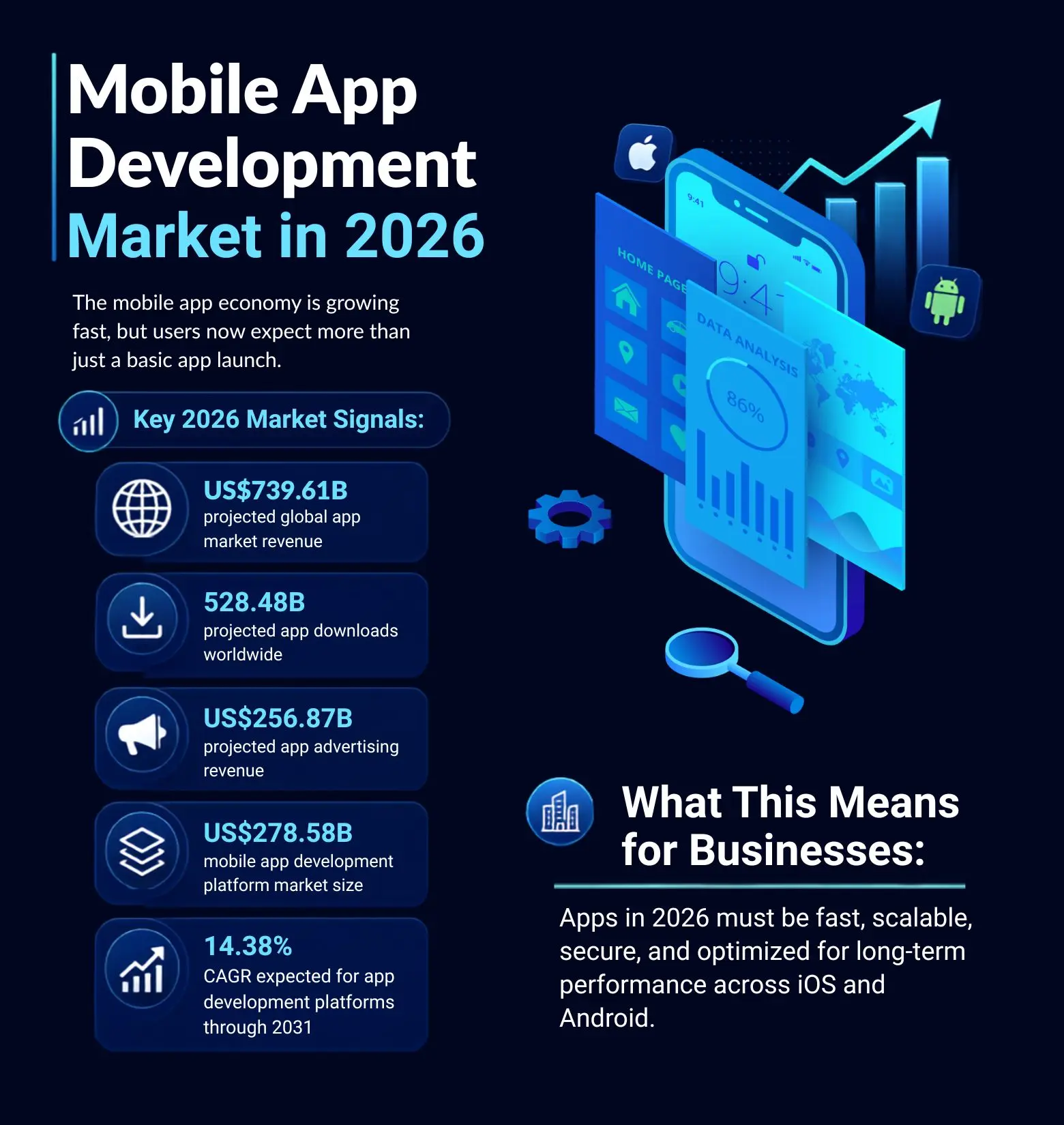
A few years ago, the focus was mostly on launching quickly. In 2026, businesses also have to think about long-term scalability, maintainability, user retention, and performance across different devices.
Cross-platform frameworks have improved significantly over the last few years. Native development tools have also become faster and more developer-friendly. Because of that, the decision between native and cross-platform mobile app development is now more strategic than ever.
Why Does the Native vs. Cross-Platform Debate Still Matter?
Some developers claim cross-platform frameworks are now good enough for everything. Others argue that native development remains the gold standard.
The truth sits somewhere in the middle.
Modern cross-platform frameworks can deliver excellent results for many business applications. However, native app development still performs better in areas where speed, hardware integration, security, and advanced graphics are critical.
The decision matters because businesses are not simply choosing a coding method. They are choosing:
- Development speed.
- Product architecture.
- Team structure.
- Long-term maintenance process
- Platform flexibility.
- Future scaling options.
Changing direction later is possible, but it usually costs time and money. That is why businesses investing in custom app development services should evaluate both approaches carefully before development begins.
What Is the Difference Between Native and Cross-Platform Mobile App Development?
Native app development means building separate applications for iOS and Android using each platform’s official technologies. For iOS, developers typically use Swift and Apple’s SDKs; for Android, developers usually work with Kotlin and Google’s Android development tools. Everything is built specifically for that operating system.
Cross-platform mobile app development works differently. Instead of maintaining two completely separate codebases, developers use a shared framework to build one core application that runs across multiple platforms.
Frameworks like Flutter, React Native, Kotlin Multiplatform, and .NET MAUI allow developers to reuse large portions of code between iOS and Android.
The biggest practical difference comes down to optimization versus efficiency. Native development focuses on maximum platform optimization, whereas cross-platform development focuses on faster delivery and lower maintenance effort.
Neither approach is automatically better. The right choice depends on the type of application being built.
What Is Native Mobile App Development?
Native app development involves building software specifically for one operating system.
An iOS app is developed using Apple technologies. An Android app is developed using Google technologies. The application communicates directly with the device operating system without requiring an additional abstraction layer.
This direct access improves responsiveness, stability, and integration with hardware features.
Core Technologies Used in Native App Development
Here’s what modern native mobile app development generally relies on:
- Swift for iOS development
- Kotlin for Android development
- SwiftUI for modern iOS interfaces
- Jetpack Compose for Android UI development
These technologies are actively maintained by Apple and Google. Developers also gain immediate access to new platform APIs, security updates, and device capabilities as soon as they are released.
Advantages of Native App Development
Better Performance
Native apps usually deliver the best overall performance. Animations feel smoother, heavy processing tasks run faster, and complex rendering operations are more stable.
This matters for applications involving:
- Real-time interactions
- Gaming
- Video processing
- AR and VR experiences
- Financial transactions
- AI-driven device processing
Stronger Device Integration
Native apps integrate deeply with hardware and operating system features.
Developers can access:
- Cameras
- NFC
- Bluetooth
- Health sensors
- Biometric authentication
- Push notifications
- Motion tracking
- Advanced security APIs
This level of integration is often important for enterprise and fintech applications.
More Natural User Experience
Users expect iOS apps to behave like iOS apps and Android apps to follow Android conventions. Native app development helps products feel more familiar because developers work directly within each platform’s design ecosystem.
Disadvantages of Native App Development
Higher Development Cost
Businesses usually need separate teams or developers for iOS and Android.
That increases:
- Development hours
- Testing effort
- Maintenance cost
- Hiring requirements
Native mobile app development services often cost significantly more than cross-platform alternatives for this reason.
Longer Development Time
Features must be developed separately for both platforms. Even when functionality is similar, implementation still needs platform-specific work. This naturally extends timelines.
More Maintenance Work
Two platforms mean two codebases. Bug fixes, feature updates, testing cycles, and release management all require additional coordination.
What Is Cross-Platform Mobile App Development?
Developers can use cross-platform mobile application development to create an application for several platforms utilizing the same code base. Rather than developing two independent apps in full, developers will be reusing most of their application logic on both platforms like iOS and Android.
This technique is one of the most common and frequently adopted technologies by businesses and startups developing a product quickly.
How Cross-Platform Development Works
Cross-platform frameworks act as a bridge between shared application code and the native operating system.
Certain Cross-platform frameworks will provide their own UI components, while others may still require the use of native platform components to the same extent. In either case, the ultimate goal is to write code once, and deploy it to multiple platforms, while minimizing the need for duplicating the code.
What Are the Best Cross-Platform App Development Frameworks in 2026?
Several frameworks dominate the cross-platform mobile app development ecosystem in 2026.
Flutter
Flutter uses the Dart programming language and Google’s rendering engine.
It is known for:
- Strong UI consistency
- Fast rendering
- Smooth animations
- Large community support
Flutter is widely used for consumer-facing applications.
React Native
React Native remains one of the most popular choices for businesses with JavaScript or TypeScript teams. It allows developers to build mobile apps using familiar web technologies while still leveraging native components.
The newer React Native architecture has improved performance considerably.
Kotlin Multiplatform
Kotlin Multiplatform focuses on shared business logic rather than shared UI. Businesses can maintain native interfaces while reducing duplicated backend and data-processing code.
This approach appeals to companies that want native user experiences without fully separate development logic.
.NET MAUI
.NET MAUI is commonly used by businesses already working within the Microsoft ecosystem. Teams using C# and enterprise Microsoft infrastructure often prefer this framework.
Is Cross-Platform Mobile App Development as Good as Native in 2026?
For many applications, yes. Modern cross-platform frameworks have improved dramatically.
For:
- E-commerce apps
- Business dashboards
- Booking platforms
- Content-driven apps
- Internal tools
- Social applications
Cross-platform mobile app development can deliver experiences that most users cannot distinguish from native apps. However, native app development still performs better in areas where hardware access, graphics rendering, and real-time responsiveness are critical.
The gap between the two approaches is smaller than it was five years ago, but it has not disappeared entirely.
The important point is this:
Most businesses do not actually need ultra-high-performance architecture. They need stable, scalable, maintainable applications that users enjoy using. For many companies, cross-platform development achieves that successfully.
Understanding Native App Development: Pros & Cons
Advantages of Native App Development
Highest Performance Levels
Native apps communicate directly with the operating system. That eliminates additional processing layers and improves responsiveness. This is especially important for apps involving:
- Advanced graphics
- Live streaming
- Gaming
- AI processing
- High-frequency transactions
Immediate Access to New Platform Features
Apple and Google regularly release new APIs and hardware features. Native developers can implement these updates immediately. Cross-platform developers often need to wait for framework support.
Better Stability
Native applications generally experience fewer compatibility issues because they rely on official platform tools. This often results in fewer crashes and more predictable performance.
Disadvantages of Native App Development
More Expensive Teams
Hiring experienced Swift and Kotlin developers can be costly. Businesses may also need separate QA processes for each platform.
Slower Feature Rollouts
Every feature update must be implemented separately. This slows release cycles compared to cross-platform mobile app development.
Higher Long-Term Maintenance Effort
Maintaining two separate apps requires more resources over time. As products grow, this maintenance overhead becomes more noticeable.
Understanding Cross-Platform App Development: Pros & Cons
Advantages of Cross-Platform Mobile App Development
Faster Launch Timelines
Businesses can release products more quickly because developers work from one shared codebase. This is extremely valuable for startups validating product ideas.
Lower Initial Development Cost
Cross-platform mobile app development services usually reduce upfront cost because businesses avoid duplicate work. One team can support both iOS and Android.
Easier Product Iteration
These feature updates happen faster. Businesses can test improvements, release updates, and respond to customer feedback more efficiently.
Simplified Maintenance
A single codebase is easier to maintain than two completely separate applications. This reduces operational complexity.
What Are the Risks of Choosing Cross-Platform App Development?
Cross-platform development has advantages, but businesses should understand the trade-offs clearly.
Performance Limitations
Complex applications may experience:
- Animation lag
- Rendering issues
- Higher memory usage
- Slower processing under heavy workloads
These problems are uncommon in simpler applications but can appear in technically demanding products.
Delayed Support for New Features
Frameworks may take time to support newly released platform APIs. Businesses dependent on cutting-edge mobile capabilities may find this frustrating.
Framework Dependency
Cross-platform applications rely heavily on third-party framework ecosystems. If framework maintainers change direction, businesses may eventually face migration challenges.
Platform-Specific Workarounds
Even with shared codebases, developers often need platform-specific fixes. Over time, those custom adjustments can increase maintenance complexity.
Does Cross-Platform App Development Affect Performance or User Experience?
It can, but the impact depends heavily on the type of app. For most business applications, performance differences are now relatively minor.
Users browsing products, reading content, making bookings, or managing dashboards are unlikely to notice major differences between native and cross-platform apps.
However, performance gaps become more noticeable in applications requiring:
- Intensive animations
- Real-time gaming
- Advanced graphics rendering
- Heavy AI processing
- Large-scale background operations
- AR and VR interactions
User experience is also influenced by platform behaviour. Cross-platform apps sometimes feel slightly less natural because interaction patterns may not perfectly match platform conventions.
Good developers reduce this issue through careful platform-specific optimization. Strong mobile app development services usually customize UI behaviour separately for iOS and Android, even within cross-platform projects.
Native vs. Cross-Platform Mobile App Development: A Detailed Comparison
| Factor | Native App Development | Cross-Platform Mobile App Development |
|---|---|---|
| Performance | Excellent | Good to very good |
| Development Speed | Slower | Faster |
| Development Cost | Higher | Lower |
| Maintenance | More complex | Easier |
| Access to APIs | Immediate | Sometimes delayed |
| User Experience | Platform-perfect | Requires optimization |
| Codebase | Separate per platform | Shared |
| Scalability | Excellent | Strong for most apps |
| Team Structure | Platform specialists | Shared development team |
| Best Fit | Performance-heavy apps | MVPs and business apps |
Which Is Cheaper — Native or Cross-Platform App Development?
Cross-platform mobile app development is usually cheaper during the early stages of a project. The biggest reason is code sharing. Businesses avoid building two separate applications from scratch.
This reduces:
- Development hours.
- Testing requirements.
- Design adaptation effort.
- Maintenance overhead.
For startups and smaller businesses, these savings can be substantial. However, cost calculations become more complicated for large-scale applications.
Complex cross-platform apps may eventually require:
- Extensive optimization.
- Native module development.
- Framework-specific troubleshooting.
- Platform-specific redesigns.
In those situations, long-term costs can begin approaching native development costs. That is why businesses should evaluate total lifecycle cost rather than only the initial estimate.
How Long Does It Take to Build a Cross-Platform Mobile App Compared to Native?
Cross-platform development is usually faster. For many projects, businesses can reduce development timelines by 20 to 40 percent.
That speed advantage comes from:
- Shared codebases.
- Shared testing logic.
- Unified feature implementation.
- Faster iteration cycles.
A moderate cross-platform application may take three to six months.
The same product built natively for both platforms may take significantly longer because development work happens separately.
Timeline differences depend heavily on:
- Product complexity.
- Team size.
- External integrations.
- Design requirements.
- Security and compliance needs.
Businesses working with aggressive launch deadlines often choose cross-platform mobile app development because of this faster delivery cycle.
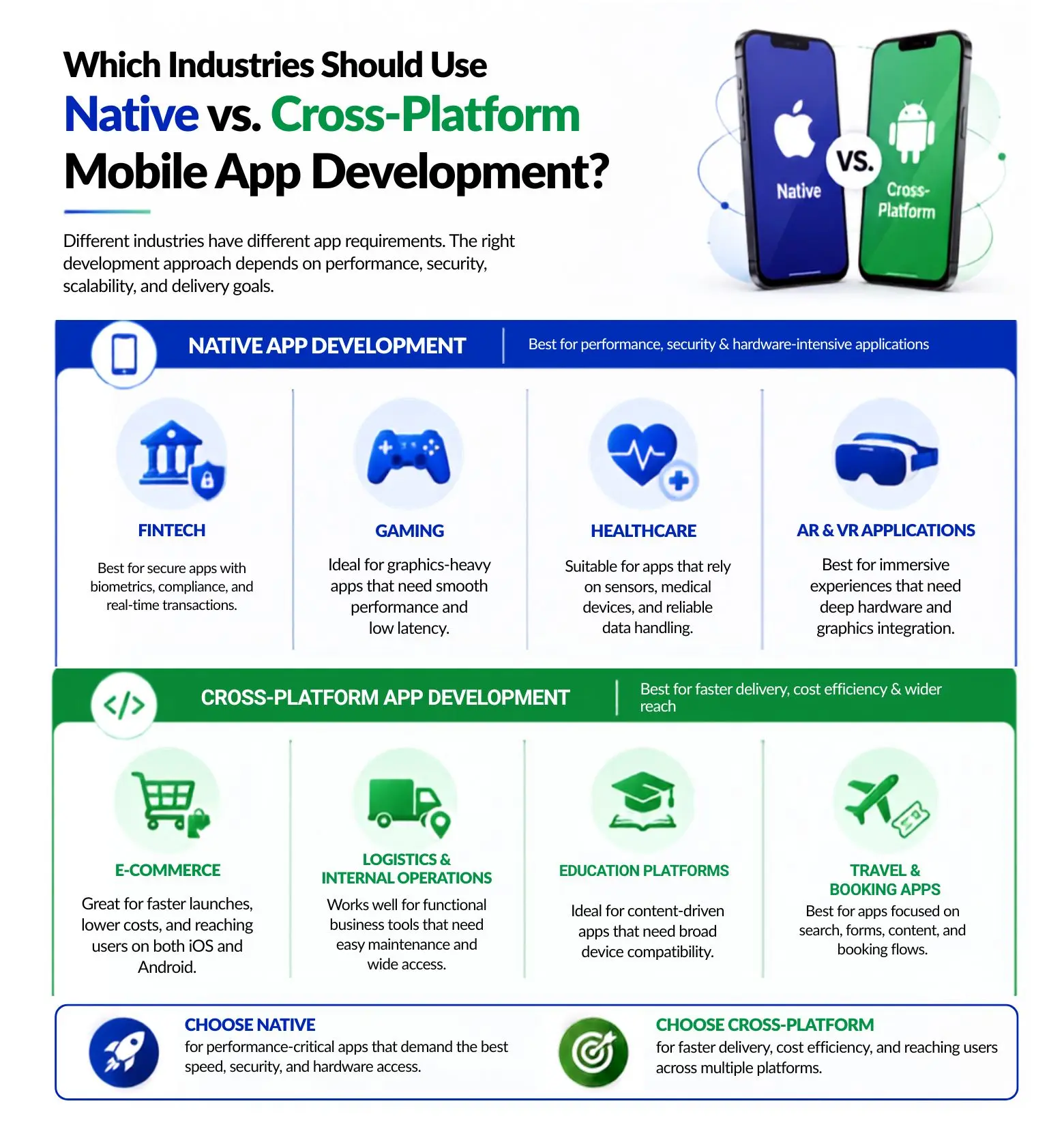
Which Industries Should Use Native vs. Cross-Platform Mobile App Development?
Different industries have different technical requirements. That is why the development strategy should always align with business goals.
Industries That Commonly Prefer Native App Development
Fintech
Banking and financial applications often prioritize:
- Security
- Stability
- Compliance
- Biometric integration
- Real-time processing
Native development helps support these requirements.
Gaming
Gaming applications can have high performance requirements for graphics and low latency requirements for gameplay. Because of this, games tend to be developed natively to maximize player experience and enjoyment.
Healthcare
Healthcare apps, which are frequently used to help manage or coordinate in healthcare facilities such as weighing patients and recording heart rate typically use sensors or medical devices to transmit data. As such, it is important that these types of applications have a native application architecture to ensure reliability.
AR and VR Applications
Augmented and virtual reality require a direct connection to hardware and graphics processing. Since native applications provide greater performance than web-based apps, they tend to be used when developing games that will utilize augmented and virtual reality.
Industries That Commonly Prefer Cross-Platform Development
E-commerce
Retail and shopping applications often benefit from faster release cycles and lower development costs. Cross-platform mobile app development works very well here.
Logistics and Internal Operations
Business operations typically focus on the function and maintainability of the internal tools than on sophisticated graphics. The operation costs associated with cross-platform development are significantly reduced.
Education Platforms
LMS, education apps & content products are the top candidates for cross-platform applications.
Travel and Booking Apps
Travel applications rely on the utilization of forms, content, searching, and booking functionality. Forms, content, searching, and booking flows are significant areas where cross-platform frameworks excel.
How AI Is Influencing Mobile App Development in 2026
Now, AI is changing the way mobile apps are built by providing developers with assistance in the following areas:
- Code generation
- UI suggestions
- Automated testing
- Documentation
- Debugging support
Across all of the native and cross platform development processes, this has led to an increase in the speed of providing mobile applications.
AI does not change the inherent differences between the two approaches of mobile app development. Native mobile app development continues to give developers more direct control of each platform’s capabilities, while cross-platform app development continues to focus more on the efficiencies/benefits to the developer.
AI-powered features inside apps are also becoming more common.
Businesses increasingly want:
- Voice assistants
- Real-time translation
- AI chat systems
- Image recognition
- Personalized recommendations
Native development often provides faster access to advanced on-device AI frameworks. Cross-platform frameworks can still support AI functionality, but integration may require additional work.
When Should a Business Choose Native App Development Over Cross-Platform?
Businesses should strongly consider native app development when:
- Performance is critical.
- Security requirements are extremely high.
- Hardware integration is central to the product.
- The app depends heavily on platform-specific capabilities.
- The business plans long-term investment into a flagship mobile product.
Some of the examples include:
- Trading platforms
- Advanced healthcare systems
- Professional editing tools
- High-performance gaming apps
- AR and VR products
Native app development is often the right long-term choice when user experience and platform optimization directly affect competitive advantage.
When Should Businesses Choose Cross-Platform Mobile App Development?
Cross-platform mobile app development works especially well when:
- Speed matters.
- Budgets are limited.
- Teams are small.
- Products are still being validated.
- Multi-platform reach is important.
MVP Development
Startups frequently choose cross-platform frameworks for MVP launches. The ability to test ideas quickly is often more valuable than perfect platform optimization.
Businesses Requiring Frequent Updates
Cross-platform development simplifies rapid iteration. Teams can update features faster and maintain consistency across platforms more easily.
Can a Cross-Platform App Be Converted to Native Later if Needed?
Yes. Many successful products begin with cross-platform mobile app development and later migrate parts of the application to native architecture.
This often happens when:
- User growth increases.
- Performance demands rise.
- Advanced platform features become necessary.
- Businesses expand engineering resources.
Some companies rebuild only performance-heavy sections natively while keeping the rest of the application shared. Others eventually migrate to the full product.
The transition requires planning and investment, but it is absolutely possible. That flexibility is one reason cross-platform development remains attractive for startups and fast-moving businesses.
How Businesses Should Actually Make the Decision
The best development approach depends on practical business realities.
Questions businesses should ask include:
- How quickly does the product need to launch?
- Is top-tier performance essential?
- How important is platform-specific design?
- What is the available budget?
- How large is the development team?
- Will the product require advanced hardware integration?
- Is this an MVP or a long-term flagship platform?
A company building an internal operations dashboard does not need the same architecture as a real-time trading application. Likewise, a startup validating an idea should not automatically spend enterprise-level budgets on native infrastructure before proving demand.
The smartest mobile app development solutions are usually the ones aligned closely with business priorities rather than technical trends.
The debate between native and cross-platform mobile app development still matters in 2026 because both approaches solve different business problems. Native app development delivers the best performance, deepest hardware integration, and strongest platform-specific user experience. On the other hand, cross-platform mobile app development offers faster releases, lower upfront cost, easier maintenance, and broader platform reach. The important thing is choosing the approach that fits the product. A well-planned architecture decision early in the project can save high cost and operational complexity later. Both native and cross-platform development are mature, capable approaches in 2026. The right choice depends entirely on what the business needs the app to achieve.
Frequently Asked Questions
1. Is cross-platform mobile app development cheaper than native in 2026?
Compared to developing native applications, using cross-platform methods for building mobile apps is generally going to be less expensive in 2026. Since developers can use the same code for both iPhone/Android devices, using a cross-platform approach tends to reduce initial development costs because it reduces the number of different programming languages the developers would need to learn. Similarly, updating and maintaining mobile apps becomes easier and less expensive when they share a codebase. On the other hand, applications that have complicated architectures (e.g., rich user interfaces) may ultimately require more optimization work which could result in long-term increases in development costs.
2. Can cross-platform mobile apps deliver native-like performance?
3. Which cross-platform framework is most popular in 2026?
4. Is native app development better for security?
5. How long does native mobile app development usually take?
6. Can businesses start cross-platform and migrate later?
7. Which option is better for startups?
8. Which industries benefit most from native development?
9. Does cross-platform development affect user experience?
10. What should businesses prioritize when choosing a development approach?
Request a
Free Quote Today!


