


Table of Contents


Running a business today means depending on software for almost everything, including managing customers, tracking inventory, processing payments, handling communications, and generating reports.
Most businesses start with ready-made software tools because they are easy to set up and affordable. But as a business grows and its operations become more complex, those tools often start to fall short. The spreadsheet that worked for ten employees breaks down with a hundred. The CRM that handled basic sales enquiries cannot keep up with a multi-team enterprise process. The inventory system takes too long to update and causes costly errors.
These are not minor inconveniences. They are real operational problems that slow businesses down.
That is where custom software development comes in. Instead of forcing a business to adapt to a tool, custom software is built to match exactly how that business operates. It fits their workflow, speaks the language of the industry, and grows alongside the organization.
The Reality of Modern Business Systems
Running a business today means depending on software for almost everything, including managing customers, tracking inventory, processing payments, handling communications, and generating reports.
Most businesses start with ready-made software tools because they are easy to set up and affordable. But as a business grows and its operations become more complex, those tools often start to fall short. The spreadsheet that worked for ten employees breaks down with a hundred. The CRM that handled basic sales enquiries cannot keep up with a multi-team enterprise process. The inventory system takes too long to update and causes costly errors.
These are not minor inconveniences. They are real operational problems that slow businesses down.
The Role of Custom Software Development
That is where custom software development comes in. Instead of forcing a business to adapt to a tool, custom software is built to match exactly how that business operates. It fits their workflow, speaks the language of the industry, and grows alongside the organization.
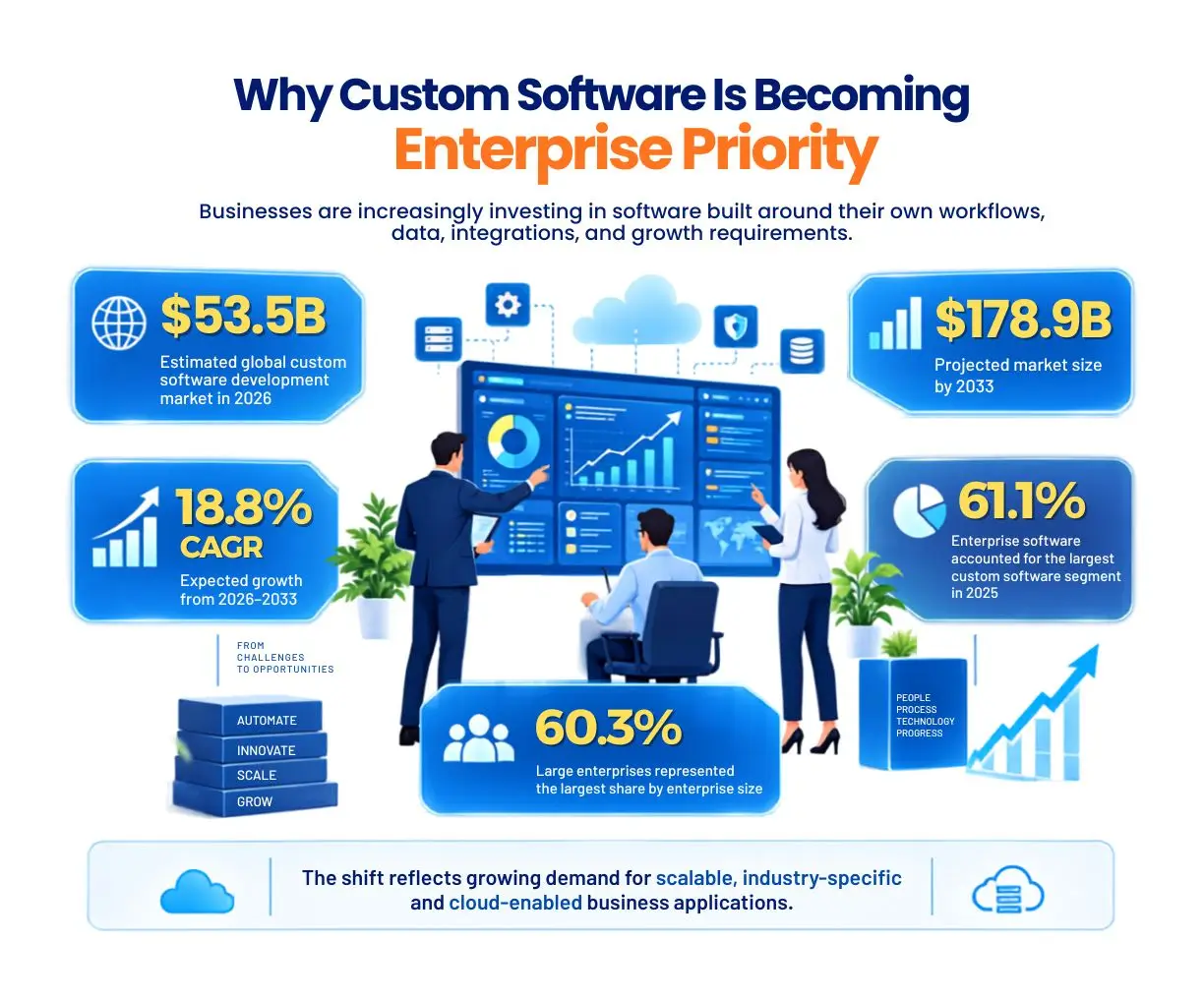
Signs a Business Needs Custom Software
Not every business needs custom software right away. But certain signs point clearly in that direction:
- Teams are spending time copying data from one system to another because the tools do not connect.
- The software being used is missing key features and workarounds are piling up.
- The business is growing, but the tools are not keeping up.
- Compliance requirements are too specific for any existing platform to meet.
- Competitors have capabilities that the current toolset cannot match.
- Staff are frustrated with the current systems and making avoidable mistakes.
When several of these signs appear together, it is usually time to have a serious conversation about custom software development.
What Does a Software Development Consultant Do?
Many people assume a software development consultant is just a senior programmer, which is not quite accurate. A consultant's job is to help a business make smart decisions about its technology before any coding begins.
Engaging software development and consulting services early in the process of operational set-ups is one of the best investments a business can make. It avoids the all-too-common situation where a company spends months and a significant budget building software, only to find out that it does not actually solve the problem.
What a Consultant Actually Does
Listens to the business first: A good software development consultant starts by understanding the business’s goals, pain points, how its teams operate, and what the current systems can and cannot do. This is not a technical conversation at the start; it is a business conversation.
Identifies the real problem: Sometimes businesses think they need a new system when the actual problem is a process issue. A consultant helps identify whether technology is the right answer and, if so, what kind of technology makes sense.
Recommends the right approach: Should the business build software from scratch, customize an existing platform, or buy something ready-made? A consultant evaluates the options and recommends what solution fits the situation.
Helps choose the right team: If the business decides to build custom software, the consultant can help evaluate different development companies, review proposals, and choose a team that is qualified and trustworthy.
Stays involved during the project: Many consultants do not disappear once the build begins. They review progress, raise concerns, and act as a bridge between the technical team and the business leadership.
In simple terms, a software development consultant helps a business avoid expensive mistakes by thinking through decisions carefully before committing to them.
The Custom Software Development Process: Step-by-Step
One of the biggest concerns businesses have about custom software is not knowing what to expect. Here is a clear, plain-language breakdown of what the process typically looks like.
Step 1: Discovery and Requirements Gathering
This is the most important step, and it happens before any design or development begins. The development team sits down with the managers, team leads, and end users to understand exactly what the software needs to do.
By the end of this phase, there is a written document that captures every requirement. This becomes the foundation for everything that follows. Skipping this step is one of the most common reasons why software projects go over budget or miss the mark entirely.
Step 2: Planning and Architecture
Once the requirements are clear, the team figures out how to build the solution. This includes decisions about what technology to use, how the different parts of the system will connect, and how the software will handle growth over time.
At this stage, a timeline and budget are also established. Businesses should expect some flexibility in both, but a clear initial plan is essential.
Step 3: Design
Before writing any code, the team creates visual designs and prototypes. These are essentially interactive mock-ups that show what the software will look like and how users will move through it.
This step gives businesses a chance to provide early feedback. It is far cheaper to change a design mock-up than to rebuild a piece of software that has already been coded.
Step 4: Development
This is where the actual building happens. Most experienced teams work in short cycles, typically two weeks at a time. At the end of each cycle, a working piece of the software is ready to review. This lets businesses give feedback regularly instead of waiting until the entire product is finished.
A reputable custom software development service keeps clients informed throughout this phase, not just at the end.
Step 5: Testing
Every feature is tested before it is signed off. Testers check that the software works correctly, handles errors properly, runs fast enough, and is secure. Testing is not a single event at the end of the project; it runs alongside development throughout.
Step 6: Deployment
Once the software passes quality testing, it is made live. This includes moving data from old systems, setting up the new environment, and training staff on how to use it.
Step 7: Ongoing Support and Updates
Custom software needs maintenance just like any tool does. Features get added as the business evolves. Bugs get fixed. Security updates are applied. Businesses should factor ongoing support into their planning from the very beginning.
Custom vs. Generic vs. Outsourcing: Which Is the Right Approach?
Choosing between custom software, mass-produced products, and outsourced development is not always straightforward. Each option has real strengths and trade-offs.
Custom Software
Custom software is built specifically for the business that commissions it. The business owns the final product and can change, expand, or rebuild any part of it in the future.
- Best for: Businesses with unique processes, complex workflows, or operations that generic tools cannot handle.
- Trade-off: Higher upfront cost and longer build time compared to buying an existing product.
Generic Software
These are products that are already built and available for purchase or subscription. Examples include accounting platforms, standard CRMs, or basic HR tools.
- Best for: Common business functions that do not vary much between organizations, like payroll processing, basic invoicing, or standard email marketing.
- Trade-off: Limited customization. As the business grows, the platform may not grow with it. Licensing fees also accumulate.
Outsourcing via Offshore Development
Outsourcing means hiring a development team in another country to build the software. This is often done to manage costs. Offshore software development services have become increasingly reliable over the past decade, particularly from regions with strong technical education systems.
- Best for: Businesses that want custom software but have budget constraints. Offshore teams can significantly reduce build costs without reducing quality, provided communication is managed well.
- Trade-off: Time zone differences and communication gaps can slow things down if not managed carefully. Strong project management is non-negotiable in this model.
Custom Software Development ROI & Business Impact
Cost is the question that comes up earliest in almost every custom software conversation. And it is a fair one. Custom software development is not cheap. So why do so many enterprises choose it?
Because, over time, it frequently costs less than the alternative.
The Hidden Cost of Generic Software
Pre-made software seems affordable at the start. But consider what happens over five years of subscription fees, per-user charges, premium tier upgrades, third-party integrations, and workarounds that require additional tools or extra staff hours. These costs are real, and they compound.
Beyond direct costs, there are productivity costs. When employees use software that does not fit their work, they find workarounds. They copy data manually. They export to spreadsheets. They maintain parallel systems. All of that takes time—time that is being paid for.
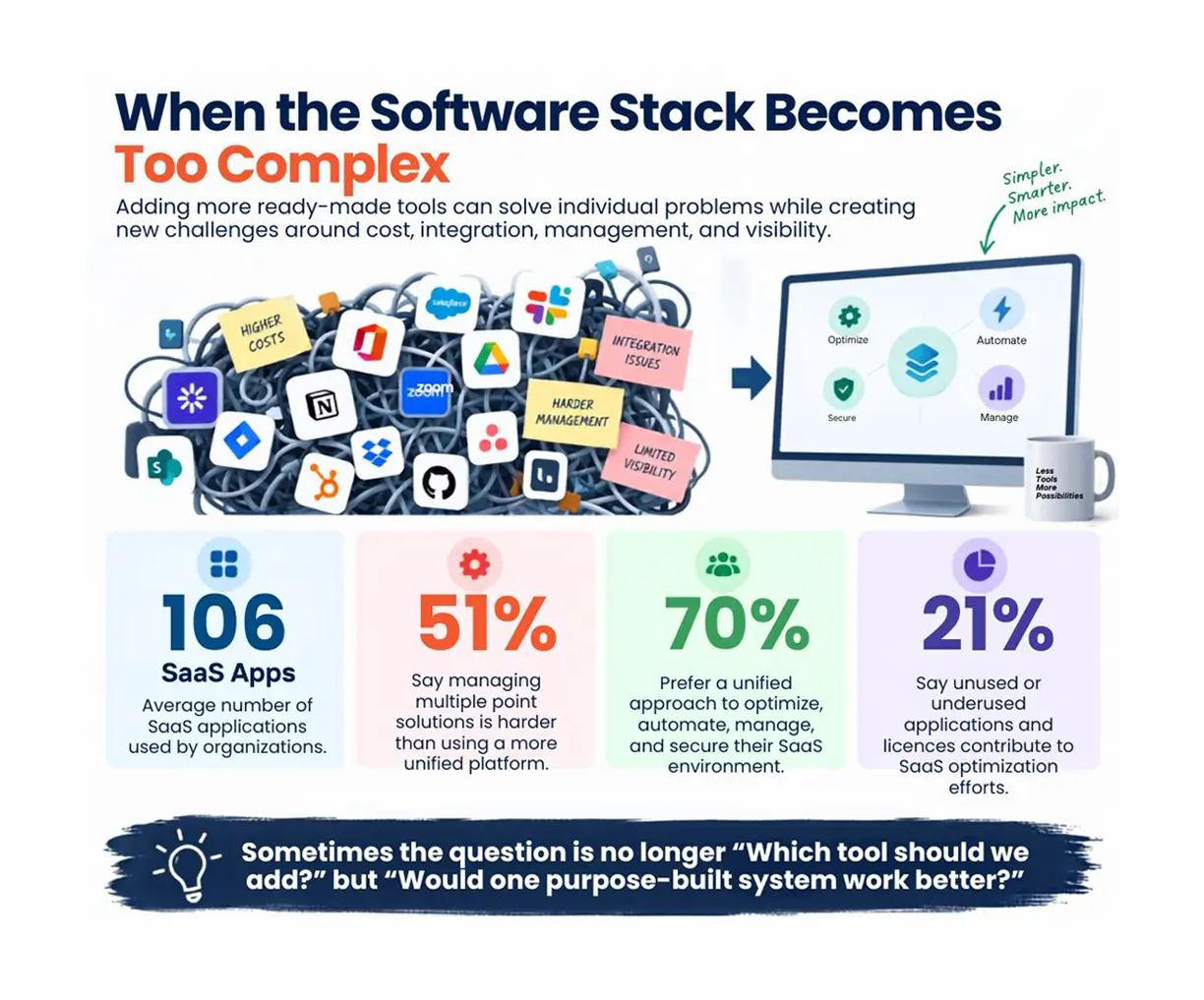
Where Custom Software Pays Back
Once custom software is built, there are no ongoing per-user or per-feature fees. The business owns the product outright.
- Lower long-term licensing costs: Once custom software is built, there are no ongoing per-user or per-feature fees. The business owns the product outright.
- Fewer errors and less rework: Software built to match a specific process reduces the chance of human error. Fewer mistakes mean less time and money spent fixing them.
- Higher staff productivity: Teams that use tools that actually fit their work get more done. The time saved across a team of fifty or one hundred people adds up significantly over a year.
- Competitive advantage that cannot be easily copied: A business that builds a unique operational tool gains a capability that competitors simply cannot buy. That advantage is real, and it compounds as the tool is improved over time.
- Scalability without extra cost: As the business adds staff or expands to new markets, the software scales with it. With generic software, more users usually means more cost.
Businesses that work with experienced providers of custom enterprise software development services typically find that the investment pays for itself within two to three years. This comes through a combination of cost savings and productivity gains.
Custom Software Development Use Cases & Industries
Custom software is not limited to large corporations with massive budgets. It is being used across industries of every size. Here are some of the most common and clearest examples.
Healthcare
Hospitals, clinics, and healthcare networks build custom patient management systems, appointment scheduling tools, and diagnostic platforms. These systems handle sensitive data and must meet strict compliance requirements that most generic platforms cannot fully satisfy.
Beyond compliance, healthcare workflows are deeply specific. A private clinic in one city operates very differently from a hospital group with multiple departments and specialist units. Custom software accounts for those differences.
Financial Services and Banking
Banks, insurance companies, and financial technology companies build custom platforms for fraud detection, loan processing, regulatory reporting, and risk analysis. The rules that govern this industry are complex and change frequently. Generic tools cannot keep up.
Many financial institutions also use offshore software development services to build and maintain large-scale platforms while keeping their development costs manageable.
Manufacturing and Supply Chains
Manufacturers use custom software to manage production schedules, track raw materials, monitor equipment, and coordinate supplier relationships. Mass-produced ERP systems exist, but many manufacturers find that those systems require so many modifications that building a purpose-built solution is more practical.
Retail and E-Commerce
Retailers build custom order management systems, loyalty programmes, and demand forecasting tools. These connect directly to warehouse operations, delivery partners, and customer data, creating a level of integration that standard retail platforms rarely provide.
Legal Services
Law firms use custom case management platforms that handle everything from document storage and deadline tracking to billing and client communication. The specific requirements of a family law firm differ significantly from those of a commercial litigation practice, and custom software accounts for that.
Education and Training
Universities, schools, and training providers build custom learning management systems that fit their specific curriculum structure. Ready-made platforms often require institutions to adapt their teaching methods to fit the software. Custom solutions reverse that, with the software adapting to the teaching approach.
Common Software Development Mistakes to Avoid
Custom software development has a strong track record when it is managed well. But it also has a long list of cautionary stories when it is not. Most of those trace back to a small number of avoidable mistakes.
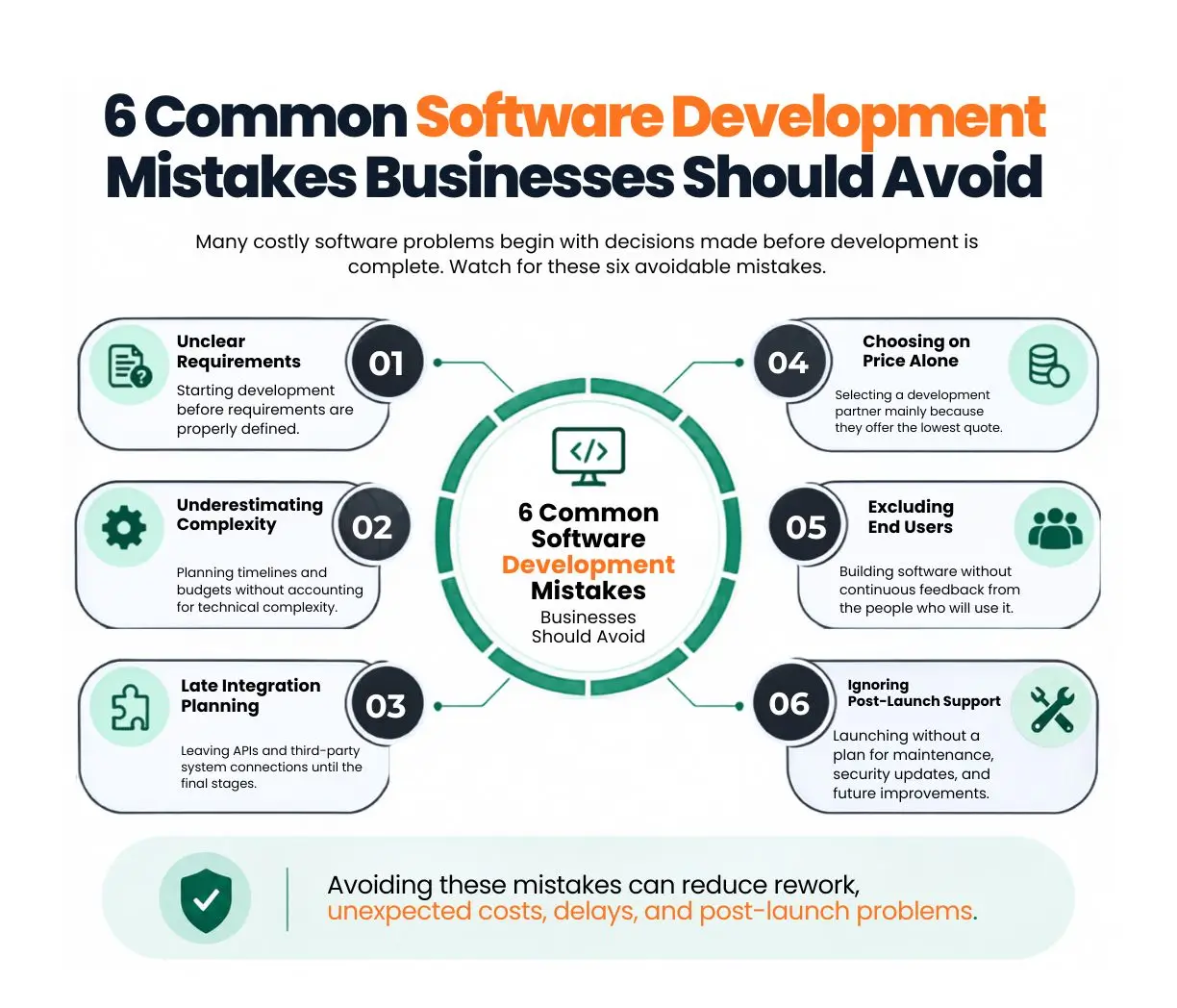
Starting Without a Clear Plan
The most expensive mistake in custom software development is starting the build before the requirements are properly documented. When teams build based on vague briefs or verbal agreements, the result almost always needs significant rework that costs time and money.
Underestimating How Complex the Project Is
Many businesses underestimate what is involved in building software. A feature that sounds simple in conversation can take weeks to build correctly when security, error handling, and performance are all factored in. Honest, experienced teams will flag this early. Teams that just agree with everything a client wants should raise a concern.
Ignoring Integrations Until the End
Most enterprise software does not work in isolation. It connects to other platforms, like accounting systems, customer databases, payment processors, and logistics tools. If those integrations are not planned from the beginning, they become a serious problem late in the project.
Choosing a Development Partner Based on Price Alone
The lowest price rarely produces the best outcome. Businesses that choose development partners based purely on cost frequently end up spending more on fixes and rewrites than they would have on a more experienced team right from the start.
Leaving Out the People Who Will Use the Software
End users know more about what the software needs to do than almost anyone else. Leaving them out of the design and testing process leads to software that is technically correct but practically frustrating to use. Getting input from actual users throughout the build leads to a better product.
No Plan for What Happens After Launch
Some businesses treat the launch as the finish line. It is not. Software needs regular updates, security patches, and new features as the business evolves. Any custom software development service agreement should clearly define what support looks like after the product goes live.
How to Choose a Custom Software Development Company
Selecting a custom software development partner is one of the most important decisions in this entire process. The right partner makes the experience manageable and the outcome strong. The wrong one creates delays, budget overruns, and software that does not work as expected.
Here is what to look for.
Relevant Experience
Has the company built software for a similar industry or solved a similar problem? A team that has already navigated the compliance requirements of healthcare, for example, is better equipped to handle a healthcare project than a generalist team starting from scratch.
Ask to see real examples of past work, not just logos on a website. Were those projects delivered on time and within budget? If not, what went wrong and how did the team handle it? Honest answers to those questions reveal a lot.
A Clear and Transparent Process
A reliable software development company explains its process clearly. It breaks down the project into phases, reports regularly, and involves the client in decisions throughout the development cycle, not just at the beginning and end.
Communication That Actually Works
Plenty of technically capable teams struggle with communication. If a team is slow to respond during the sales process, it will likely be slow during the project too. Look for teams that are clear, prompt, and easy to understand—especially when the client does not have a technical background.
This matters even more with offshore software development services, where time zone gaps can affect response times. Clear communication protocols and regular check-ins become non-negotiable in those cases.
Pricing That Is Honest and Explained
Whether a company charges a fixed project price or bills by time and materials, the pricing structure should be easy to understand and fully explained upfront. Hidden costs and vague estimates are warning signs.
Post-Launch Support
Ask every potential partner what their support model looks like after the software goes live. Some companies disappear after handover. Others offer ongoing maintenance contracts. Knowing what the post-launch plan is before signing anything prevents problems later.
Questions Worth Asking Before Signing
- Who will be working on the project day to day, and what are their qualifications?
- How has the team handled projects where requirements changed mid-build?
- Who owns the code and intellectual property once the project is complete?
- What does the handover process look like?
- Can the team provide references from past clients?
Companies that provide software development and consulting services—meaning they combine strategic advice with technical execution—often deliver better outcomes than those that only focus on writing code. Strategy without execution creates plans that go nowhere. Execution without strategy creates software that solves the wrong problem.
Custom software development takes time, money, and genuine business involvement. But for enterprises with complex operations or serious growth ambitions, it is often the most practical long-term decision. Generic software tools create hidden costs through workarounds, manual processes, and lost productivity, while custom software eliminates those problems at the source. The key is approaching the process with a clear plan, the right development partner, and a long-term view of what the investment is meant to achieve. Businesses that work with teams offering custom enterprise software development services backed by real consulting experience find that their success is measurable. This is because the software was built for that specific business, not for a hypothetical average customer.
Frequently Asked Questions
1. How long does it typically take to build custom enterprise software?
2. Is custom software development only for large enterprises, or can smaller businesses benefit too?
3. What is the difference between custom software development and hiring an in-house developer?
4. How can one safeguard a business’s concept or intellectual property in collaboration with a software development corporation?
5. How should a business prepare before approaching a software development company?
Request a
Free Quote Today!


