


Table of Contents


Among businesses with an active online presence, there is a significant and often underestimated distinction between a website that exists and one that works.
Both may be professionally designed and attract a consistent volume of visitors. Yet only one converts that traffic into customers in a manner that contributes directly to business growth.
Conversion-focused web development is the discipline responsible for building and maintaining the kind of website that sells. It extends well past the visual and functional elements most people associate with web development. Its foundation is behavioural: understanding how visitors think, what they respond to, and how a website can be structured to support purposeful action at each stage of the buyer’s journey.
For this reason, many organizations today engage professional web development services to close the distance between a website that looks credible and one that delivers measurable commercial results.
How Smart UX Design Transforms Casual Visitors Into Potential Customers
User experience (UX) sits at the foundation of every conversion strategy. When someone lands on a page for the first time, an instinctive reaction forms within seconds. It is shaped by how the layout is organized, how fast the content appears, and how obvious the next step looks.
Brands that take UX seriously outperform those that treat it as a secondary concern. The results show up in real performance data with lower bounce rates, longer visits, and more completed actions across the site.
Building a Website Structure That Guides People Forward
A website organized around how visitors think rather than how the company is internally arranged creates a meaningfully better browsing experience.
When a website’s structure is designed well, visitors find what they need without effort. They do not have to guess where to click or dig through nested menus to reach basic information.
High-converting websites consistently share a few structural qualities:
- Short, descriptive menus with no unnecessary subcategories
- Pages that each serve a single, focused purpose
- A content hierarchy that mirrors the visitor's likely journey through the site
- Critical information and actions visible without excessive scrolling
When site visitors do not have to work to find what they need, they stay longer. Longer stays create more opportunities to convert, and more opportunities mean better overall results.
Why Page Speed and Mobile Performance Define the Visitor Experience
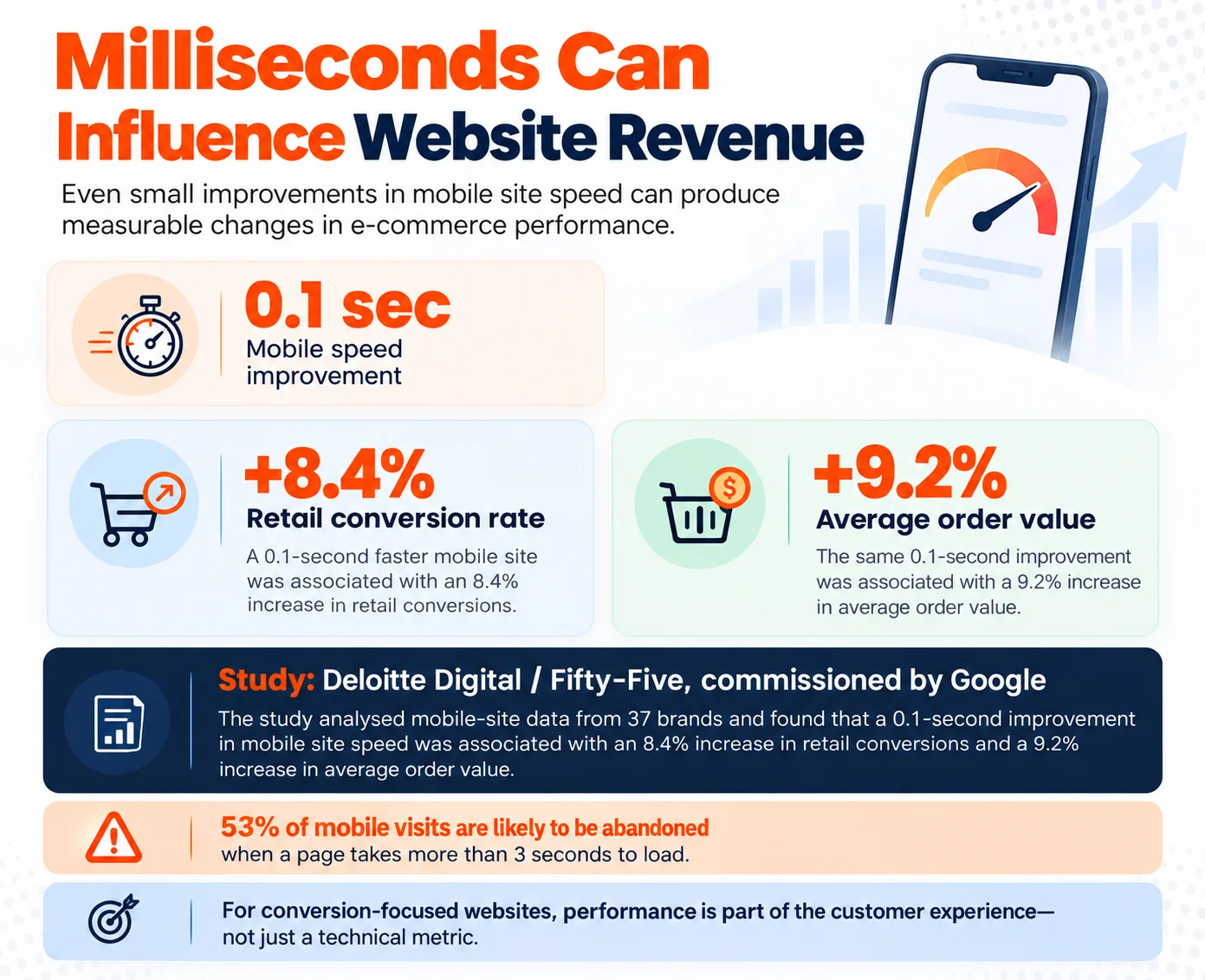
A reputable website design and development agency treats page speed as a foundational requirement, not a finishing detail. Slow pages lose visitors before they have seen a single line of content.
Mobile users are particularly unforgiving when a page loads slowly. A large portion of web browsing today happens on smartphones, and those users expect pages to load just as quickly as they would on a desktop computer. A website that performs well on a large screen but struggles on a smaller one is, in effect, delivering a poor experience to a significant portion of its audience. That is a conversion problem with real commercial consequences.
Standard webpage speed and performance optimization practices among leading brands include:
- Properly compressing images so they load quickly without visible quality loss.
- Minimizing and bundling code files to reduce overall page weight.
- Deferring non-essential scripts so primary content loads first.
- Leveraging content delivery networks to serve assets from servers closer to the user's location.
Performance monitoring needs to happen on an ongoing basis as the site grows and evolves.
CTAs That Are Clear, Purposeful, and Well-Positioned
A call-to-action button might appear small in the overall design, but its influence on conversion is significant. Its wording, colour, size, and placement all affect how many visitors follow through on the intended next step.
Effective CTAs are specific about what happens next. For example, Book My Free Consultation outperforms Submit, and Start My Free Trial outperforms Sign Up. That specificity reduces hesitation among visitors by setting up a clear expectation before the click.
How Top Brands Use A/B Testing and Analytics to Build Smarter Websites Over Time
The brands that grow their conversion rates from their website consistently over time are not relying on instinct or assumptions. They are making decisions based on evidence gathered from real visitors, on real pages, in real time.
What A/B Testing Reveals That Assumptions Cannot
A/B testing places two versions of a webpage, or a single element within a webpage, in front of different groups of real visitors. Version A might carry a different headline and version B might position the checkout button in a different location. By measuring which version produces more conversions, teams replace guesswork with grounded evidence.
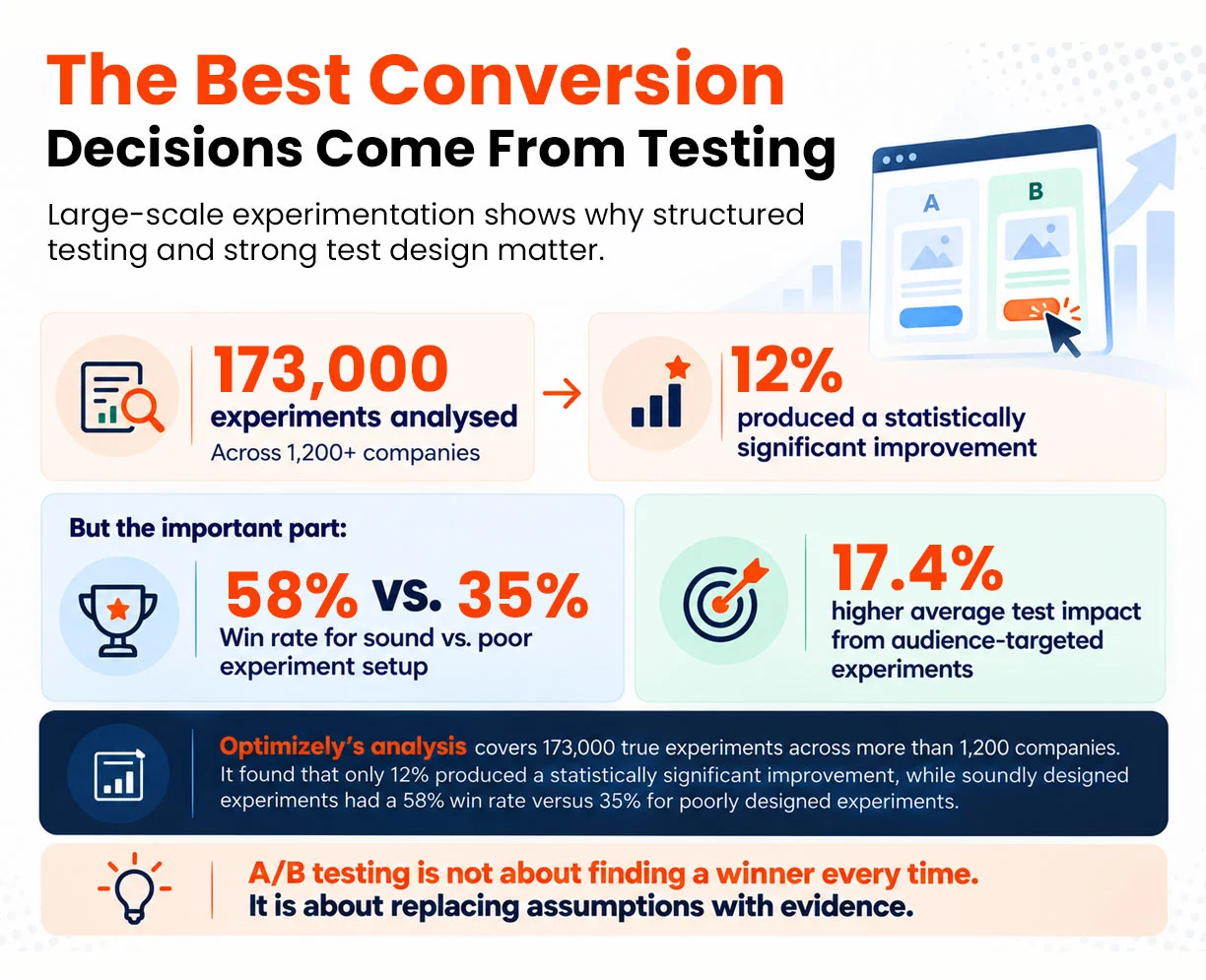
What makes A/B testing particularly powerful over time is the knowledge it builds around visitor behaviour and decision-making patterns. Each test produces an insight that builds a detailed picture of what motivates a specific audience—something you can't buy or borrow from a competitor's strategy. It has to be developed through consistent, disciplined testing of a website.
Strong web page development service providers treat A/B testing as a standing element of the client relationship, not a one-time deliverable. Brands that test continuously separate themselves from those that treat their websites as finished products.
Reading Analytics Like a Diagnostic Tool
Web analytics tools give teams a granular view of how a website is truly performing. Beyond traffic volume, they reveal which webpages hold attention, which push people away, and exactly where in the conversion funnel visitors are dropping off.
Analytics patterns that deserve close attention include:
- Landing pages with bounce rates significantly higher than the site average.
- Product or service pages that attract strong view counts but generate few conversions.
- Forms where many visitors begin the process but very few complete it.
- Pages where scroll depth data shows that most visitors never reach the main offer.
Each of these patterns points to a specific, addressable problem. Analytics take vague dissatisfaction and turn it into a prioritized list of improvements.
Accessibility and Inclusive Design: Building Websites That Work for Every Visitor
Web accessibility sits at the intersection of ethical responsibility and smart commercial strategy, where doing right by users and doing right by the business point in the same direction. It means building websites everyone can use, regardless of ability, device, or browsing environment.
What WCAG 2.1 Requires in Practice
The Web Content Accessibility Guidelines (WCAG) 2.1 represent the internationally accepted standard for accessible website design. They are organized around four core principles, each addressing a distinct dimension of the user experience:
- Perceivable— All information must be presented in ways every website user can perceive. This includes image alt text, captions on video content, and adequate colour contrast between text and its background.
- Operable— Interfaces must be fully operable by users who rely on keyboards or assistive devices rather than a mouse. Every interactive element needs to be keyboard-accessible.
- Understandable— Content must be clearly written, interfaces must behave predictably, and error messages must explain exactly what went wrong and how to resolve it.
- Robust— The underlying code must be built to work reliably with current and future assistive technologies across a range of browsers and platforms.
Meeting these standards is not as complicated as many teams assume. However, it does require intentional effort from a development team that knows what to look for.
The Business Case for Inclusive Web Design
A website design and development agency that builds with accessibility in mind produces websites with broader market reach, lower legal risk, and stronger organic search performance. These three outcomes are not coincidental and follow directly from building to WCAG standards.
Accessible websites reach more people. This includes users with permanent disabilities, older adults whose browsing preferences may differ from a younger demographic, people with temporary physical limitations, and those using older or lower-powered devices.
The overlap between accessibility best practices and search engine optimization is also genuine and well-documented. Descriptive headings, meaningful image alt text, clean semantic code, and logical reading order all benefit assistive technology users and search engine crawlers alike. Brands that invest in accessibility are simultaneously investing in discoverability.
E-Commerce Web Development: What Successful Online Stores Do Differently
For brands that sell products or services online, every element of the website is either helping or hurting conversions. The gap between a product page that converts well and one that does not can represent a significant revenue difference over the course of a year.
Product Pages That Remove Doubt and Drive Buying Decisions
A product page that converts does not simply describe what is being sold. It removes doubt within the visitor and provides a solution to a problem that already exists in the market. Visitors arrive with unspoken questions about the product, the purchase process, the returns policy, and whether the brand can be trusted. Therefore, the webpage needs to answer those questions before they are even asked.
The qualities shared by high-performing product pages include:
- Multiple images showing the product from different angles, with a zoom capability.
- Descriptions that open with the primary benefit, not the first technical specification.
- Clear, complete information on pricing, delivery timelines, and available variants.
- Verified customer reviews visible directly on the page.
- Trust indicators or security badges that confirm the transaction is protected.
- A purchase button that is prominent and accessible without scrolling on any device.
Product page copy also shapes the consumer outcome. Short sentences, scannable paragraphs, and direct, plain language reduce the cognitive load on the reader. Visitors should not have to work to understand what they are thinking about buying.
Experienced web development services teams that pay dedicated attention to product page architecture consistently help e-commerce clients see measurable improvement in add-to-cart rates and completed transactions.
Reducing the Friction That Leads to Abandoned Carts
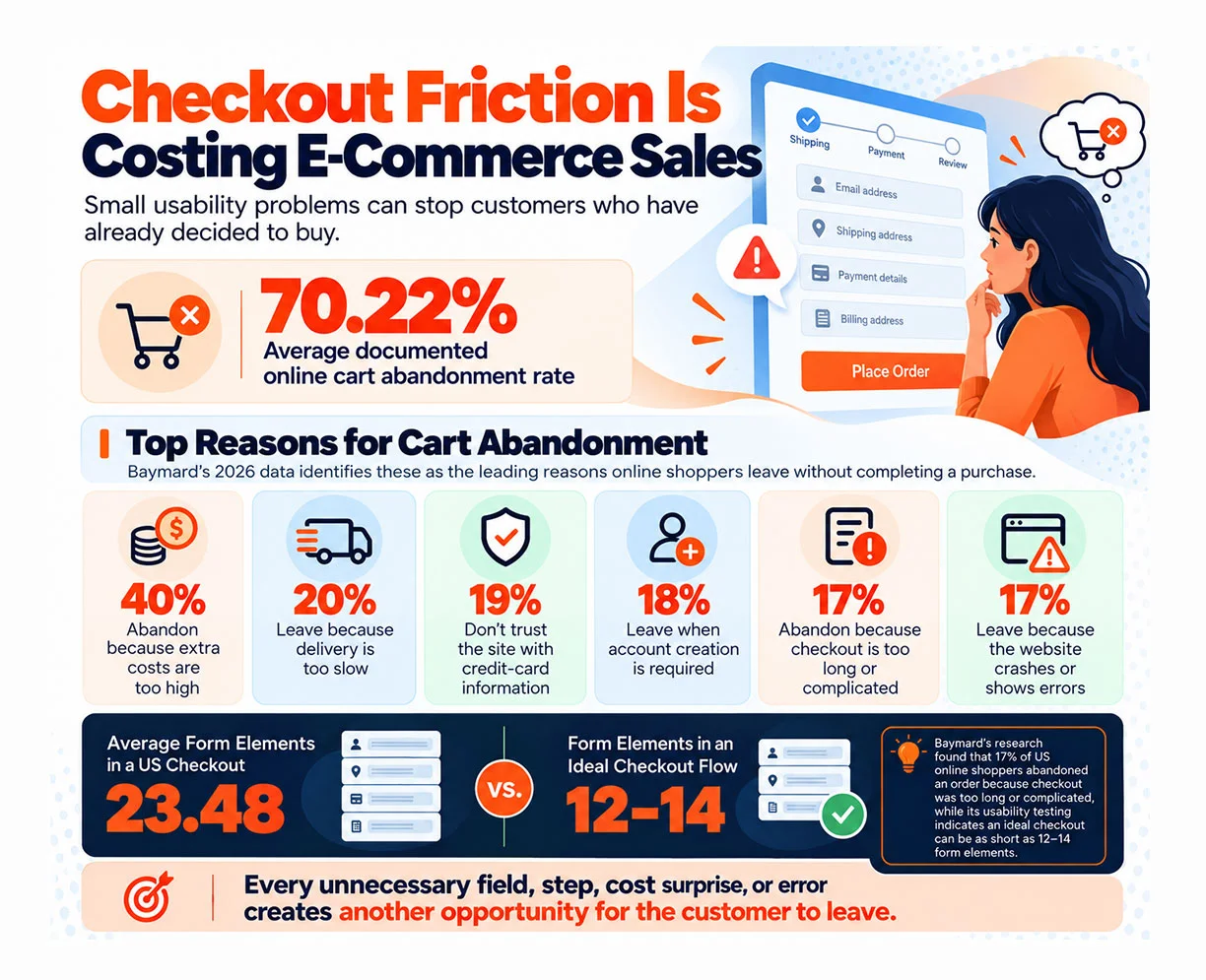
Cart abandonment is one of the most consistently discussed challenges in e-commerce. A substantial number of customers who genuinely intend to complete a purchase leave before doing so. The checkout process itself is often a key contributing factor.
Leading brands address this by removing every unnecessary obstacle from the path to purchase:
- Guest checkout is offered as standard but account creation should be optional, not mandatory.
- The checkout flow involves the minimum number of steps achievable.
- A visible progress indicator shows customers exactly where they are in the checkout process.
- The full cost, including taxes and shipping, is displayed as early as possible.
- Multiple payment methods accommodate different customer preferences.
- When error messages appear, they explain the problem clearly and suggest a resolution.
Every unnecessary form field, every extra confirmation step, every moment of ambiguity about the total cost are opportunities for a customer to decide the effort is not worth it. Therefore, eliminating them is among the highest-impact improvements any e-commerce team can make.
Trust Signals That Give Cautious Buyers the Confidence to Act
A visitor who has found a product they want to buy still needs to trust the website enough to enter their payment details. For first-time buyers especially, that trust is not automatic. It must be established through visible, credible signals that the brand has made a deliberate choice to include.
A skilled website design and development agency builds trust signals into the e-commerce experience from the outset, rather than treating them as optional additions. The most effective trust-building elements include:
- HTTPS across the entire site, with a visible padlock in the browser address bar.
- Security badges from recognized providers, displayed near the purchase button.
- A clear, accessible returns and refund policy linked directly from the product page.
- Genuine customer reviews with verified purchase indicators.
- Contact information that includes a physical address and a reachable customer support channel.
These elements work together to lower the psychological barrier that holds cautious buyers back. Brands that take trust seriously at the product and checkout stage see measurably higher bottom-of-funnel conversion rates.
Content Management and Ongoing Maintenance: Why High-Performing Websites Never Stand Still
A website is not a project with a completion date. It is an ongoing responsibility. The brands that sustain strong online performance over years are the ones that keep investing in content, in technical upkeep, and in continuous refinement.
A Content Strategy That Serves Both Visitors and Search Engines
Search engines reward websites that consistently publish accurate, useful, and current content. But there is a more fundamental reason to invest in content strategy: it gives visitors a reason to return. A brand that regularly answers the questions its audience is genuinely asking builds credibility and authority over time.
Effective content management goes well beyond maintaining a publishing schedule. It includes:
- Planning content around real audience questions and search demand, not internal convenience or arbitrary topics.
- Scheduling regular reviews of existing webpage content to update information that has become outdated.
- Building a logical internal linking structure that helps visitors discover related content naturally.
- Repurposing high-performing content into different formats to extend its reach and usefulness.
Smart web page development services partners understand that content and technical performance are not separate concerns but two parts of the same system. Content that is technically well-configured performs better in organic search than content that is not, even when the writing quality is comparable.
Technical Maintenance That Protects What Has Been Built
Beneath every well-performing website is a maintenance routine. It is not visible to visitors, but its absence eventually becomes apparent—in declining page speeds, accumulating security vulnerabilities, broken links, and a site that no longer performs as it once did.
A responsible technical maintenance program covers several areas:
- The platform, themes, plugins, and any third-party integrations connected to the site all need updates on a regular cycle.
- Uptime should be monitored continuously, with a clear internal protocol for how the team responds when something goes down.
- Security audits need to happen on a set schedule, and any vulnerabilities that surface should be patched without delay.
- Broken internal links and outdated redirects are worth reviewing periodically since both affect user experience and search performance in ways that build up quietly.
- Webpage speed deserves consistent attention too because slowdowns do not always announce themselves visibly. Review analytics on a regular cadence so you catch unexpected drops in traffic or shifts in user behaviour early, rather than weeks after they start.
Brands that maintain their websites consistently avoid the compounding issues that follow from neglect. Prevention is substantially less expensive than the remediation work that builds up when maintenance is deferred.
Most businesses already sense that their website is not working as hard as it should. The harder question is figuring out where it is falling short and what it would take to change that. Rarely is it one thing and tends to be several layers at once, each affecting the others in ways that are not always obvious without the right expertise. Businesses that engage a professional web development services partner gain more than technical support. They gain a clearer picture of what their website is doing, what it should be doing, and a practical, structured way to close that distance over time.
Frequently Asked Questions
1. What is conversion-focused web development, and how does it differ from a standard web build?
Think of it this way. A standard web build puts a business on the map digitally. That is largely where its job ends. Conversion-focused web development starts from a different question entirely — not just how the site looks, but what it needs to get visitors to do. Page structure, content, loading speed — none of these are treated as isolated technical decisions. They all serve a commercial purpose. The end result is a website built around outcomes, not just appearances.
2. How long does it take to see meaningful improvement in conversion rates after a redesign?
3. Does WCAG 2.1 compliance matter for businesses outside of regulated industries?
4. How often should a live website be reviewed and updated?
5. What should a business look for when choosing a web development partner?
Request a
Free Quote Today!


