


Table of Contents


Imagine a world where your business runs more efficiently, makes strategic decisions in real time, and continuously strives for expansion to meet customer demands, all without requiring constant manual effort or any operational errors. With the help of AI development services, this is achievable.
AI is rapidly reshaping how companies from retail and healthcare to finance operate in terms of automating routine tasks and enhancing user experience. To meet the ever-increasing demand for innovation, AI-driven technologies are quickly becoming a game-changer for businesses seeking a competitive edge.
However, despite its growing influence, many companies remain uncertain about what AI development solutions entail, how they work, and why they are crucial to future growth.
Let’s understand the key components of AI development solutions, explore their transformative impact on industries, and consider how AI could fit into your business strategy.
What Are AI Development Services?
In simple terms, AI development services involve developing, integrating, and optimizing AI-powered systems to enhance business functions. These services go beyond basic automation. They involve the deployment of machines to assess vast amounts of data, forecast future trends, and even interact naturally with humans.
AI development services use advanced techniques. These include machine learning, natural language processing, computer vision, and robotic process automation, improving operational efficiency in customer service.
Below are the key components of AI development and how they play a significant role in business operations:
1. Machine Learning (ML)
Machine learning is a core component of AI that enables learning from data and improves their performance over time. It operates by recognizing trends in data and leveraging these trends to make predictions or decisions, all without the need for direct programming. For businesses, ML can be used for a myriad of applications:
- Predictive Analytics: For example, businesses in the retail sector use ML to predict future customer purchasing patterns, enabling them to stock inventory efficiently.
- Recommendation Systems: Streaming services like Netflix or Amazon use ML to provide users with personalized recommendations based on their behaviour.
- Fraud Detection: Financial institutions and banks depend on ML models to detect unusual transactions that may indicate fraud, thereby enhancing security for their clients.
- Optimization: Machine learning can optimize supply chain management by predicting demand, reducing waste, and improving operational efficiency.
2. Natural Language Processing (NLP)
NLP allows computers to interpret, and generate human language. NLP techniques bridge the gap between human communication and machine understanding, enabling businesses to create systems that interact with customers more naturally. Common NLP applications include:
- Chatbots and Virtual Assistants: AI-powered chatbots and virtual assistants are widely used by businesses to automate customer service. These systems can interpret and address various customer inquiries, enhancing interaction and satisfaction while minimizing the need for human support.
- Sentiment Analysis: NLP models are used by brands to monitor social media, genuine reviews, and customer feedback to assess public sentiment and gauge customer satisfaction.
- Voice Recognition: Devices like Amazon Echo and Google Home rely on NLP to interpret voice commands, enabling hands-free operation and a more intuitive user experience.
3. Computer Vision
Computer vision involves training AI systems to interpret and make decisions from visual data, such as images and videos. With the help of this technology, businesses can create applications that understand and process visual inputs, offering use cases like:
- Facial Recognition: This is used in security systems, customer identification, and even personalized marketing, where facial features are analyzed to grant access or deliver customized experiences.
- Object Detection: In manufacturing and logistics, AI-driven computer vision is used for quality control and monitoring inventory along the production line.
- Autonomous Vehicles: Computer vision is central to autonomous driving systems, where the AI must interpret real-time images from cameras and sensors for better on-road navigation and driving.
4. Robotic Process Automation (RPA)
RPA involves utilizing software bots to handle repetitive, rule-driven tasks that would typically need human involvement. By integrating AI into these processes, businesses can achieve significant improvements in terms of the efficiency and accuracy of their processes. For example:
- Data Entry and Management: RPA systems can automatically derive data from documents or emails and input it into business systems, saving time and reducing human error.
- Invoice Processing: AI-enabled RPA tools can scan invoices, extract relevant information, and even process payments without manual intervention, reducing the administrative workload.
- Customer Service Automation: By integrating RPA with AI-powered chatbots, businesses can offer 24/7 support while reducing staffing costs.
5. AI Chatbots and Virtual Assistants
AI chatbots are powerful tools for customer service, sales, and marketing. They simulate human conversation by interpreting customer queries and providing relevant responses. These systems improve customer interaction by offering:
- 24/7 Support: Chatbots can provide immediate responses to customer’s doubts at any time of day, ensuring consistent and reliable service.
- Task Automation: Chatbots can assist with tasks such as appointment scheduling, order tracking, and even transaction processing, enhancing operational efficiency.
- Personalized Engagement: With NLP and machine learning, chatbots can offer a personalized customer experience, learning from past interactions to offer more relevant solutions.
These AI development solutions allow businesses to solve complex problems, optimize operations, and ultimately deliver better products and services to their customers.
The Types of AI Development Services Your Business Needs
To address the unique challenges that businesses experience that hinder their operational efficiency, a custom AI development company offers a range of services to help them unlock the full potential of AI. Let’s look at some of the most commonly sought-after services:
1. Custom AI Solutions
AI isn’t just about implementing off-the-shelf software and tools—it’s about creating solutions that fit your unique business requirements. Whether a business needs an AI-driven recommendation engine, a predictive analytics system, or a personalized chatbot, custom AI development ensures that these solutions align with business objectives and scale as your operation grows.
Moreover, custom AI solutions are designed based on:
- Core Industry Needs: Different industries have different AI requirements. For example, healthcare might need AI-powered diagnostic tools, while retail may require personalized shopping experiences. Hence, custom AI solutions ensure that your specific business needs are met.
- Integration with Existing Systems: Custom AI solutions integrate seamlessly with your existing software infrastructure, enabling better data sharing and workflow management.
2. AI Consultation Services
If businesses are unsure where to begin with AI, expert AI consultation services can guide them. These services help business owners assess their current infrastructure, identify areas for AI integration, and outline a roadmap for implementing AI technology that aligns with their strategic goals.
- Technology Assessment: AI consultants will conduct a thorough review of your existing systems to identify potential areas that could benefit from AI integration.
- Strategic Planning: The right consultants will develop a clear roadmap for AI implementation, prioritizing short-term projects with measurable outcomes, and aligning with long-term strategic goals.
3. AI System Integration
Successful AI development goes beyond creating a tool; it’s about enabling the AI to integrate smoothly into your existing business systems. Whether it's connecting AI-powered CRM systems, ERP software, or business intelligence platforms, AI integration allows these tools to work in harmony for maximum efficiency.
- Seamless Data Flow: Integration enables AI systems to access real-time data from existing platforms, keeping AI models up to date with the latest information.
- Cross-Platform Compatibility: AI systems need to integrate with a business's existing tools. This integration checks that the systems are compatible and able to share information smoothly.
4. Data Management & AI Training
AI relies heavily on clean, structured, and relevant data. A strong AI development company will not only help collect and manage this data but also ensure that AI models are trained on high-quality datasets for optimal performance.
- Data Collection and Preprocessing: Businesses often struggle with inconsistent or incomplete data. Here, data management services help in cleaning and preparing the data for training AI models.
- AI Model Training: Once data is organized, the next step is to train AI models to make predictions, detect patterns, or automate decisions. A well-trained AI system will perform more accurately, ensuring high returns on investment.
5. Ongoing AI Maintenance and Support
The work doesn’t stop after AI deployment. AI systems need to be monitored, updated, and optimized regularly to ensure they continue to meet your business needs. Ongoing support ensures that the integrated AI solutions evolve with the company and the data it processes.
- Performance Monitoring: AI systems need to be regularly evaluated to ensure they are working as expected. For this reason, monitoring tools track performance metrics like accuracy, speed, and error rates.
- Updates and Patches: As new technologies emerge and business needs change, AI systems require updates to stay competitive and relevant.
Why AI Development Services Are Crucial for a Business
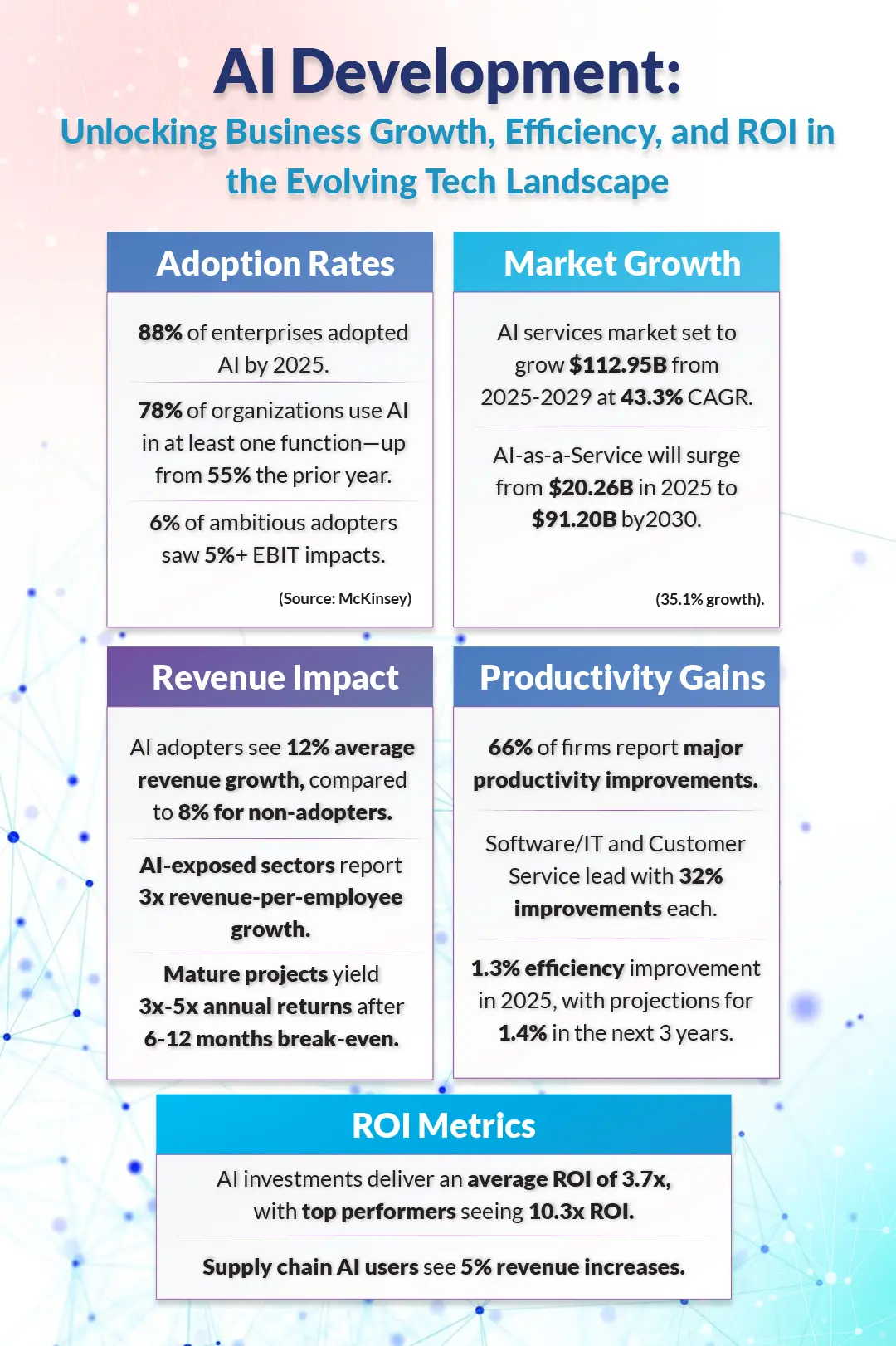
The digital transformation journey has now become a necessity for businesses aiming to stay competitive. AI development services, when evaluated against business needs, offer a host of advantages, making them essential for operations of all sizes. Here's why your business should invest in AI development:
1. Increased Efficiency Through Automation
An important advantage of AI is its ability to automate repetitive, manual tasks. From automating customer support through chatbots to streamlining financial operations with predictive algorithms, AI can save time, reduce errors, and free up human workers for more complex tasks.
- Faster Processing: Automation powered by AI can handle tasks in seconds, something that would take human workers hours or even days to complete.
- Cost-Effectiveness: With fewer manual processes, businesses can reduce staffing costs and increase their overall profitability.
2. Data-Driven Decision Making
AI can analyze vast amounts of data and extract actionable insights that would be impossible for humans to identify. This data-driven approach assists businesses to make informed decisions quickly, thereby improving the quality of strategic planning and operational decisions.
- Real-Time Analysis: AI systems can process data in real time, providing businesses with up-to-date insights to inform decision-making.
- Enhanced Forecasting: Businesses can use AI to predict future trends, helping them stay ahead of their competition and prepare for changes in demand.
3. Personalized Customer Experience
AI helps businesses provide personalized experiences by analyzing customer data and tailoring interactions based on preferences, behaviour, and past purchases. From personalized email campaigns to targeted product recommendations, AI enables businesses to keep their customers engaged more effectively.
- Targeted Marketing: AI analyzes customer behaviour to deliver the most relevant advertisements and promotional content, improving conversion rates.
- Personalized Product Recommendations: By analyzing past purchases and browsing history, AI recommends products most likely to interest each customer.
4. Cost Savings
Though the initial investment in AI development services may seem high, the long-term savings are significant. AI can reduce the need for manual labour, minimize errors, and optimize business processes. This overall reduction in operational costs, especially over time, provides a substantial return on investment.
- Efficiency Gains: Automating time-consuming tasks allows businesses to operate more efficiently, lowering overall operational costs.
- Error Reduction: AI systems are less likely to make errors, lowering the risk of costly mistakes caused by human oversight.
5. Competitive Advantage
In a crowded marketplace, AI development solutions can help you differentiate your business. Companies using AI can make faster, more accurate decisions, improve customer interactions, and adapt to market changes more quickly, keeping them ahead of competitors.
- Innovation: By integrating AI into their systems, businesses can adopt cutting-edge technologies that distinguish them from the competition.
- Agility: AI systems allow businesses to react faster to changes in the market and customer requirements, providing a competitive advantage over those who are slower to adjust.
Key Benefits of AI Development Services for Your Business
Beyond the immediate advantages, AI offers several long-term benefits that can position a business for sustained growth:
1. Scalability
As a business grows, AI solutions can scale alongside it. Whether they are handling increasing volumes of data, customer interactions, or transactions, AI systems are highly adaptable and can scale without requiring significant re-engineering.
- Cloud-Based Solutions: Many AI platforms are cloud-based, enabling them to scale quickly without the need for significant upfront infrastructure investment.
- Flexible Capacity: AI systems can adjust to accommodate growing data sets and user demands, ensuring seamless growth for businesses.
2. Precision and Accuracy
AI excels at processing data with high precision, reducing human error. From detecting fraud in financial transactions to predicting maintenance needs in machinery, AI ensures that business operations run with minimal risk.
- Error-Free Operations: By minimizing human error, AI ensures that businesses maintain high-quality standards across various processes.
- Predictive Capabilities: AI can make highly accurate predictions through data analysis, helping businesses avoid risks and capitalize on opportunities.
3. 24/7 Operation
Unlike humans, AI systems don’t need breaks. Whether it's a chatbot providing customer support or an AI-driven inventory management system, AI solutions can operate around the clock, allowing the business to run smoothly at all times.
- Always-On Support: AI chatbots and virtual assistants can provide uninterrupted support for customers, ensuring they have access to help whenever they need it.
- Continuous Monitoring: AI systems can monitor operations in real time, enabling immediate responses to issues as they arise.
How to Choose the Right AI Development Partner
Choosing the appropriate custom AI development partner is a vital choice that can greatly influence your business's growth and success. If the wrong partner is chosen, it can lead to inefficient AI solutions, wasted resources, and missed opportunities, ultimately hindering your company's growth and competitive edge. Here’s what you should consider:
1. Experience and Industry Knowledge
Businesses should look for a partner with proven experience in AI development, especially within their industry. A company with a deep understanding of the business's specific challenges and objectives is more likely to deliver superior results.
2. Technical Expertise
Make sure the development team is skilled in the most current AI technologies and frameworks, such as TensorFlow, PyTorch, and Keras. These are crucial for creating scalable and reliable AI solutions.
3. Customization Capabilities
AI solutions should be designed to meet a business's specific needs. It is important to collaborate with a partner that provides custom AI development services, rather than relying on generic, pre-made solutions.
4. Long-Term Support
AI is an evolving technology, and businesses should choose a development partner that provides ongoing support and maintenance. This ensures that AI systems continue to perform optimally as the business grows and adapts to new challenges.
Incorporating AI development services into a business strategy has become a necessity rather than an option for staying competitive and achieving sustained growth. With AI’s capacity to automate processes, generate valuable insights, and improve customer experiences, the advantages for businesses are vast. By partnering with the right AI development company, businesses can fully leverage AI's power, optimize operations, and position themselves for success in an increasingly digital landscape.
Frequently Asked Questions
1. Which industries gain the most from AI development services?
AI is transforming industries like healthcare (diagnostics), finance (fraud detection), retail (personalized shopping experiences), and manufacturing (predictive maintenance), among others.
2. How much does AI development cost?
3. Can small businesses afford AI development services?
4. How long does it take to implement an AI solution?
5. How does AI improve customer service?
6. Can AI systems grow as my business grows?
7. What are the challenges in AI development?
Request a
Free Quote Today!


