


Table of Contents


Artificial intelligence is no longer limited to large technology companies with massive research budgets. Startups across the United States are now building AI-powered products for healthcare, fintech, retail, logistics, SaaS, cybersecurity, and customer support.
However, one major problem continues to slow down early-stage founders: many startups invest heavily in AI products before validating whether users actually need them.
This is where the concept of an AI MVP becomes important. An AI MVP, or Artificial Intelligence Minimum Viable Product, allows startups to test an AI idea with limited investment before building a large-scale system. Many startups today partner with an experienced AI/ML development company to build lean MVPs that can be tested quickly in real market conditions. Rather than spending years on development, they focus on rapid experimentation, user feedback, and measurable outcomes.
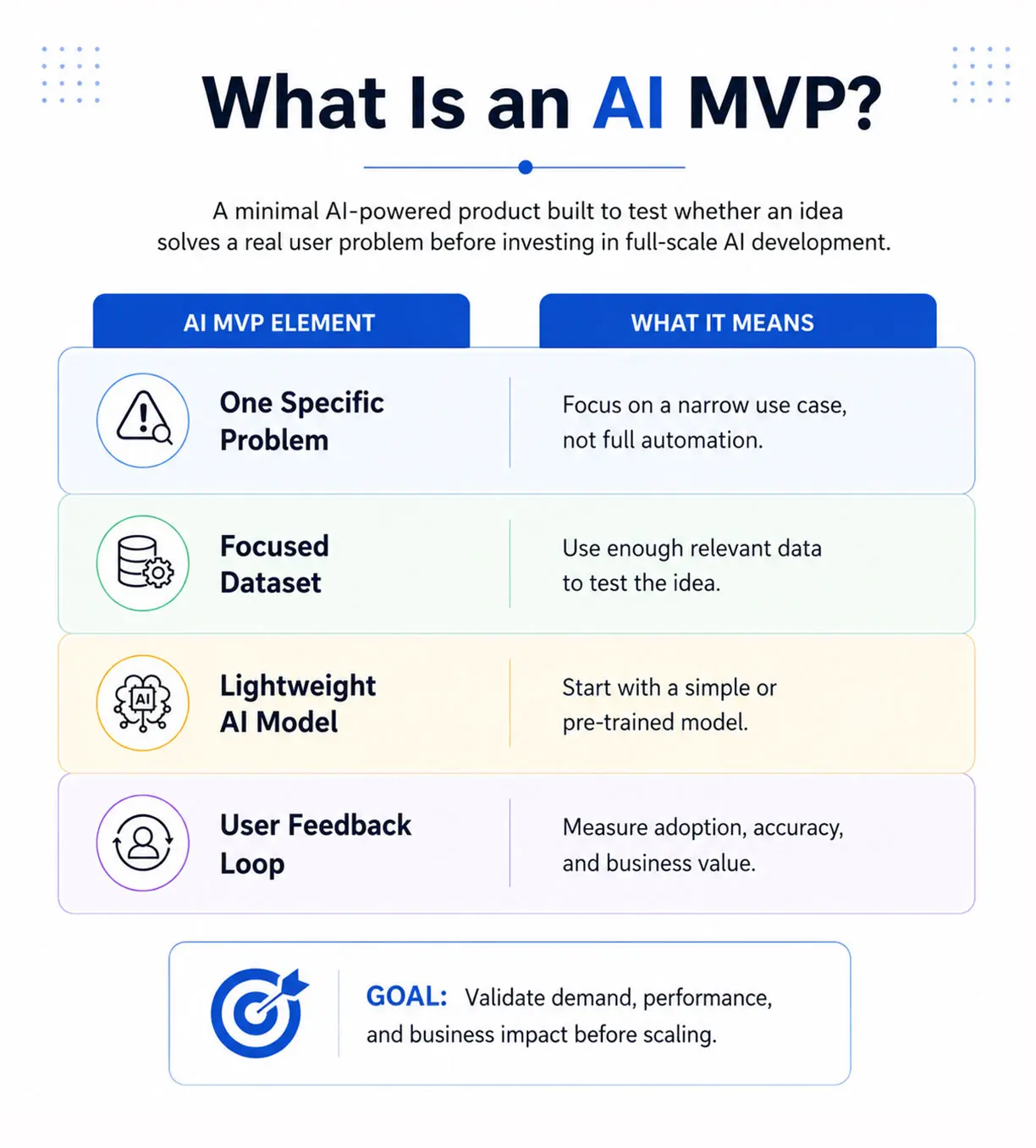
This article explains what an AI MVP is, how it differs from a traditional software MVP, the core components involved, common mistakes startups make, and how businesses can validate AI ideas without exhausting their budget.
What Is an AI MVP?
An AI MVP is the simplest version of an AI-powered product that includes only the minimum functionality required to test whether the solution delivers value to real users.
The goal here is not to build a perfect AI system. It is to validate whether users genuinely need the AI solution, whether the feature solves a measurable business problem, and whether the product can generate meaningful engagement. At the same time, startups also evaluate whether the business model is sustainable and whether the AI model performs reliably in practical environments.
An AI MVP typically focuses on one narrowly defined problem instead of attempting to automate an entire workflow.
For instance, a healthcare startup may test an AI symptom recommendation engine instead of building a complete hospital automation platform. A fintech company may validate an AI fraud detection system for a limited transaction category before scaling it further. Similarly, an e-commerce startup may launch a recommendation engine for a single product category, while a SaaS company may release a basic AI chatbot capable of handling only common support queries.
An experienced AI/ML development company generally recommends building lightweight systems first because AI products improve through continuous learning, feedback, and iteration.
Unlike traditional software products, AI systems depend heavily on data quality, training accuracy, and real-world behaviour. This means assumptions made during development often change once users begin interacting with the system.
That is why startups increasingly use AI/ML development services to create validation-focused MVPs before committing large budgets to production-scale AI infrastructure.
The 5 Core Components of a Lean AI MVP
A successful AI MVP is not simply a smaller version of a large AI product. It must contain the essential components required to validate technical feasibility and user demand.
1. A Clearly Defined Business Problem
Many startups fail because they start with the technology instead of the business problem.
A lean AI MVP begins with a highly specific use case.
A poor example would be:
“Build an AI platform for e-commerce.”
Instead, a better example:
“Reduce abandoned carts by recommending products based on browsing behaviour.”
Hence, a narrow problem statement makes it easier to measure outcomes, train relevant models, collect meaningful feedback, reduce development costs, and improve prediction accuracy. A skilled AI/ML development company usually spends significant time identifying the exact workflow that requires automation or prediction before development starts.
2. A Focused Dataset
Data is the backbone of any AI system — but there's a widespread misconception among startups that you need millions of records before anything meaningful can be built. The truth is, most early-stage AI products get off the ground with far leaner, well-organized datasets.
Early-stage teams typically piece together their data from a mix of sources - public repositories, synthetically generated samples, third-party APIs, internal operational records, or even manually tagged inputs. None of these is glamorous, but together they're often enough to stress-test whether the core AI idea actually holds up.
This is also where experienced AI/ML development partners earn their keep - helping founders honestly assess whether what they have on hand is genuinely sufficient to move forward, or whether gaps exist that need addressing before real validation can happen.
3. A Lightweight AI Model
Not every AI MVP requires a highly customized deep learning architecture. Many successful MVPs use pre-trained language models, recommendation systems, regression models, basic classification algorithms, rule-assisted machine learning techniques, or cloud AI APIs. These approaches allow startups to move faster while keeping development costs under control. The objective is speed and validation.
For example, using a pre-trained natural language processing model can reduce development time significantly compared to training a large language model from scratch.
An experienced AI/ML development company typically recommends simpler models during the MVP stage because they require lower infrastructure costs, need less training data, deploy faster, simplify debugging, and improve iteration speed.
4. A Simple User Interface
A lean AI MVP does not need complex design systems. The interface should simply allow users to:
- Input information.
- Interact with the AI system.
- Receive results.
- Provide feedback.
At this stage, usability matters more than visual perfection. Many startups spend too much money on UI polish before validating whether the AI feature itself creates value.
5. Analytics and Feedback Mechanisms
An AI MVP without measurement is ineffective.
Startups must track:
- Prediction accuracy
- User engagement
- Retention metrics
- Error rates
- Customer satisfaction
- Conversion impact
- Operational efficiency improvements
Analytics help founders understand whether the AI system is improving business outcomes. This is one reason why businesses work with an AI/ML development company that understands both machine learning engineering and product analytics.
Without proper tracking systems, startups cannot determine whether the MVP should be improved, pivoted, or discontinued.
What Is the Difference Between an AI MVP and a Regular Software MVP?
Although both concepts focus on validating ideas with minimal investment, AI MVPs differ significantly from traditional software MVPs.
| Factor | AI MVP | Regular Software MVP |
|---|---|---|
| Core Functionality | Focuses on predictions, automation, and intelligent decision-making using machine learning models | Focuses on predefined software functionality using fixed business logic |
| Data Dependency | Requires training data to generate accurate outputs | Usually operates using structured workflows without model training |
| Output Nature | Produces probabilistic outputs based on learned patterns | Produces deterministic outputs with predictable behaviour |
| Performance Improvement | Improves continuously through retraining and feedback loops | Improves mainly through software updates and feature additions |
| Infrastructure Requirements | May require GPUs, model hosting, inference systems, and data pipelines | Typically uses standard backend and hosting infrastructure |
| Testing Complexity | Requires testing for accuracy, bias, precision, recall, and model drift | Primarily tested for functionality, usability, and bugs |
| Maintenance Requirements | Needs continuous monitoring and retraining | Requires standard software maintenance and updates |
| Success Metrics | Measured through prediction quality, accuracy, and business impact | Measured through engagement, usability, and revenue metrics |
The biggest difference between an AI MVP and a regular software MVP is that AI systems evolve continuously based on data and user interactions. Traditional software products usually follow fixed logic, while AI systems improve through learning, retraining, and feedback.
An experienced AI/ML development company typically approaches AI MVP development differently because machine learning systems require ongoing optimization after deployment. Businesses using AI/ML development services must therefore plan for long-term model monitoring and improvement rather than treating the launch as the final stage of development.
A Step-by-Step Framework to Build Your AI MVP
Building an AI MVP requires structured execution. Startups that rush into model development without proper planning often waste both time and funding.
Step 1: Identify a High-Impact Business Problem
The first step in building your own AI MVP is selecting a problem that creates measurable business value.
Strong AI MVP opportunities usually involve repetitive manual work, large datasets, pattern recognition, prediction tasks, personalization, or decision-support workflows where machine learning can create measurable operational improvements.
Some of the common examples include customer support automation, demand forecasting, risk scoring, lead qualification, recommendation engines, and document processing systems. The business problem here should be specific enough to measure success clearly. Also, a reliable AI ML development company helps startups avoid vague problem definitions that increase project complexity.
Step 2: Validate Whether AI Is Actually Necessary
The next step is to understand whether AI is needed because not every problem requires machine learning. Some workflows can be solved using:
- Rule-based automation
- Traditional software logic
- Workflow systems
- Standard analytics
AI should only be used when the problem involves:
- Complex pattern recognition
- Dynamic decision-making
- Natural language understanding
- Predictive behaviour
- Large-scale classification
Using AI unnecessarily increases infrastructure costs and development timelines. Experienced providers offering AI/ML development services typically conduct feasibility assessments before model selection.
Step 3: Collect and Prepare Data
This third step is all about sata preparation as it is one of the most time-consuming parts of AI development. This stage includes cleaning records, removing duplicates, handling missing values, structuring datasets, labelling information, and filtering irrelevant entries to improve model reliability.
Also, it is important to consider that poor-quality data produces weak model performance. For example:
- Inconsistent customer labels reduce recommendation quality.
- Incorrect transaction data affects fraud detection.
- Noisy chat logs weaken NLP systems.
A strong AI/ML development company invests heavily in data preparation because model quality depends directly on the quality of the training data.
Step 4: Choose the Right AI Approach
The model selection process depends on the business objective. Some of the examples include:
- Classification models for spam detection
- Regression models for forecasting
- NLP systems for chatbots
- Recommendation engines for e-commerce
- Computer vision for image analysis
Many startups overcomplicate this stage. A lean MVP should prioritize:
- Fast deployment.
- Lower computational cost.
- Easy iteration.
- Sufficient performance.
This is why many AI/ML development services use pre-trained models during the MVP stage rather than building highly customized architectures.
Step 5: Build a Lightweight Frontend
The frontend should allow real users to interact with the AI system quickly. At this stage, startups should avoid:
- Large design investments.
- Complex animations.
- Excessive feature sets.
- Enterprise-grade dashboards.
Instead, they should focus on:
- Clear workflows.
- Fast interactions.
- Easy onboarding.
- Feedback collection.
Here, the primary goal is user validation.
Step 6: Launch to a Controlled User Group
AI MVPs should initially launch to:
- Beta users
- Internal teams
- Pilot customers
- Early adopters
This controlled rollout helps startups identify:
- Prediction errors
- Usability problems
- Performance bottlenecks
- Model bias
- Unexpected user behaviour
A capable AI/ML development company generally recommends gradual rollouts because real-world AI behaviour often differs from test environments.
Step 7: Measure Performance and Iterate
After launch, startups should evaluate both technical and business metrics. The technical metrics include:
- Accuracy
- Precision
- Recall
- Latency
- Model confidence
Essential business metrics include:
- Customer retention
- Revenue impact
- Productivity gains
- Reduced manual effort
- Conversion rates
- Iteration
Feedback and retraining are necessary to enhance AI systems. AI and ML professionals will assist companies in creating long-term optimization procedures for their projects instead of treating them as one-off projects.
How Long Does It Take to Build an AI MVP?
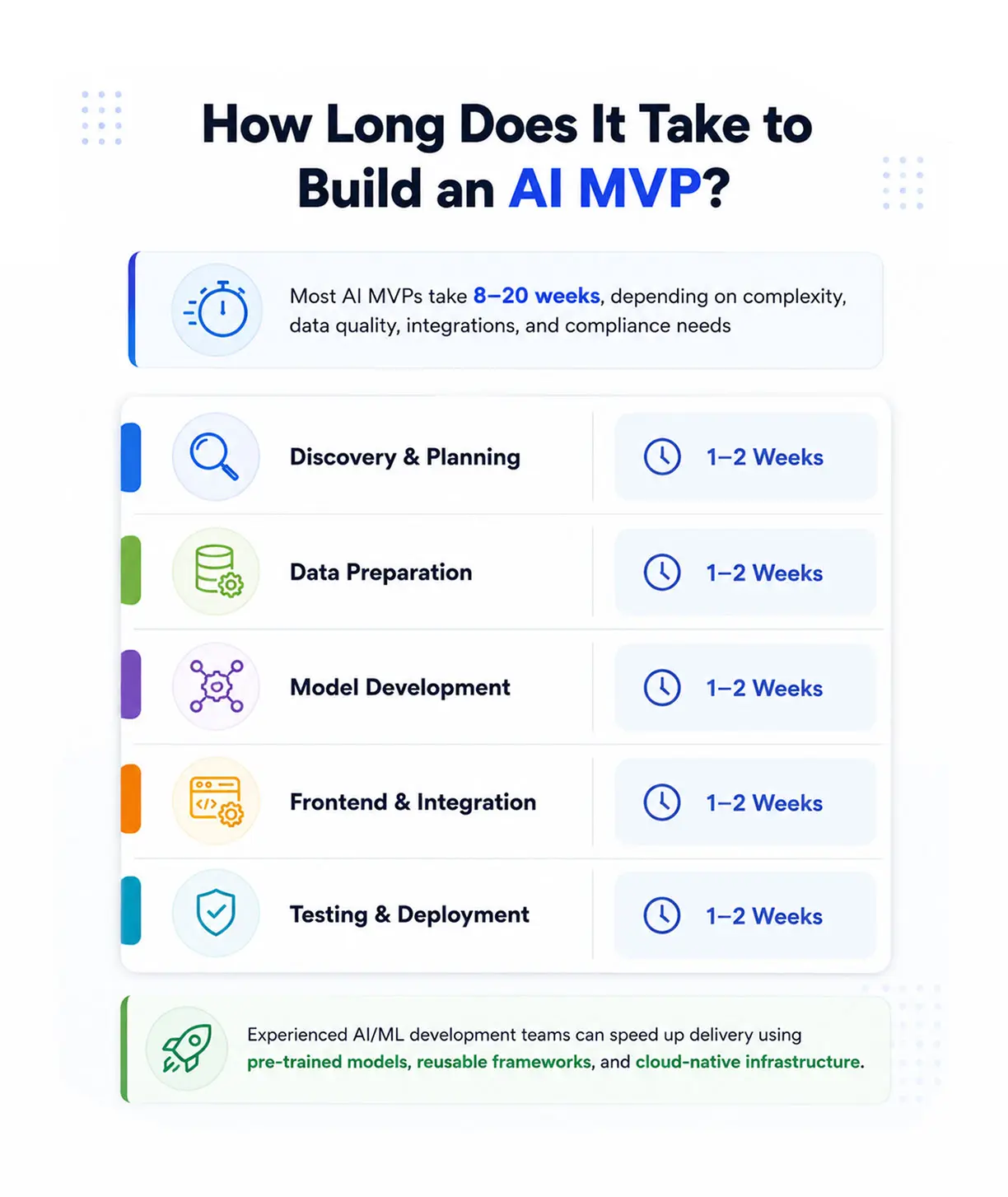
The development timeline depends on:
- Project complexity.
- Dataset quality.
- Model type.
- Integration requirements.
- User interface scope.
- Compliance requirements.
That said, most AI MVPs take between eight and twenty weeks.
Typical Timeline Breakdown
1. Discovery and Planning: 1–2 Weeks
This phase includes problem definition, technical feasibility analysis, requirement gathering, data assessment, and architecture planning.
2. Data Preparation: 2–5 Weeks
This stage often consumes the most time. Tasks during this stage include cleaning datasets, labelling records, structuring data pipelines, and identifying data gaps.
3. Model Development: 2–6 Weeks
This stage involves model selection, training, validation, fine-tuning, and testing.
4. Frontend and Integration: 2–4 Weeks
This phase covers:
- User interface development.
- API integration.
- Backend configuration.
- Authentication systems.
Testing and Deployment: 1–3 Weeks
This stage generally includes QA testing, performance optimization, monitoring setup, and controlled rollout.
An AI/ML development company with extensive experience will reduce the project's timeline by leveraging reusable AI framework libraries, pre-trained models and cloud-native infrastructure. In addition, many startups do not have enough experience developing their own AI solutions. This often leads to added development time and cost for the startup. Therefore, more businesses are outsourcing the execution of their MVPs to AI/ML development services companies that specialize in MVP development.
How to Measure Whether Your AI MVP Is Working Smoothly
Launching an AI MVP is only the beginning. The real challenge is determining whether the product performs effectively under real-world conditions.1. User Adoption
The first sign to know if your product is validated is consistent user engagement with your AI feature. The primary measurements for user engagement include active users, usage frequency, repeat usage, feature engagement, and customer retention metrics. If you see a healthy amount of activity within these metrics, then you can assume that customers are continuously creating value with your AI feature.
2. Prediction Accuracy
AI systems must deliver reliable outputs. Depending on the use case, startups may measure:
- Precision
- Recall
- F1 score
- Error rates
- Classification accuracy
For example:
- A fraud detection system with excessive false positives frustrates users.
- A recommendation engine with irrelevant suggestions reduces engagement.
- An AI chatbot with poor intent detection lowers customer trust.
A professional AI/ML development company continuously monitors model performance to maintain reliability.
3. Response Time
In today’s times, users expect fast AI interactions because slow response times negatively affect:
- User experience
- Customer trust
- Product adoption
Here, latency becomes especially important in:
- Financial applications
- Customer support systems
- Real-time analytics
- E-commerce recommendations
Efficient AI/ML development services optimize infrastructure to reduce inference delays.
4. Business Impact
A Minimum Viable Product (MVP) can be used to establish measurable operational improvement or financial improvement. Some examples would be:
- Reduced support costs.
- Faster processing times.
- Higher conversion rates.
- Increased retention.
- Improved customer satisfaction.
- Better decision-making efficiency.
If the AI system fails to improve business metrics, scaling may not be justified.
5. Feedback Quality
Qualitative feedback matters as much as technical metrics. Startups should analyze:
- User complaints
- Feature requests
- Support tickets
- Behavioral patterns
- Customer interviews
This helps identify areas requiring retraining or workflow adjustments.
Common Mistakes to Avoid When Building Your First AI MVP
Many startups fail during the MVP stage because they focus on technology hype instead of business fundamentals.
1. Trying to Build Too Many Features
A lean MVP should solve one primary problem. Startups often attempt to include:
- Multiple AI modules.
- Complex automation systems.
- Enterprise dashboards.
- Large integrations.
This generally increases development cost, technical debt, testing complexity, and infrastructure expenses.
Therefore, a focused AI/ML development company generally recommends starting with one core workflow.
2. Ignoring Data Quality
AI systems are only as good as the data they learn from.
Poor-quality data leads to:
- Biased predictions
- Incorrect outputs
- Low accuracy
- User distrust
Businesses investing in AI and ML development services should prioritize structured data management from the beginning.
3. Overengineering the AI Model
Most entrepreneurs mistakenly believe that advanced deep learning models automatically provide improved outcomes.
In reality:
- Simplicity leads to ease of deployment.
- Lightweight architecture saves money.
- Small systems simplify debugging
- Faster iterations enhance learning cycles.
MVPs should focus on validating solutions rather than adding technical complexity.
4. Failing to Define Success Metrics
Without measurable goals, startups cannot determine whether the MVP works.
Clear KPIs may include:
- Reduced churn.
- Faster processing time.
- Increased engagement.
- Improved lead quality.
- Lower operational costs.
An experienced AI/ML development company helps define realistic performance benchmarks before development begins.
5. Underestimating Infrastructure Costs
Building an AI system may require cloud GPUs, model hosting, storage systems, continuous training pipelines and monitoring infrastructure.
It is important to consider that poor infrastructure planning can increase monthly expenses rapidly. Therefore, professional AI/ML development services often use scalable cloud architectures to control operational costs during the early stages.
When Should a Startup Move From an AI MVP to a Full AI Product?
Scaling too early is one of the biggest reasons AI startups burn through funding. A startup should only transition from MVP to full product development when the solution demonstrates consistent value.
Strong User Adoption
Users repeatedly engage with the AI feature and integrate it into their workflows.
Measurable Business Results
The AI system improves:
- Revenue
- Efficiency
- Retention
- Customer satisfaction
- Operational speed
Stable Model Performance
Prediction accuracy remains consistent across larger datasets and broader user scenarios.
Clear Product-Market Fit
Customers actively request expanded functionality or paid plans.
Scalable Infrastructure Readiness
The startup has a technical foundation capable of supporting:
- Higher traffic.
- Larger datasets.
- Additional integrations.
- Continuous retraining.
An experienced AI/ML development company can help startups transition from MVP infrastructure to production-grade AI systems without rebuilding everything from scratch.
AI MVPs offer startups with a practical approach to perform testing intelligent product ideas without making large financial commitments too early. Hence, instead of building massive AI platforms based on assumptions, businesses can validate demand through focused, measurable experiments. Also, for many startups in the United States, partnering with a specialized AI/ML development company helps reduce technical risk while accelerating product validation. Experienced providers offering AI/ML development services can guide startups through data preparation, model selection, infrastructure planning, deployment, and optimization without unnecessary complexity.
Frequently Asked Questions
1. How much does it cost to build an AI MVP for a startup?
An AI MVP's construction costs are affected by many factors, including how complex the project is to complete and how much data is available to train your models. For projects that have a low complexity and require fewer functions, costs can range from US $15,000 to $50,000, while for projects that require the training of custom models, integration with third-party platforms, and/or working with large amounts of data, costs will likely exceed $100,000.
By working with a company that specializes in AI and/or machine learning, new businesses can help locate and prioritize key features and eliminate spending that is unnecessary while validating their concept.
2. What should an AI MVP include?
3. How do I validate an AI MVP with real users?
4. Can I build an AI MVP without a large dataset?
5. How do I choose the right AI development partner to build my startup’s AI MVP?
Request a
Free Quote Today!


