


Table of Contents


Most businesses do not just decide one day to build custom software. They arrive at this decision gradually, after months of recurring frustrations. Perhaps reports take far longer to produce than they should, and the tools you have no longer match how your teams actually work. Commercially available software served a real purpose in the early days. It was fast, affordable, and good enough. However, as a company’s operations grow more complex and customers expect faster, more personalized service, non-custom tools start to show their limits.
The concern is that building software from scratch seems to be an expensive and risky proposition. After all, nobody wants to spend time and money on a project that stalls or delivers less than it promised. These are real fears, and they deserve a straight answer before any decision is made.
Here, we discuss how businesses prepare themselves to develop custom software to help you make an informed decision.
How to Know If Your Business Is Ready to Develop Custom Software
Readiness is not just about having the budget in place. It is also about recognizing the signs that your current tools are no longer doing the job and having a clear sense of what custom software can realistically do for your business.
1. Your Current Tools Are Full of Workarounds
According to Tech.us, when teams start exporting data to spreadsheets because the main system cannot produce the right report, or keeping personal checklists because the software misses a step, those workarounds quietly become the actual way work gets done. New staff members have to learn these steps before they can follow the official ones.
Every workaround weakens your data quality. Information ends up in separate places, gets updated at different times, and can no longer be fully relied upon. Plus, workarounds carry a hidden cost in time. Ten minutes per person per day adds up to a significant amount of lost work across a team over a full year. For instance, a company with 20 staff using just one daily workaround loses more than 800 hours annually.
Custom software removes the need for these patches because it is built around how your business actually works, not how a vendor assumed it might.
2. Packaged Software Costs More Than It Saves
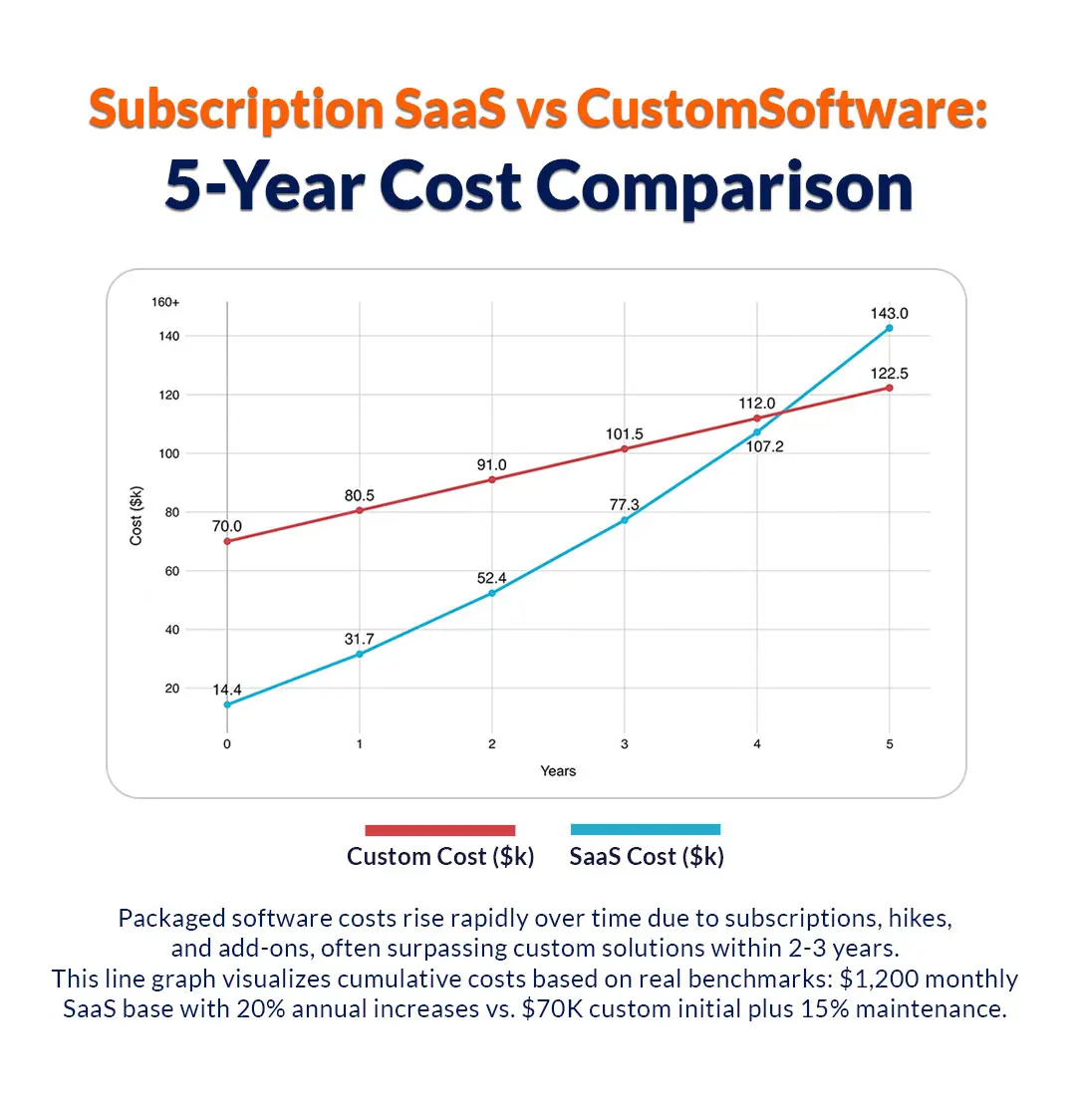
Subscription renewals, integrations that require heavy work, and paying for features teams never use can drain budgets over time. Most growing businesses end up subscribing to multiple platforms and upgrading their plan whenever a new team member joins.
Many vendors charge separately for API access, premium support, and storage upgrades. When you add it all up, the annual spend on stacked subscriptions often rivals what a well-scoped custom build would cost in total.
With readymade software, you are paying indefinitely for a solution you do not fully own. For example, a business paying $1,200 per month across three tools spends $72,000 over five years. These costs include software that may be discontinued, repriced, or stripped of features at any time.
A custom solution is a one-time investment that can be maintained and updated without ongoing licence fees.
3. Your Processes Are Too Specific for Readymade Solutions
Fingent observes that every business has at least one process that no standard tool can fully support, whether that’s a complex approval cycle, a unique way of onboarding clients, or particular compliance requirements.
Industries like healthcare, finance, and logistics run on specific rules and workflows that simply do not fit neatly into general platforms. When a business has its own way of doing things, generic tools cannot accommodate those differences, and the business ends up changing how it works to fit the software rather than the other way around.
Software development and consulting services have become much more accessible in recent years, making a custom build a realistic option for mid-sized businesses, not just large enterprises. For instance, businesses that invest in software built around their specific processes consistently report that staff settle in faster and feel more confident in their work because the system matches how they actually operate.
4. Scaling Up Breaks Your Current System
Tech.us highlights that growth is supposed to feel rewarding. But for many businesses, taking on more clients, new locations, or additional team members puts real pressure on the software holding everything together.
Things slow down, errors show up in places they did not before, and teams end up spending more time fixing problems than doing actual work. Most standard platforms are built for an average-sized business, not for a company at a specific and fast-moving stage of growth. When the volume of work or the complexity of operations goes past what the platform was designed for, businesses either pay for a much more expensive plan or learn to live with the gaps.
Plus, those higher-tier plans often come with long contracts and features that still don’t quite fit. For instance, a logistics company that doubled its routes in 18 months may find its dispatch software simply cannot keep up without heavy manual input.
Custom software grows with the business rather than against it.
5. Integration Between Your Tools Is Slow or Broken
According to a Gartner report cited by Odyssey Inc., nearly 63 percent of businesses using standard platforms faced integration problems within two years of getting started. Bringing in third-party tools to bridge the gaps only adds more moving parts, more costs, and more things that can go wrong.
When data moves between systems that were never designed to work together, it rarely transfers accurately. Fields do not line up, records get duplicated, and someone ends up spending time at the end of each week sorting out the differences manually.
These data problems have real consequences downstream, including billing mistakes, unreliable reports, and decisions made on figures that are slightly off. For example, a company connecting its CRM, billing system, and project tool through two different middleware services may be working with information that is hours or even days out of date.
Custom software connects these functions from the inside, so data moves cleanly without the risk of broken connectors in between.
6. You Cannot Get the Data You Need to Make Decisions
If data is scattered across multiple CRM platforms, ERPs, spreadsheets, and older systems, the result is slow and leads to uncertain decision-making. Standard platforms come with fixed report templates that rarely reflect how a specific business tracks its own performance.
When you cannot look at your data the way you need to, decisions either get delayed or get made on incomplete information. Sometimes they do not get made at all because pulling the right numbers together is simply too much work.
Having cleaner and faster access to your own data leads to more confident decisions, and that has real financial value over time.
For instance, a service business that used to export three separate reports just to work out how profitable each client was can now see that figure on one screen, updated in real time.
Custom software is built around the numbers your business actually tracks, in the format that makes sense to you.
7. Your Business Has a Clear Competitive Advantage to Protect
Standard software cannot protect a competitive advantage because every competitor has access to the same tool. When a business builds its best ways of working directly into its own software, those practices become part of how the company runs. They are harder to copy, easier to maintain at scale, and consistently available to every team member.
Having a proprietary system sends a clear signal to clients and investors that the business is well organized and serious about how it operates. A financial planning firm that built its own client onboarding and portfolio tracking system offers its clients an experience that competitors cannot copy. Custom software turns a business strength into something that lasts.
How Much Does It Cost to Create Custom Software?
Cost is the question almost every business asks first, and it deserves a straight answer. The honest answer is that it varies, and that variation follows a pattern, and understanding that pattern helps you budget with confidence.
Project Scope and Complexity Drive the Biggest Cost Differences
According to Soltech, small applications typically run between $100,000 and $200,000, mid-sized apps fall in the $200,000 to $400,000 range, and large enterprise-grade platforms can exceed $400,000 depending on scope. Complexity is not just about features; it is also about the quality of the underlying architecture.
A system built to handle 50 users' needs is different from one built for 50,000. Space-O Technologies notes that the number of screens, the complexity of the data model, and the number of third-party systems that need to connect all influence the final figure.
Small applications typically have 10 to 25 unique screens; mid-size applications, 25 to 40; and large applications, 40 or more. A mid-sized business that wants to replace three separate tools with one system that covers everything should expect to budget for a moderately complex build, not for the cost of a simple standalone application.
The True Cost Comparison: Custom vs. Ongoing Subscriptions
As Artezio reports, the average custom software development project in 2025 costs between US$75,000 and $250,000, though this range masks significant variation based on scope and team location. The honest comparison spans five years.
A business paying $3,000 per month across three tools spends $180,000 over five years—for software it does not own, cannot fully modify, and may lose access to if a vendor changes pricing.
Discipline Infotech advises budgeting 15 to 20 percent of the original development cost per year for post-launch updates and maintenance. This is far lower than the ongoing subscription burden most businesses carry. A company that builds a custom platform for $120,000 and spends $20,000 annually on maintenance has a total five-year cost of $220,000, while keeping full ownership and a system that fits its operations precisely.
Why Are More Businesses Turning to Custom Software Development?
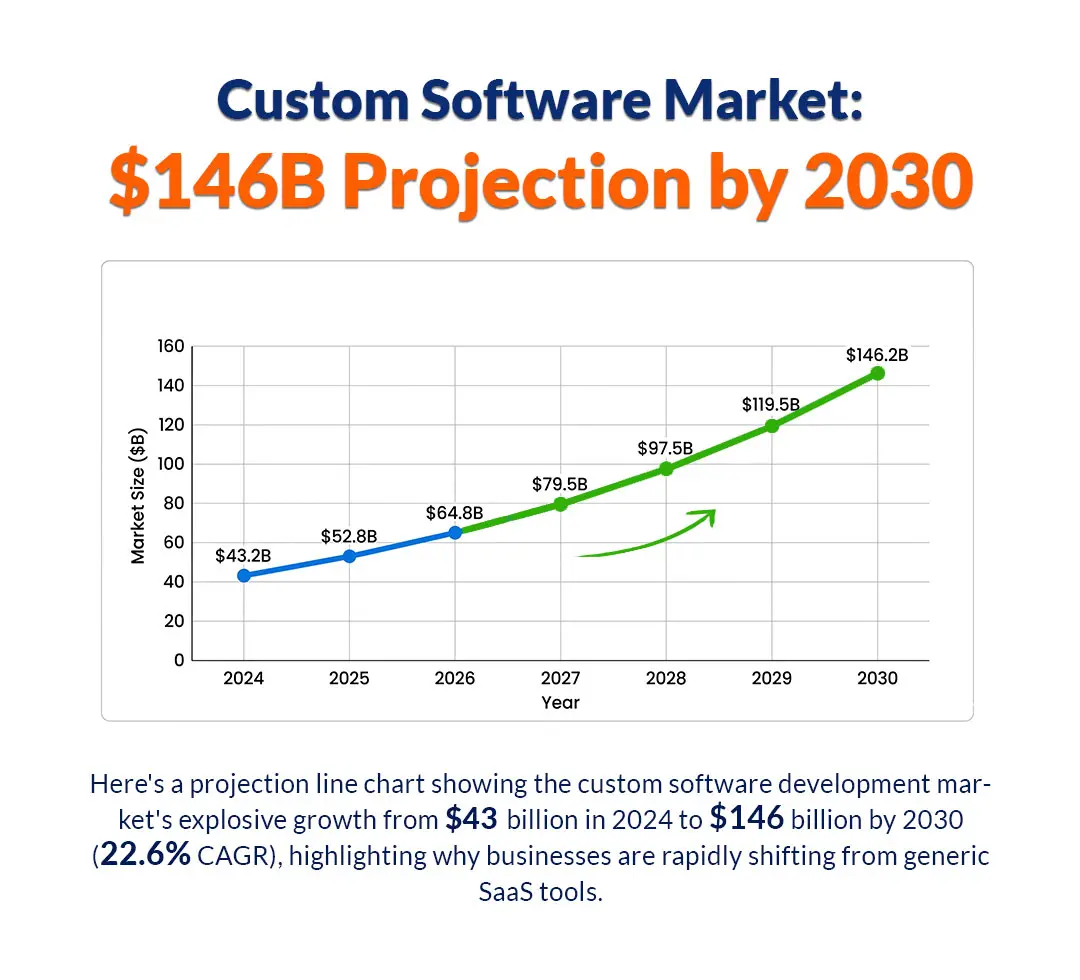
The number of businesses choosing to build their own software has grown steadily over the past few years. According to Grand View Research via Technostacks, the global custom software development market was valued at approximately US$43 billion in 2024 and is expected to reach $146 billion by 2030. Much of that growth comes down to one simple reason, and that is that standard tools are no longer keeping up with what businesses actually need.
Businesses Are Paying More Than They Realize for Generic Tools
Research compiled by Technostacks shows that approximately 80 percent of features in standard SaaS platforms go unused, resulting in an estimated $29.5 billion in wasted research and development spending yearly. Businesses are paying for capabilities that have no relevance to how they actually work.
Also, operational costs from subscription renewals, forced integrations, and add-ons keep rising year after year with no corresponding increase in value.
A Gartner report cited by Odyssey Inc. found that nearly 63 percent of businesses using commercially available software faced integration challenges within two years. For instance, a professional services firm relying on three separate tools to manage client intake, billing, and project tracking may spend more time managing the gaps between tools than serving clients.
Custom software eliminates those gaps by design, because the system is built around the business from the start, not retrofitted to it after the fact.
Security and Data Control Have Become Business-Critical Concerns
Cybersecurity threats have become more advanced, and readymade software is a prime target because the same code runs across thousands of businesses, thereby making any known vulnerability a wide-open door.
Businesses in regulated industries such as healthcare, financial services, and legal sectors face compliance requirements that standard platforms often cannot satisfy without expensive add-ons or manual workarounds.
As Fingent notes, sensitive data needs and regulatory controls are exactly where custom software becomes invaluable. Custom development allows security and compliance protocols to be built into the architecture from day one, rather than patched on afterwards.
For instance, a healthcare provider that needs to track exactly who accessed patient records and when cannot get that level of control from a standard CRM system. Custom development allows security protocols to be designed specifically for the organization’s regulatory environment and risk profile and not for the broadest possible customer base.
AI and Automation Are Raising the Bar for What Software Can Do
A study cited by Odyssey Inc. found that businesses using custom software saw an average of 21 percent higher return on investment within three years compared to those relying on pre-built tools. AI integration into custom software is a powerful combination, as predictive analytics, process automation, and intelligent classification are no longer reserved for technology companies with massive budgets.
Technostacks reports that productivity gains from purpose-built platforms frequently reach 35 to 40 percent, with revenue increases of 20 percent or more via unique digital experiences cited by McKinsey.
For instance, a manufacturing company that builds a custom operations platform with AI-assisted maintenance scheduling can reduce downtime by acting on patterns in its own equipment data. This is something a generic platform cannot replicate with the same accuracy or relevance.
What to Look for in a Custom Software Development Partner
Deciding to build is only part of the equation. The partner you choose determines whether the project delivers what it promises. Here are four qualities that matter.
Proven Experience Across Multiple Sectors
A custom software development partner who has built solutions across industries, from healthcare data platforms to retail automation tools, brings a wider frame of reference to your problem.
They have already solved challenges similar to yours and can apply that knowledge to shorten the time it takes to get your project right. This cross-sector experience reduces the risk of applying the wrong solution to your specific situation. A team that only knows one vertical tends to apply the same solutions regardless of fit.
A strong track record of completed projects is a reliable sign that the team has handled edge cases, client feedback, and post-launch changes in real conditions. For instance, a team that has delivered thousands of projects globally has come across nearly every type of integration challenge, data migration issue, and stakeholder concern, and knows how to manage them without throwing a timeline off course.
AI and Machine Learning Capabilities Built Into the Process
Custom software built today should be designed with tomorrow in mind. AI capabilities such as predictive analytics, process automation, and intelligent data classification are no longer reserved for technology companies with massive budgets. They are becoming standard features of well-built business software.
A development partner who integrates AI and ML from the ground up, rather than adding it on later, produces software that grows smarter over time. The system learns from your data, identifies patterns you might miss, and surfaces insights that support better decisions.
This kind of capability is now within reach for mid-market businesses that previously could not justify the cost. An operations team using an AI-assisted scheduling tool can reduce planning time while also flagging conflicts or resource gaps before they become problems.
A custom software development service that includes AI expertise gives your business the ability to act on data in ways that commercially available software simply cannot match.
Mobile and Web Development Under One Roof
Most modern businesses need their tools to work on multiple surfaces, such as a web application for the back office, a mobile app for field staff, and a client-facing portal for external users. Working with a partner who handles all three in one engagement saves enormous coordination effort.
When the same team builds your web and mobile interfaces, they share context. There are no translation errors between teams, no conflicting design decisions, and no delays caused by miscommunication across vendors.
A unified development team also makes maintenance simpler, with updates rolling out consistently across surfaces. And issues are easier to trace when one team owns the entire stack.
For instance, a property management company that needed both an owner portal and a mobile app for maintenance staff saved months of back-and-forth by working with a single team from start to finish.
A Rigorous Vetting Process for the Engineering Team
The quality of the people building your software is the single biggest factor in whether the project works out.
A partner with a thorough vetting process—one that looks at technical ability, problem-solving, and how well people communicate—gives you a much stronger foundation to work from. A proper vetting process protects you from the most common problem in software projects, which is the gap between what was agreed upon and what gets delivered.
Plus, engineers who have been assessed carefully tend to take more responsibility for their work. They ask better questions before starting, raise concerns early, and suggest solutions that account for real-world constraints.
For instance, a team that has passed a multi-stage technical and practical assessment is far less likely to misread a requirement or miss a security concern than a team that was pulled together quickly to meet a deadline. The people doing the work shape everything that comes out of it.
Deciding to develop custom software is one of the more meaningful investments a business can make. It requires honest preparation, including a clear picture of your current gaps, a realistic view of costs, and a partner you trust. When those pieces are in place, custom software stops being a risk and starts being an asset. Sourcedesk has helped businesses across sectors build software that fits the way they work and not the way a vendor imagined they might. If the signals in this article feel familiar, it may be time to have that conversation.
Frequently Asked Questions
Q1. How do I know if my business is ready for custom software or if a commercially available tool will do?
The clearest sign is repetition, specifically, the repetition of workarounds, data reconciliation tasks, and staff complaints about a tool not fitting how they work. Businesses rarely reach a breaking point overnight. They typically reach a stage where everyday work takes more effort than it should.
If your team regularly exports data to spreadsheets to do things the platform cannot, or if you are paying for multiple tools that still do not cover your full process, you are likely past the point where a generic solution will serve you well.
Fingent notes that when generic platforms become restrictive, slow, or require endless workarounds, that is the cue to consider a purpose-built solution. If your current toolset requires more than two layers of manual work to produce a weekly report, a custom-built solution will likely pay for itself in recovered staff time within the first year.
Q2. How long does it take to build custom software?
Q2. How long does it take to build custom software?
Q3. What is the difference between custom software and commercially available software?
Q3. What is the difference between custom software and commercially available software?
Q4. Can custom software be updated and maintained after launch?
Q4. Can custom software be updated and maintained after launch?
Q5. What is the biggest risk in a custom software project, and how is it managed?
Q5. What is the biggest risk in a custom software project, and how is it managed?
Q6. Do I need a technical background to work with a custom software development team?
Q6. Do I need a technical background to work with a custom software development team?
Request a
Free Quote Today!


