


Table of Contents


For many B2B companies, the challenge is no longer whether AI should be used but how it should be introduced into their business process without disturbing daily work. Teams already depend on CRMs, ERPs, accounting tools, helpdesk platforms, and reporting systems to manage customers, orders, finances, and internal decisions.
If AI is added without a clear plan, it can create more confusion than value. This is why an AI/ML integration roadmap matters. It helps a business decide where AI should be used first and how the results will be measured.
With the right plan and support from AI/ML development services, companies can test AI in a controlled way and adopt it without disrupting their existing operations. The next step is to understand why a structured roadmap is so important for B2B AI adoption.
Understanding AI/ML Integration in Simple Business Terms
AI/ML integration into business operations means adding intelligent features to the software and workflows a company already uses. These features can study data, identify patterns, suggest actions, detect risks, or automate selected tasks.
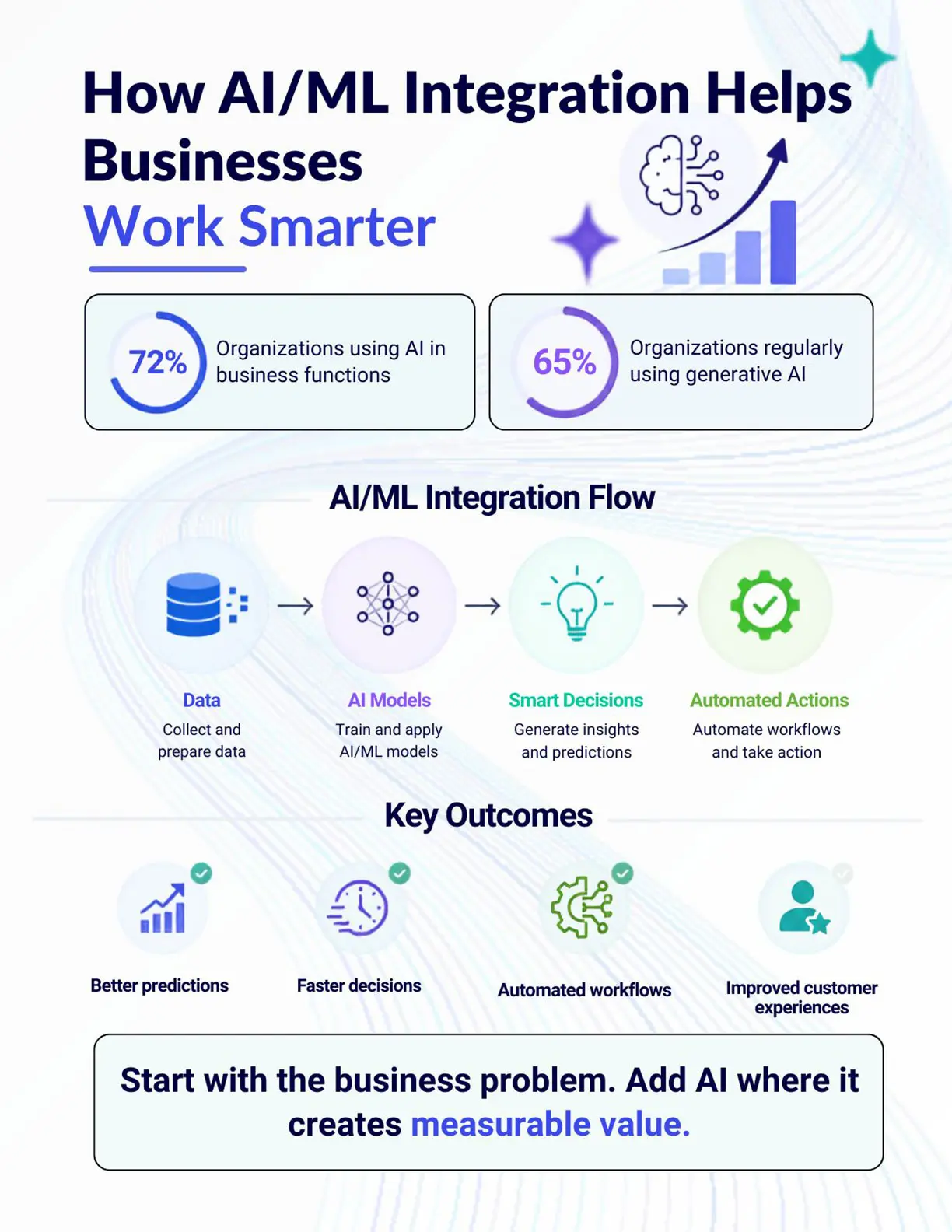
In simple terms:
- AI helps software make useful recommendations or decisions.
- Machine learning helps software learn from past data.
- Integration connects these abilities with existing business systems.
An AI/ML development company can help determine whether the business needs a small AI feature, a custom application, or a larger system upgrade. This decision should be based on your business’s needs, not trend pressure.
Understanding the AI/ML Integration Roadmap for B2B Companies
An AI/ML integration roadmap gives your company a clear path from early planning to full adoption. It reduces confusion and helps different teams work toward the same goal. Let’s explore the steps involved in this integration.
Step 1: Identify the Business Problem First
The first step is to exactly define the business problem you want solved. You shouldn’t attempt to add AI into your business process just because it seems like the right thing to do. It should solve a specific issue that affects your costs, time spent, work accuracy, revenues, customer experience, or team productivity.
Some of the problems that businesses need to highlight are:
- Sales teams are spending too much time on poor-fit leads.
- Support teams are struggling to sort customer tickets.
- Finance teams are reviewing too many documents manually.
- Operations teams are dealing with repeated planning errors.
- Managers are waiting too long for reports.
- HR teams are spending excessive time on résumé review.
The problem should be clear enough to measure so that necessary actions can be taken.
Step 2: Review Current Systems and Workflows
Once the team clearly understands the problem, the company should review the systems associated with it. This may include checking software, data sources, approval steps, user roles, and manual work.
A proper workflow review should answer some of the following questions, including:
- Which teams are involved?
- Which tools do they use?
- Where does the data come from?
- Which steps are manual?
- Where do delays happen?
- Which decisions need human approval?
- Which parts of the process cannot be interrupted?
This review helps the business understand how AI can fit into daily work. It also prevents the company from building a solution that looks good in theory but does not match real operations.
Step 3: Check Data Readiness
AI depends heavily on data. So, if the data is incomplete, outdated, duplicated, or poorly organized, the output will not be reliable. That is why data preparation is often one of the most important parts of AI implementation.
A company should check the following:
- Whether the data is accurate
- Whether important fields are missing
- Whether records are duplicated
- Whether different systems use different formats
- Whether sensitive data is protected
- Whether data access follows company rules
- Whether the data is updated often enough
Data does not need to be perfect from day one, but it must be good enough for the selected use case. If data quality is poor, the first phase should focus on fixing that foundation.
A bespoke software development service can help when a company has business-specific data flows that standard tools cannot handle properly. This is common in B2B environments where processes have grown over many years and do not follow a simple pattern.
Step 4: Select the Right First Use Case
The first AI use case should be useful but not overly risky. It should solve a real problem, use available data, and allow human review.
Here is what a good first use case usually contains:
- Clear business value.
- Available data.
- Limited operational risk.
- A small user group.
- Simple success metrics.
- A process that can still run manually.
- Strong support from the team involved.
Examples of good first use cases include lead scoring, invoice exception alerts, support ticket routing, demand forecasting support, document classification, and internal knowledge search.
Step 5: Design the AI Workflow
The AI workflow should explain how the system will work inside the business process. It should not only focus on what the AI can do. It should also define how people will use the AI output.
Here, the design should cover:
- Where users will see AI suggestions.
- Whether AI will recommend or act.
- Who can approve the result.
- What happens when the result is unclear.
- How errors will be reported.
- How the system will be monitored.
- Which data will be stored.
- Which users will have access.
This stage is important because AI must be useful to the people who work with it every day. If the workflow is confusing, adoption will remain weak.
Step 6: Build a Pilot Version
A pilot is a small version of the AI solution. It is tested with a limited number of users, limited data, and clear goals. The pilot should not immediately replace the full process.
During the pilot, the business should check:
- Whether the output is useful.
- Whether users understand it.
- Whether the results are accurate enough.
- Whether the process saves time.
- Whether any new risk appears.
- Whether the current workflow is affected.
A pilot allows the company to learn before expanding the solution. It also reduces pressure on employees because the change is limited.
Step 7: Roll Out Gradually
After a successful pilot, the AI solution can be expanded in stages. This may mean adding more users, locations, departments, or data sources.
A gradual rollout helps the company:
- Training employees properly.
- Monitoring the performance.
- Collecting feedback.
- Fixing issues early.
- Reducing sudden disruptions.
- Building internal confidence.
- Controlling cost and risk.
The rollout should include clear documentation and support. Teams should understand how the tool works, when to use it, and when human judgment is still needed.
Step 8: Monitor and Improve the System
It is important to consider that AI is not a one-time setup. In short, it needs regular review. Business conditions change, customer behaviour changes, and data patterns change. If the system is not monitored, results can become less useful over time.
The company should track:
- Accuracy.
- Time saved.
- Adoption rate.
- Error rate.
- Cost impact.
- Revenue impact.
- Customer response time.
- Employee feedback.
- Compliance concerns.
Hence, monitoring helps the company improve the AI system and decide when it is ready for wider use.
What Is the Typical Timeline for Integrating AI/ML Into Existing Software Systems?
The timeline depends on the size of the company, the condition of current systems, the quality of data, and the complexity of the selected use case. A simple AI feature may be planned and tested within a few months. A larger project that connects several systems may take longer.
For many B2B companies, a practical first AI/ML implementation can take three to twelve months. This timeline usually covers discovery, data review, pilot development, testing, and gradual rollout. It does not mean the whole company becomes AI-powered within that period. It means one meaningful business use case can move from planning to active use.
A company with clean data and modern systems may move faster. A company with scattered data, older software, or unclear ownership may need more preparation. That preparation should not be viewed as wasted time. It protects the business from weak results later.
The timeline also depends on the type of solution. A standard tool may work for a common task, while custom AI features may be needed for complex workflows. Companies often use AI/ML development services when they need support with scoping, system planning, testing, and controlled adoption.
How Can Businesses Implement AI Without Downtime or Operational Disruption?
AI can be implemented without major downtime when the company doesn’t suddenly replace its current work processes. The safest approach is to introduce AI in stages and keep the current process active during testing.
The business should not turn off a manual or existing process until the AI system has been tested under real conditions. This is especially important for finance, customer service, operations, logistics, compliance, and sales processes that directly affect revenue or customer relationships.
Practical Ways to Reduce Disruption
| Area of Risk | What Can Go Wrong | Safer Method |
|---|---|---|
| Daily work | Teams may not understand the new process | Begin with a small user group |
| Data flow | Systems may not share information correctly | Test data connections before rollout |
| Customer impact | AI may give incorrect suggestions | Keep human approval for customer-facing actions |
| Employee adoption | Staff may avoid the tool | Provide simple training and collect feedback |
| Reporting | Leaders may not trust the numbers | Compare AI output with current reports |
| Compliance | Sensitive data may be used incorrectly | Set access rules before testing |
| System performance | New features may slow down the current software | Test in a controlled environment first |
Keep Human Review in Important Decisions
Human review is important when AI affects money, customers, contracts, hiring, compliance, or business commitments. During early adoption, AI should support decisions rather than control them completely.
Human review helps the company in a myriad of ways such as:
- Catch incorrect suggestions
- Understand where AI performs well
- Identify weak spots
- Protect customer trust
- Improve training data
- Build confidence across teams
Avoid Company-Wide Change at the Start
A full company-wide rollout can create confusion. B2B companies should begin with one team, one location, one workflow, or one department.
For example, a company may test AI ticket routing with one support team before expanding it to all customer service locations. A sales team may test lead scoring for one product line before using it across all sales activities.
An AI/ML development company can help plan these rollout stages based on system limits, user readiness, and business risk. The goal is steady adoption, not sudden change.
Main Challenges in AI Implementation and How to Overcome Them
AI implementation often becomes difficult because businesses underestimate the practical work behind it. The technology may be advanced, but the biggest challenges are often simple: poor data, unclear goals, limited training, weak ownership, and fear of change.
Challenge 1: Poor Data Quality
AI needs reliable data to work well. If records are outdated, duplicated, incomplete, or inconsistent, the AI output may be inaccurate.
How to overcome it:
- Review data before development begins.
- Remove duplicate records.
- Fix missing fields.
- Create data entry rules.
- Assign data owners.
- Use only relevant data for the first use case.
A company should not feed every available record into the system just because the data exists. The best results usually come from useful, clean, and relevant data.
Challenge 2: Unclear Business Goals
Some companies begin AI projects without defining the problem that the AI is meant to solve. This can lead to tools that do not improve anything important.
How to overcome it:
- Define the business problem in simple language.
- Connect the project to one measurable goal.
- Decide what success will look like.
- Avoid projects that are only trend-driven.
- Start with a process that already has clear pain points.
For example, “improve customer support” is too broad. “Reduce manual ticket sorting time by 30%” is clearer.
Challenge 3: Integration With Current Systems
Many B2B companies use several software systems. These tools may not share data properly. Some may be older, heavily customized, or difficult to connect.
How to overcome it:
- Map all systems involved in the process.
- Identify where data enters and leaves.
- Test connections before the pilot.
- Keep fallback steps ready.
- Avoid changing all systems at once.
A bespoke software development service may be helpful when the company needs AI features built around specific approval flows, user roles, data sources, or reporting needs. This is often more practical than forcing a standard tool into a complex business process.
Challenge 4: Employee Resistance
Many employees may worry that AI will replace jobs, increase tracking, or make work more complicated. If leaders ignore these concerns among their teams, adoption and integration of AI in the system may remain low.
Here’s how to overcome it:
- Explain the purpose of the AI project.
- Show how it reduces repetitive work.
- Involve users during planning.
- Offer simple training.
- Allow feedback during the pilot.
- Keep human control in sensitive decisions.
People are more likely to use AI when they understand how it helps them work better.
Challenge 5: Lack of Internal Skills
A company may have IT staff but still lack AI-specific experience. AI projects need knowledge of data, software, testing, business processes, and risk control.
How to overcome it:
- Start with a limited pilot.
- Build internal knowledge gradually.
- Document decisions and processes.
- Assign business and technical owners.
- Bring in outside experts where needed.
The company does not need to become an AI lab. It needs enough internal knowledge to manage the solution responsibly.
Challenge 6: Weak Governance
Governance related to AI means creating regulations governing the use of AI, how it is reviewed, and how it will be improved over time. If AI did not have appropriate governance and rules regarding its usage, then it would pose risks regarding data privacy, bias, accuracy, and accountability.
How to overcome it:
- Define who approves AI use cases.
- Limit access to sensitive data.
- Set review steps for high-impact decisions.
- Track errors and corrections.
- Review performance regularly.
- Keep records for audit needs.
Governance should be practical. It should help the business use AI safely without adding unnecessary delay.
Building an AI/ML Roadmap by Department
AI can support different departments in different ways, so a strong roadmap should not treat the whole company as a single process. Each department has its own goals, data, challenges, and daily responsibilities. A department-wise roadmap helps a B2B company understand where AI can bring the most value and how each team can adopt it without confusion.
Sales and Business Development:
Sales teams work with leads, accounts, conversations, proposals, and pipeline data. AI can help them understand which leads are more likely to convert and which accounts need immediate attention. It can support lead scoring, deal prediction, account prioritization, renewal risk alerts, customer intent review, and sales activity suggestions.
However, AI should not replace sales judgment. Its role should be to help sales teams spend more time on stronger opportunities and make better follow-up decisions.
Customer Support:
Customer support teams often manage large volumes of tickets every day, and each request may not need the same level of attention. AI can help identify urgent cases, prepare short case summaries, suggest possible responses, recommend helpful knowledge base articles, and review customer sentiment. This can help support teams respond faster and manage workload better. For customer-facing work, human review remains important because sensitive replies should still be checked before they are sent.
Finance and Accounting
The Finance department has a variety of responsibilities such as managing invoices, processing payments, approving expenses, recording cash flows, generating reports and conducting risk assessments. These repetitive tasks can be simplified with the inclusion of artificial intelligence (AI). In the financial process, AI can assist finance departments with: matching invoices, providing alerts for payment risk, reviewing expenses, forecasting cash flow, or identifying fraud. However, because the data in finance is so sensitive, companies should put adequate access controls, approval processes and review procedures in place before implementing AI into their operations.
Operations and Supply Chain:
Operations and supply chain teams can use AI to improve planning, reduce delays, and make better use of resources. These teams often manage demand planning, stock levels, supplier performance, delivery schedules, production needs, and equipment maintenance. AI can support demand forecasting, stock planning, delivery delay prediction, supplier risk review, production planning, and maintenance alerts. These use cases can create strong value, but they depend on reliable operational data.
HR and Workforce Planning
HR teams can use AI to reduce repetitive administrative work and support better workforce decisions. AI can help with résumé sorting, candidate matching, workforce trend analysis, employee feedback review, training need identification, and attrition risk indicators.
However, HR decisions affect people’s careers and opportunities, so human review is especially important. AI should support HR teams with better information, while final decisions should remain with people.
A department-wise roadmap allows B2B companies to introduce AI in a more practical way. Instead of forcing one solution across the entire business, the company can study which teams are ready, which processes need improvement, and where AI can be added with the least disruption.
Common Mistakes B2B Companies Should Avoid During AI Integration
AI implementation becomes risky when companies move too quickly or skip basic planning. The following mistakes are common.
Mistake 1: Starting With a Tool Instead of a Problem
A business may buy an AI tool because it looks impressive, but later discovers that it does not solve the issue. The business problem should always come first.
Mistake 2: Ignoring Data Quality
AI cannot produce reliable results from weak data. Data review and cleanup should happen before development moves too far.
Mistake 3: Removing Human Review Too Early
AI should support important decisions before it controls them. Human review protects the business while the system is still being tested.
Mistake 4: Measuring ROI Too Late
ROI planning should begin before launch. If the company does not record current performance, improvement will be harder to prove.
Mistake 5: Treating AI as an IT-Only Project
AI affects departments, customers, workflows, and decisions. Business users should be involved from the start.
Mistake 6: Expanding Before the Pilot Is Stable
A successful demo does not mean that the system is ready for full use. The pilot should be tested in real working conditions.
Mistake 7: Underestimating Change Management
Employees need clear guidance. If they do not understand why the tool exists or how to use it, adoption will remain low.
AI and machine learning can help B2B companies improve their daily operations, but only when adoption begins with a clear problem, reliable data, a controlled pilot, and measurable goals. Instead of replacing every system at once, businesses can add AI to existing workflows, test its value, and expand it only after results are proven. With the right roadmap and support from AI/ML development services, companies can reduce manual work, improve accuracy, support better decisions, and adopt AI without creating unnecessary disruption.
Frequently Asked Questions
1. What is an AI/ML integration roadmap?
An AI/ML integration roadmap is a clear plan that helps a business understand how to add AI into its existing systems and processes. It usually covers where AI should be used first, what data is needed, how teams will test it, and how results will be measured. For B2B companies, this kind of roadmap is helpful because it keeps the adoption process organized and reduces the risk of sudden disruption.
2. Do we need to replace our entire tech stack to implement AI solutions?
3. How can businesses implement AI without disrupting daily operations?
4. How do we measure AI implementation ROI in the first year?
5. What are the common challenges in AI/ML implementation?
6. Which business areas can benefit most from AI/ML integration?
Request a
Free Quote Today!


