


Table of Contents


Launching a startup is exciting until the reality of product development begins to sink in. Many founders start with a brilliant idea, a rough vision of the product, and the hope that building software will be straightforward. But once development discussions begin, they quickly realize how easy it is to overspend, overbuild, and lose focus.
For early-stage startups, after the inception, every decision matters. One wrong technology choice, an overloaded feature list, or a poorly planned launch can stretch budgets far beyond expectations. That is why many modern startups are now choosing a leaner, more strategic approach to product development. This has made custom software development service providers increasingly important for businesses that want tailored digital products without wasting time or resources.
This guide explains how startups can approach custom software development intelligently, avoid common mistakes, choose the right technology, and build their first product without the involvement of any unnecessary financial pressure.
What Is Custom Software Development for Startups?
Custom software development refers to building software specifically designed for a business's unique requirements instead of using generic off-the-shelf tools. For startups, this often means creating platforms, mobile apps, SaaS products, marketplaces, or internal systems tailored to a specific business idea.
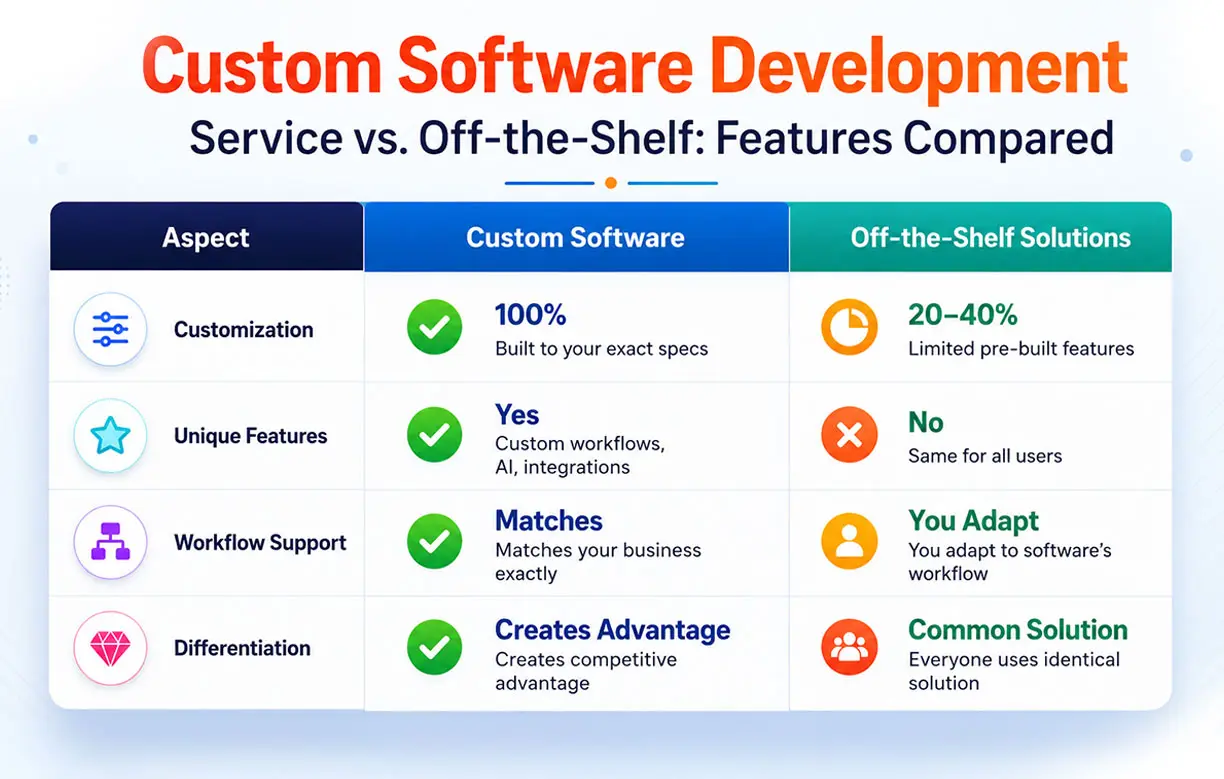
Unlike ready-made software that offers the same features to every company, custom software gives startups complete control over how the product works, looks, scales, and evolves.
A startup offering online education, for example, may require unique learning workflows, AI-powered recommendations, interactive dashboards, or subscription systems that standard software cannot fully support. In such cases, custom software development solutions become a practical option.
Why Do Startups Prefer Custom Software Over Ready-Made Platforms?
Startups operate in highly competitive environments. Therefore, if every company uses the same software, it becomes difficult to create a distinct customer experience.
In short, custom-built platforms allow startups to:
- Differentiate their products.
- Introduce unique workflows.
- Improve customer engagement.
- Scale features gradually.
- Maintain complete ownership of data and infrastructure.
Another consideration is scaling capabilities. Most startups begin with low user bases but are prepared for rapid growth. Many generic platforms limit businesses when they reach larger numbers of users. Custom software allows for room to integrate new functions, upgrade infrastructure, and add new features along the way, without requiring a business to rebuild its entire platform in the future.
Is Custom Software Development Worth It for Startups?
The answer depends on the startup's goals, market readiness, and product complexity.
Custom development is often worth the investment when:
- The startup solves a unique market problem.
- Existing tools cannot support the business model.
- Long-term scalability is important.
- User experience is a major differentiator.
- Data ownership and security are critical.
However, not every startup should immediately invest in a fully developed product. Many early-stage founders make the mistake of building large platforms before validating customer demand. That is why experienced software development and consulting services providers usually recommend starting with an MVP before scaling.
What Is an MVP and Why Do Startups Need It?
One of the most important concepts in startup product development is the MVP.
MVP stands for Minimum Viable Product. It is a simplified version of a software product built with only the essential features needed to solve a core user problem. Instead of spending months or years building a fully loaded platform, startups release a lean version first, gather feedback, validate demand, and improve gradually. This approach helps businesses reduce their financial risk and improve decision-making.
Why Is MVP Development Important for Startups?
Building a full product without market validation is one of the biggest reasons startups waste money. An MVP reduces that risk. Instead of investing heavily up front, startups can:
- Launch faster.
- Test assumptions.
- Validate customer interest.
- Identify usability issues.
- Improve the product using real feedback.
Startups develop MVPs to better facilitate fundraising from prospective investors. Many investors prefer to review past product successes and prior validated products in the marketplace instead of simply having product ideas. The startup's MVP demonstrates that the business can execute an idea and therefore shows that there will be an interested marketplace for their product.
What Features Should an MVP Include?
A successful MVP focuses only on essential features. The biggest challenge for founders is deciding what to include and what to postpone. An MVP should:
- Solve one primary problem.
- Deliver a clear user outcome.
- Include only core workflows.
- Prioritize usability over complexity.
When launching an MVP, Founders are generally concerned about how "complete" their product looks. As a result, they often overbuild, adding many unnecessary features to their product that will only raise the cost of creating the new MVP and therefore increase the time frame for launching it. This is why consulting and software development firms can be so valuable, as they will know how to prioritize the right features based on experience.
What Is the Difference Between MVP And Full Product Development?
| Aspects | MVP Development | Full Product Development |
|---|---|---|
| Purpose | Built to validate a startup idea and test market demand quickly | Built to deliver a complete and scalable product experience |
| Feature Set | Includes only the core features required to solve one primary problem | Includes advanced features, integrations, automation, and expanded workflows |
| Development Cost | Lower development cost because the scope is limited | Higher cost due to larger functionality and infrastructure requirements |
| Time to launch | Faster launch timelines, often focused on speed and early feedback | Longer development timelines because of broader functionality and testing |
| User Feedback Approach | Feedback is collected early to improve and shape the product gradually | Feedback is usually focused on optimization and feature enhancements after launch |
How Much Does It Cost to Build Custom Software for a Startup?
Costs related to software development are not only not standardized, but also vary greatly based on many components such as complexity, product type and development strategy. There is no one price model that applies to every startup, due to each company's individual needs. However, knowing the three major cost drivers can allow founders to plan for their projects better.
What Factors Affect Startup Software Development Costs?
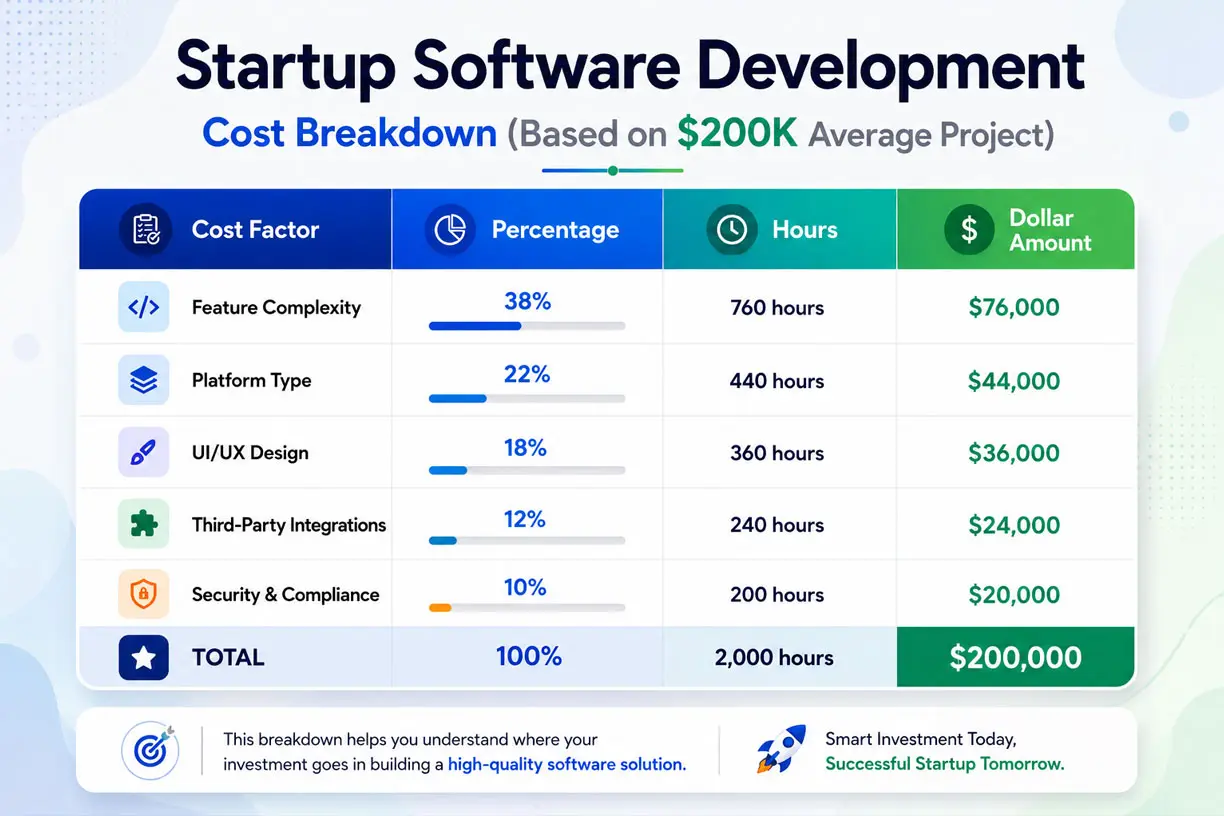
The cost of developing software for a startup can differ greatly based on what is built, how complex it is, and what the company's business objectives are. Many founders believe that the cost of building software is determined solely by the number of features included. However, there are multiple technical and operational variables that ultimately determine the total cost of development. Having a good understanding of these variables will allow a new business to plan more realistically and avoid unforeseen costs later in the development process.
Feature Complexity
The number of features on a project depends directly on how complicated the feature is. With simple features, a system may have very basic components (user registration, dashboards, standard workflows) that are less costly to develop than if there are numerous high-end features being developed as part of a solution.
Some examples of features that typically involve more hours of development include:
- Real-time instant messaging or video conferencing
- AI-assisted automation or recommendations
- Integration of payment gateways
- Analytic reporting dashboards
- Multi-user role management
- Workflow automation systems
- Custom admin panels
The more advanced the functionality, the more time developers need for architecture planning, coding, testing, and optimization.
For example, building a simple booking platform is very different from developing a real-time logistics tracking system with live location updates and automated notifications.
Platform Type
The type of platform being developed also affects the overall budget. Different products require different development approaches, technologies, and testing processes.
Startups may choose to build:
- A web application.
- A native mobile app.
- A cross-platform mobile app.
- A SaaS platform.
- A marketplace platform.
A simple web platform is generally faster and more affordable to develop compared to building separate applications for iOS and Android.
UI/UX Design Requirements
UI and UX design directly affect how users interact with the product. UI (user interface) refers to the visual interface, while UX (user experience) focuses on usability. Startups that prioritize clean navigation, responsive layouts, and intuitive workflows usually require more detailed design planning before development begins.
Strong UI/UX design often includes:
- Wireframing
- User journey mapping
- Interactive prototypes
- Responsive mobile optimization
- Accessibility improvements
Although good design requires additional effort upfront, it often improves customer retention and reduces usability issues after launch.
Third-Party Integrations
Modern applications rarely operate independently. Most startup products integrate external services such as:
- Payment gateways
- CRM platforms
- Analytics tools
- Email automation systems
- Cloud storage services
- Social login systems
- API-based platforms
All integrations need development, testing, and ongoing maintenance. Some third party tools can be fairly easily integrated, whilst others will necessitate the creation of a custom API and more in-depth configuration. The overall level of effort required to develop the product will increase in direct proportion to the number of integrations the product requires.
Security and Compliance Requirements
For startups in industries where security plays an important role (like fintech, healthcare, legal tech, e-commerce), having a secure authentication system(s) is necessary because many of these applications will handle sensitive user information.
Some of the requirements for these types of secure authentication systems include:
- Data encryption
- Compliance frameworks
- Multi-Factor Authentication (MFA)
- Secure payment processing
- Infrastructure monitoring
Implementing these types of secure authentication systems can require specialized knowledge and additional testing which can result in increased costs of a given project. But by investing in establishing a secure authentication system early on, startups can mitigate the potential for significant operational and legal risks at a later date.
How Do You Build a Startup Product Step by Step?
Building a startup product is not just about writing code and launching an app. It is a process that involves planning, validation, prioritization, testing, and continuous improvement. Many startups struggle because they rush into development without a clear direction. As a result, budgets increase, timelines stretch, and products become unnecessarily complicated.
An ordered approach to product creation allows new businesses to remain on track, avoid unnecessary expenditures, and result in a more effective end product. If you choose to work with an internal product team or by using a third-party software developer, if the proper process is followed from beginning to end, the entire project will run smoothly and ultimately result in monetary savings.
Step 1: Identify the Problem You Want to Solve
Every successful startup product starts with a real problem.
Before discussing features, design, or technology, founders need to clearly understand:
- What issues are users facing?
- Why existing solutions are not enough.
- Who is the target audience?
- How serious is the problem?
This stage is extremely important because many startups fail by building products based on assumptions instead of actual customer needs. A product built around a genuine pain point has a much stronger chance of gaining traction.
Step 2: Validate the Startup Idea Before Development
Having an idea does not automatically mean people will pay for it. Validation helps startups test market interest before investing heavily in development. This reduces financial risk and prevents founders from spending months building something users may not want.
Startups can validate ideas through:
- Customer interviews
- Surveys
- Landing pages
- Waitlists
- Prototype demonstrations
- Competitor research
The goal here is not perfection but to understand whether the market genuinely needs the product. This is where many software development and consulting services teams recommend delaying full-scale development until enough customer feedback is collected.
Step 3: Define the Core Features of the Product
One of the biggest mistakes startups make is trying to build too many features too early. At this stage, founders should focus only on the features that directly solve the primary problem.
Ask simple questions like:
- What is the single most important function of the product?
- Which features are absolutely necessary for launch?
- Which features can wait until later updates?
This process helps startups avoid feature overload. A lean feature list reduces development costs, shortens timelines, and improves product clarity for users. Most successful MVPs begin with simplicity rather than complexity.
Step 4: Create a Product Roadmap
A product roadmap acts like a development blueprint. It helps startups organize:
- Development phases.
- Feature priorities.
- Launch timelines.
- Budget allocation.
- Scaling plans.
Without a roadmap, projects often become disorganized because teams start adding random ideas during development. Roadmaps also improve communication between founders, designers, developers, and stakeholders. Even a simple roadmap can significantly reduce confusion and unnecessary delays.
Step 5: Choose the Right Development Approach
Startups usually choose between in-house development, freelancers, and outsourcing to a software company. Each option comes with different costs, risks, and advantages. For many early-stage startups, outsourcing to a custom software development service provider is often more practical because it provides access to experienced developers without the long-term cost of hiring an internal team.
Step 6: Select the Right Technology Stack
The technology stack determines how the software is built and how well it performs in the future. A typical stack includes:
- Frontend technologies.
- Backend frameworks.
- Databases.
- APIs.
- Cloud infrastructure.
The wrong technology decisions can create scalability issues later, especially when user traffic increases. Startups should prioritize technologies that are:
- Scalable
- Secure
- Cost-efficient
- Flexible
- Easy to maintain
Many modern custom software development solutions use technologies like React, Node.js, Python, Flutter, PostgreSQL, and cloud-based infrastructure because they support rapid development and future scalability.
Step 7: Design the User Experience
Good products are not only functional but easy to use. This is where UI and UX design become important. UI refers to how the product looks, while UX focuses on how users interact with it.
Strong UI/UX design helps startups:
- Improve user retention.
- Increase engagement.
- Simplify navigation.
- Reduce customer frustration.
Before development begins, startups should create wireframes, user flows, interface designs and clickable prototypes. This planning stage helps avoid expensive redesign work later.
Step 8: Build the MVP
Once planning is complete, development begins. Instead of building a large and feature-heavy platform immediately, startups should first develop an MVP that focuses on:
- Core functionality.
- Stable performance.
- Simple user journeys.
- Fast launch timelines.
The purpose is to get the product into users' hands quickly and begin collecting real feedback. A focused MVP helps startups test business assumptions without exhausting their budget. This lean approach is commonly recommended by software development and consulting services teams because it significantly reduces risk.
Step 9: Test the Product Thoroughly
Launching software without proper testing can damage user trust quickly. Before release, startups should conduct thorough QA or Quality Assurance testing to identify:
- Bugs
- Broken workflows
- Security vulnerabilities
- Performance issues
- Mobile responsiveness problems
Testing ensures the product works smoothly across devices and usage conditions. Even small usability problems can affect customer retention during the early growth stage. This is why experienced development teams prioritize testing before launch instead of treating it as an afterthought.
Step 10: Launch, Collect Feedback, and Improve Continuously
Many founders think the development process ends after launch. In reality, launch is only the beginning. Once users start interacting with the product, startups gain valuable insights about:
- User behaviour.
- Feature usage.
- Pain points.
- Customer expectations.
- Product performance.
This feedback helps teams improve the product gradually. Successful startups continuously iterate by:
- Fixing usability issues.
- Improving workflows.
- Adding high-demand features.
- Optimizing performance.
- Scaling infrastructure.
The most successful products are rarely perfect at launch. They improve through consistent learning and adaptation. That is why startup product development should always be viewed as an ongoing process rather than a one-time project. Building software becomes much easier when startups follow a structured process. Without a roadmap, development often becomes chaotic, expensive, and slow.
What Are the Biggest Mistakes Startups Make During Custom Software Development?
Many startup failures are linked not to bad ideas but to poor execution. Understanding common mistakes can help founders avoid expensive setbacks and make smarter development decisions from the beginning.
Building too many features too early
One of the most common mistakes startups make is trying to build a "complete" product from day one. Founders often believe that adding more features will make the product more attractive to users. In reality, excessive functionality usually creates the opposite effect.
Too many features can:
- Increase development timelines.
- Create confusing user experiences.
- Raise infrastructure costs.
- Slow product testing.
- Delay customer feedback collection.
Instead of building ten features moderately well, startups should focus on building one core feature exceptionally well. This is exactly why most experienced custom software development service providers encourage startups to begin with focused MVPs.
Developing without validating market demand
Some entrepreneurs will get so emotionally connected to their idea that they will rush into development without confirmation from actual users that they need this new product. This is risky because guessed or assumed behaviours do not always match how your potential customers actually behave.
Without validation, startups may:
- Build products nobody wants.
- Solve the wrong problem.
- Misunderstand customer expectations.
- Waste large amounts of capital.
Simple validation techniques such as customer interviews, prototype testing, and landing page campaigns can help reduce this risk significantly.
Selecting an inappropriate developer
Several startups consider the development company solely based on price alone. However, while cost is important, low-quality development will usually lead to long-term technical and operational issues.
An inexperienced group may:
- Generates poor code quality.
- Have no considerations for scalability.
- Delay project completion dates.
- Develop insecure products.
- Finish projects that are unstable.
An organization that provides credible software development and consulting services, understands the startup culture, utilizes agile processes, understands the need for scalability and supports the long-term evolution of products developed through their software development and consulting services.
Ignoring scalability during early development
Scalability means that a software program to handle changes in workload by accommodating multiple users is capable of doing so effectively. For example, a new startup's platform could quickly attract thousands of new users and need to expand to keep all these users happy without crashing or slowing down too much.
When scalability is ignored early:
- Platforms become unstable under traffic pressure.
- Performance issues increase.
- Infrastructure costs rise unexpectedly.
- Rebuilding becomes necessary later.
Planning scalable architecture early helps startups avoid expensive redevelopment in the future.
Underestimating Software Maintenance Costs
Many founders assume software costs stop after launch. That is rarely true. Modern applications require ongoing:
- Security updates
- Bug fixing
- Server monitoring
- Infrastructure optimization
- Performance improvements
- API maintenance
Startups should always allocate a maintenance budget after launch. Ignoring post-launch maintenance often leads to security problems and poor user experiences.
Launching without proper QA testing
QA stands for Quality Assurance. This process ensures the software functions correctly before release. Without proper testing, users may encounter:
- Broken features
- Payment issues
- Slow loading speeds
- Login failures
- Security vulnerabilities
Negative first impressions can damage trust quickly, especially for new startups. That is why thorough testing should always be part of every custom software development solution's strategy.
What Technology Stack Should Startups Choose for Custom Software Development?
Choosing the right technology stack is an important part of startup software development because it directly affects scalability, performance, security, development speed, and long-term maintenance.
A technology stack refers to the combination of programming languages, frameworks, databases, and infrastructure used to build and run a software product. Choosing the wrong stack can increase development costs, slow product growth, and create scalability issues later.
What Is a Technology Stack in Software Development?
A technology stack usually consists of four main layers.
Frontend Technologies
Frontend technologies manage everything users see and interact with inside the application. Popular frontend technologies include:
- React
- Next.js
- Angular
- Vue.js
React and Next.js are widely preferred for startup products because they support fast and responsive user experiences.
Backend Technologies
Backend technologies handle server-side operations, business logic, APIs, and database communication. Common backend technologies include:
- Node.js
- Python
- Django
- Laravel
- Java
Node.js is commonly used for scalable web applications, while Python is popular for AI-powered and data-driven platforms.
Databases
Databases store and manage application data such as user accounts, transactions, and analytics. Popular database options include:
- PostgreSQL
- MongoDB
- MySQL
The database choice usually depends on product requirements and scalability needs.
Cloud Infrastructure
Cloud platforms help startups host, manage, and scale applications efficiently without investing in physical servers. Common cloud providers include:
- AWS
- Google Cloud
- Microsoft Azure
Many startups work with software development and consulting services teams to select infrastructure that supports future growth.
What Is the Best Tech Stack for Startup MVP Development?
There is no single tech stack that works for every startup. The ideal stack depends on:
- Product type
- Budget
- Scalability goals
- Development timeline
- User traffic expectations
However, several technologies are commonly preferred for startup MVPs because they support rapid development and scalability.
Recommended Startup MVP Technologies
- React and Next.js for frontend development
- Node.js and Python for backend development
- Flutter and React Native for cross-platform mobile apps
- PostgreSQL and MongoDB for databases
- AWS and Google Cloud for cloud infrastructure
These technologies are widely used because they support flexibility, faster development, and long-term scalability.
How Do Startups Choose the Right Tech Stack?
Choosing the right stack requires balancing technical and business requirements. Startups should consider factors such as:
- Scalability requirements.
- Development speed.
- Budget limitations.
- Security needs.
- Developer availability.
- Third-party integration requirements.
The goal should be choosing technologies that are scalable, maintainable, and suitable for long-term product growth. Instead of selecting technologies simply because they are trending, startups should focus on practical solutions that align with their business goals and future expansion plans.
Why Custom Software Development Gives Startups a Competitive Advantage
The startup industry has an abundance of competition, and developing new ways to provide better experiences to customers is critical to the success of many companies. Companies who quickly adapt their product or service will have an advantage over their competitors. As a result, more and more startups choose to create their own custom software development solutions instead of depending solely on a generic software platform.
Faster innovation and product iteration
As an owner of the codebase, you have the ability to test new features within days instead of months. Rather than having to wait for your vendor's roadmap to ship changes, you will receive all of your changes much faster. This ability to iterate quickly is also one of the key reasons why many founders transition to a dedicated custom software development service.
Better customer experience through customization
Personalized journeys, unique flows, and product details that match how users behave—these come from custom builds. Off-the-shelf tools force compromises that competitors can spot easily.
Full ownership over the product roadmap and features
You decide what to build next and what your product becomes. Platform-dependent products must wait for someone else to make those decisions for them.
Easier scalability compared to generic SaaS tools
A well-built custom system scales with your business. Generic SaaS tools scale with their whole customer base, which means your needs are weighed against those of thousands of others.
Long term savings and supervision
The initial costs are very high but typical long-term costs are low on account of inconsistent monthly fees and no need to re-subscribe to each individual tool, plugin, or assigned seat. You also gain greater operational control because there will be less reliance on outside parties, fewer sudden price changes and less likelihood that certain functionalities won't be available.
How to Prepare Before Contacting a Software Development Company
Many startup founders approach development companies with only a rough idea of what they want. While that is common, preparing properly before discussions can save significant time and money.
What documents should startups prepare before development?
A few documents make every conversation more productive. A clear product requirements outline what the product should do. These include:
- User personas describing who it's for.
- A feature list ranked roughly by priority.
- A realistic budget range, even if it's broad.
The clearer your inputs, the more accurate the estimates and timelines you'll receive.
What questions should startups ask software developers?
Be sure to ask about:
- Their experience with startups, specifically.
- Actual products they've shipped, not just marketing case studies.
- How they handle change requests, sprints, and feedback.
- Who exactly will be on your team, and how communication will work.
- What happens after launch—including bug fixes, updates, and ongoing support—because that part matters more than founders realize.
How do software companies estimate project costs?
There are three common models:
- Fixed pricing, where the scope is locked and so is the cost.
- Hourly pricing, where you pay for time spent.
- Dedicated team pricing, where you essentially hire a small group full-time for a monthly cost.
Each model comes with unique advantages and disadvantages. A fixed price gives you predictability. However, it can be difficult to change. An hourly price gives you a lot of flexibility; however, there is little certainty. A dedicated team has continuity but requires a long-term commitment. Choosing the right model depends on the clarity of your scope and the amount of change you anticipate.
What should startups include in a software development roadmap?
A solid roadmap covers MVP milestones, budget allocation by phase, launch goals, and a scaling strategy for the months after launch. It doesn't have to be perfect—roadmaps always change—but it has to exist. Without one, projects drift.
Creating software for startups has little to do with funding levels. Instead, startups need to strategically plan, execute on that plan, and prioritize their resources and tasks in order to develop successful products. Startups have many failed ideas due to an inability to keep their development efforts simple and affordable early on. Lean, agile, scalable and generally well-structured MVPs as well as establishing priorities for upcoming features before developing them are key components of any startup in relation to software development. Custom developed software enables startups to develop products that are specifically designed for their users, business objectives, and future growth potential. When developed appropriately companies can then deliver the elasticity, scalability, and operational control to successfully compete.
Frequently Asked Questions
1. How much does custom software development cost for startups?
The price of custom-made software for a startup varies based on several parameters. This includes the complexity of the system, how much functionality is included, what technologies are being used, whether third party integrations will be needed, and how long it will take to create an MVP versus a fully developed software system. Normally, an MVP has less of a budget than a completely finished product since the MVP only has core functionality present.
2. What is an MVP in startup software development?
3. How long does it take to build a startup MVP?
4. Should startups outsource software development?
5. What is the best tech stack for startup software products?
6. Can startups build software on a limited budget?
7. What are some of the largest blunders that new businesses make when developing software?
8. What distinguishes custom-built solutions from subscription-based solutions such as Software as (SaaS)?
Request a
Free Quote Today!


