For many B2B companies, software has moved from a support tool to an integral part of how the business operates every day. For instance, sales teams depend on it to manage their leads, whereas operations teams use it to track work. When software does not fit the business well, the impact is not limited to a single team. It slows decisions, creates extra manual work, and makes growth harder to manage.
To mitigate this problem, enterprise SaaS has been a popular choice for years because it gives companies quick access to ready-made tools. A business can subscribe, set up users, and start using the platform without building everything from the ground up.
For standard business needs, this can be useful. However, many B2B companies are now finding that the same SaaS tools that helped them grow in their early stages may not support their next stage.
This is one major reason why decision-makers are looking at a custom software development service as a serious alternative. Instead of adjusting the business around a ready-made platform, companies can build software around the way their teams actually work.
Let’s get started to understand where enterprise SaaS can work and where custom software takes the lead.
Why the SaaS vs. Custom Software Debate Matters for B2B Companies
The debate between enterprise SaaS (Software as a Service) and custom software is not just about technology. It is also about cost, control, growth, data, and long-term business direction. For B2B companies, even small software limitations can become expensive when they affect sales cycles, delivery timelines, customer experience, or reporting accuracy.
Enterprise SaaS works on a shared product model. Many companies use the same platform, and the vendor controls the features, updates, pricing, and product roadmap. This model is useful when the business need is common and easy to standardize. For example, email tools, video meeting platforms, accounting systems, and basic HR platforms often work well as SaaS products.
Custom software works differently. It is built for the company’s own processes, rules, users, and goals. A bespoke software development service gives the business more control over what the software does, how it connects with other tools, and how it changes over time. This can be valuable when a company has complex workflows, industry-specific requirements, or a unique operating model.
What Are the Key Differences Between Custom Software and SaaS for B2B Companies?
The main differences are ownership and fit. SaaS gives access to a ready-made product owned by a vendor. Custom software gives the company a product built for its own business model. Both options have value, but they solve different problems.
| Basis of Difference |
Enterprise SaaS |
Custom Software |
| Ownership |
The vendor owns the product, code, and roadmap |
The business owns or controls the product based on the contract |
| Setup Time |
Usually faster to start |
Takes more time to plan, build, and test |
| Cost Model |
Monthly or yearly subscription |
Upfront build cost plus support and improvement costs |
| Flexibility |
Limited to available features and vendor rules |
Built around company-specific workflows |
| Scalability |
Cost grows with users, storage, usage, or add-ons |
Cost grows based on product changes and support needs |
| Integrations |
Depends on vendor-supported connections |
Can be built to connect with existing business systems |
| Data Control |
Data sits inside the vendor’s platform |
More control over data structure, access, and storage |
| Competitive Advantage |
Competitors may use the same tool |
Features can reflect the company’s own process |
| Long-Term Cost |
Can rise with user count and extra modules |
Can become more cost-efficient after break-even |
| Vendor Dependency |
High dependency on SaaS vendor pricing and product changes |
Lower dependency when the system is built and owned properly |
Why These Differences Matter in Daily Operations
The difference becomes clear when a business starts growing. A SaaS product may work well for the first 20 users. At 100 users, the cost may look different. At 300 users, the business may be paying for features many people barely use. If the company needs advanced reporting, extra workflow steps, or deeper connections with internal systems, the subscription can become only one part of the total cost.
Custom software development solutions can reduce this gap by focusing on the exact use cases that matter. For example, a B2B logistics company may need order tracking, driver updates, customer notifications, and billing rules in one place. A general SaaS product may cover some of this, but not all of it. On the contrary, a custom system can be planned around the complete workflow.
Why B2B Companies Are Moving Toward Custom Development
B2B companies are not moving toward custom development because SaaS offers no long-term value. They are doing it because their needs are becoming more specific. As companies grow, they often need software that reflects their business model more closely.
1. They Want More Control Over Business Processes
A SaaS product comes with fixed workflows. A company may be able to adjust fields, settings, or dashboards, but the core structure is still controlled by the vendor. This can become a problem when the business has special approval rules, pricing logic, customer onboarding steps, or reporting needs.
Custom software gives the business more control. Teams do not have to adjust their process to match the platform. Instead, the system can be built around the actual workflow.
Many B2B companies use multiple SaaS tools to manage a single business function. For example, a sales team may use a single CRM, proposal tool, contract tool, reporting tool, and communication tool. Each platform adds cost and creates another place where data can get stuck.
Custom development can bring related functions into one system. This does not mean every SaaS tool must be removed. It means the company can reduce overlap and keep only the tools that add real value.
3. They Need Better Data Visibility
Business leaders need accurate data to make decisions. When data sits in different SaaS tools, reports can become incomplete or delayed. Teams may export files, combine spreadsheets, or manually check records before presenting updates.
Custom software development solutions can be built with reporting needs in mind from the beginning. This helps leaders see sales performance, delivery progress, customer issues, and operational data in one place.
4. They Want to Avoid Long-Term Subscription Pressure
SaaS subscriptions can feel affordable at first. But their costs become more significant as the user count grows, new modules are added, or the company requires premium support. For B2B firms with hundreds of employees, subscription growth can become difficult to control.
Custom software usually has a higher starting cost, but the long-term cost may become more stable. Once the core product is built, the business can plan upgrades based on value instead of paying for every user or every add-on.
5. They Want Software That Supports Competitive Advantage
If a company uses the same SaaS product as every one of its competitors, the tool itself may not create a strong advantage. Custom software can support a company’s unique way of selling, serving customers, managing operations, or using data.
This does not mean custom software automatically creates success. Its development must be planned well. But when it is tied to a strong business process, it can become a valuable asset.
Custom Software vs. SaaS: A Practical B2B Decision Table
The best choice depends on the business situation. The table below gives a practical view.
| Business Situation |
Better Fit |
Reason |
| A startup needs a basic CRM quickly |
SaaS |
Faster setup and lower starting cost |
| A mid-sized company has complex approval rules |
Custom Software |
Can be built around an internal process |
| A company needs standard payroll or email tools |
SaaS |
These needs are common and well-covered |
| A B2B firm needs custom pricing logic |
Custom Software |
Standard platforms may not support the exact rules |
| A team needs a short-term tool for a small project |
SaaS |
Easier to start and stop |
| A company wants one platform for operations, billing, and reporting |
Custom Software |
Can combine key workflows in one system |
| A company has a limited technical budget |
SaaS |
Lower upfront spend |
| A company is paying for many unused licenses |
Custom Software or SaaS cleanup |
Cost review is needed before a decision |
| A business needs full control over data and permissions |
Custom Software |
More control over structure and access |
| A company wants vendor-managed updates |
SaaS |
Vendor handles product updates |
A custom software development service is not always the right answer. It becomes more valuable when the software supports a core business process, not just a general office task.
How Much Can Businesses Save by Choosing Custom Software Development Over SaaS?
The amount a business can save depends on several factors, including the number of users, subscription charges, support costs, integrations, and the amount of manual work that the current SaaS setup creates.
In most cases, savings do not appear immediately because custom software needs planning, design, development, testing, and support. However, once the system is active and widely used, the long-term cost can become easier to control.
For example, a B2B company using an enterprise SaaS platform may pay a monthly fee for every user. At first, this may look affordable. But as the team grows, costs rise with every new employee, every added feature, and every upgrade to an advanced plan.
This is where a custom software development service can become more practical. The business may spend more initially, but it is not tied to the same per-user subscription model after launch. Instead, the cost is connected to product scope, updates, support, and future improvements. Over time, this can give the company more control over its software budget.
In short, savings usually come from areas such as:
- Reduced SaaS license costs.
- Fewer overlapping tools.
- Less dependency on paid add-ons.
- Less manual data entry.
- Fewer third-party connectors.
- Reduced time spent on manual reporting.
- Better use of internal data.
- Fewer delays caused by disconnected systems.
- Less training across multiple platforms.
However, it is important to look beyond software fees alone. The bigger savings often come from better work efficiency. If a team spends hours every week moving data between systems, checking reports, or fixing mistakes, that time has a real cost. When custom software removes repetitive tasks and gives teams a single clear process, the value far exceeds the subscription difference.
What Hidden Costs Are Involved in Enterprise SaaS That Custom Development Avoids?
The monthly subscription is only one part of the SaaS cost. Many B2B companies start with a platform that seems affordable, but costs change as usage grows. This happens because enterprise SaaS pricing often depends on factors such as users, features, storage, support levels, and integration needs.
Some common hidden costs include:
- Unused licenses: Many companies pay for users who rarely use the platform.
- Add-on modules: Certain features may be available only on higher plans.
- Integration tools: Extra software may be needed to connect SaaS platforms.
- Data migration: Moving data into or out of the platform can cost more than expected.
- Premium support: Faster support or expert help may come with an additional fee.
- Training cost: Every tool has its own learning curve, which takes time.
- Vendor price increases: The business has limited control over vendor price changes.
- Contract lock-in: Long-term agreements can make it harder to switch later.
- Reporting limits: Useful reports may require advanced plans or separate tools.
- Workflow gaps: Teams may still need spreadsheets or manual checks to complete work.
These costs are easy to miss because they do not always appear as one clear line item.
Custom software development solutions can reduce these hidden costs by consolidating the process into a single planned system. Instead of paying for multiple tools to fill gaps, the company can build the exact functions it needs. This does not mean every SaaS product should be replaced. Rather, the business can keep useful tools and remove the ones that create extra cost without adding enough value.
Understanding Custom Software: Benefits
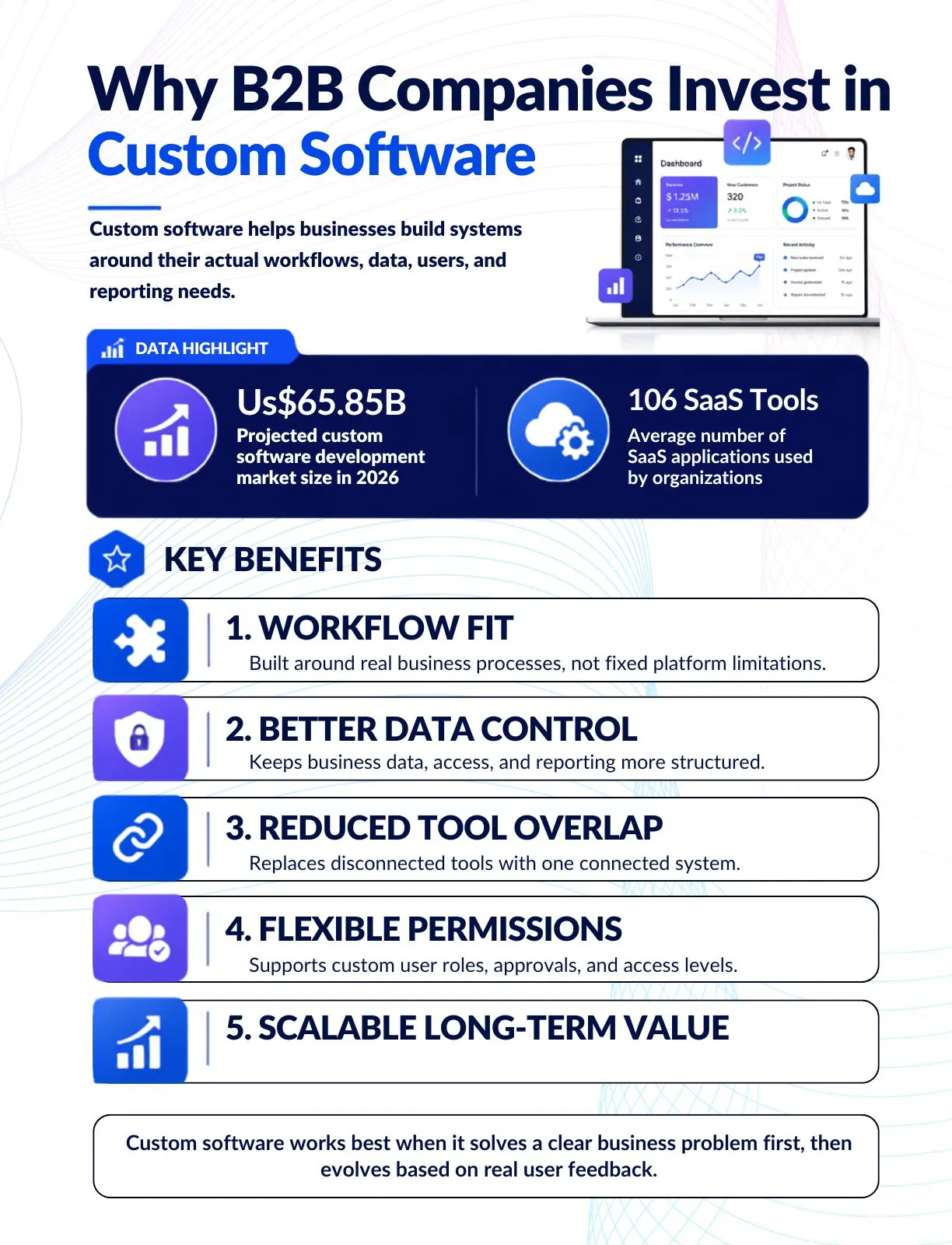
Custom software gives B2B companies more control over how their systems work. Instead of adjusting internal processes to match a ready-made platform, the company can build software around its actual operations, users, data, and reporting needs.
The key benefits include:
- Better fit with business workflows.
- More control over features and updates..
- Stronger data ownership
- Reduced tool overlap.
- Better reporting based on real business needs.
- More flexible access and permission settings.
- Lower dependency on per-user pricing.
- Ability to connect with existing systems.
- Long-term value when the system supports core operations.
A bespoke software development service can be especially useful when a company has specific approval rules, pricing methods, customer onboarding steps, delivery models, or reporting needs. In such cases, standard software often covers only part of the process, while the rest depends on manual effort.
Custom software works best when the business understands the problem before development begins. The goal should not be to build every possible feature. Instead, the first version should solve the most important problems and then improve over time based on real user feedback.
Security and Data Control: Why B2B Companies Are Paying More Attention
B2B companies handle sensitive information every day. This may include customer records, contract details, pricing data, financial reports, supplier information, employee records, and business performance data. When this information is spread across many SaaS tools, it becomes harder to manage access and control.
SaaS vendors may offer strong security features, especially at the enterprise level. However, the company still needs to manage permissions, connected apps, exported files, and user behaviour. Problems often appear when teams use unapproved tools, share data through spreadsheets, or connect apps without proper review.
Custom software can give companies more control over:
- User roles and permissions.
- Data storage rules.
- Approval flows.
- Audit history.
- Internal access levels.
- Reporting rights.
- Customer or vendor portal access.
- Connections with other business systems.
Security is not only about preventing attacks. It is also about reducing confusion. When fewer systems handle sensitive data, it becomes easier to know who has access, what they can see, and how information moves across the company.
When Custom Software Becomes the Better Choice
Custom software becomes a stronger and even better option when the company has outgrown ready-made platforms. This usually happens when the business process becomes more specific, and SaaS tools end up creating more work rather than reducing it.
- Custom development may be the better choice when:
- Teams depend on too many manual steps.
- Several SaaS tools are being used for one process.
- Subscription costs are rising every year.
- Reports are slow, incomplete, or unreliable.
- Existing platforms do not match the workflow.
- Data is spread across departments.
- Customers need a better portal or service experience.
- The company has industry-specific rules.
- The software supports revenue, operations, or delivery.
- Leadership wants more control over future improvements.
In these situations, custom software development solutions can help the business build a stronger foundation. The process should begin with discovery, not coding. The company should first identify what is broken, what costs too much time, and what the system must improve.
The Hybrid Approach: Combining SaaS and Custom Software
Many B2B companies do not need to choose only one side. A hybrid approach often works best. The business can keep SaaS tools that perform well and build custom software for areas where ready-made products fall short.
For example:
- A company may keep its accounting software but build a custom billing approval system.
- A manufacturer may keep its ERP but create a customer order portal.
- A sales team may keep its CRM but build a custom quoting tool.
- A service company may keep its project platform but create a custom profitability dashboard.
- A support team may keep its ticketing tool but build a better customer history view.
This approach avoids unnecessary rebuilding. At the same time, it gives the business more control over the workflows that matter most. Custom software can also connect selected SaaS tools, so teams do not have to jump between platforms as often.
How B2B Companies Should Decide Between SaaS and Custom Development
A good decision starts with a clear review of the business problem. Companies should avoid choosing software only because a platform is popular or because the first-year price looks attractive.
Before deciding, decision makers of a business should ask:
- What process is the company trying to improve?
- Which teams are affected?
- Where does manual work still happen?
- Which tools overlap?
- What reports are difficult to create?
- How much is the company paying for unused licenses?
- Will the user count grow in the next few years?
- Does the current software support the company’s growth plans?
- Is the system important to revenue, delivery, or customer experience?
- Would ownership give the business more long-term value?
The company should also calculate the full cost. This includes licence fees, add-ons, support, training, integrations, manual work, migration, and renewal increases. Once these numbers are clear, the choice becomes more practical.
A custom software development service should guide this review before recommending a build. The right partner will study business goals, daily workflows, users, reporting needs, data flow, and long-term growth plans.
Common Mistakes Companies Make When Comparing SaaS and Custom Software
Many software decisions go wrong because businesses compare the wrong things. A monthly SaaS fee and a custom build cost are not the same type of expense. SaaS is rented access, while custom software is a long-term product investment.
Some of the common mistakes that companies make while distinguishing between enterprise SaaS and custom software include:
- Comparing only the first-year cost.
- Ignoring the cost of manual work.
- Buying more SaaS tools to fix gaps created by existing tools.
- Starting custom development without clear priorities.
- Building too many features in the first version.
- Forgetting user training and adoption.
- Ignoring long-term support needs.
- Failing to plan data migration properly.
A smaller first version that solves a serious problem is often better than a large system filled with features people may not use. This approach helps the company control costs, test adoption, and improve the product based on real feedback.
B2B companies are choosing custom development because software now supports growth, operations, customer service, and key business decisions. While enterprise SaaS is still useful for standard needs and quick setups, it can become costly and restrictive as companies grow. Therefore, businesses should compare total cost, manual work, growth plans, system control, and ownership value before deciding. For companies that need better process fit, a custom software development service can support efficient operations, reduce avoidable costs, and build software around the way the business actually works.


