


Table of Contents


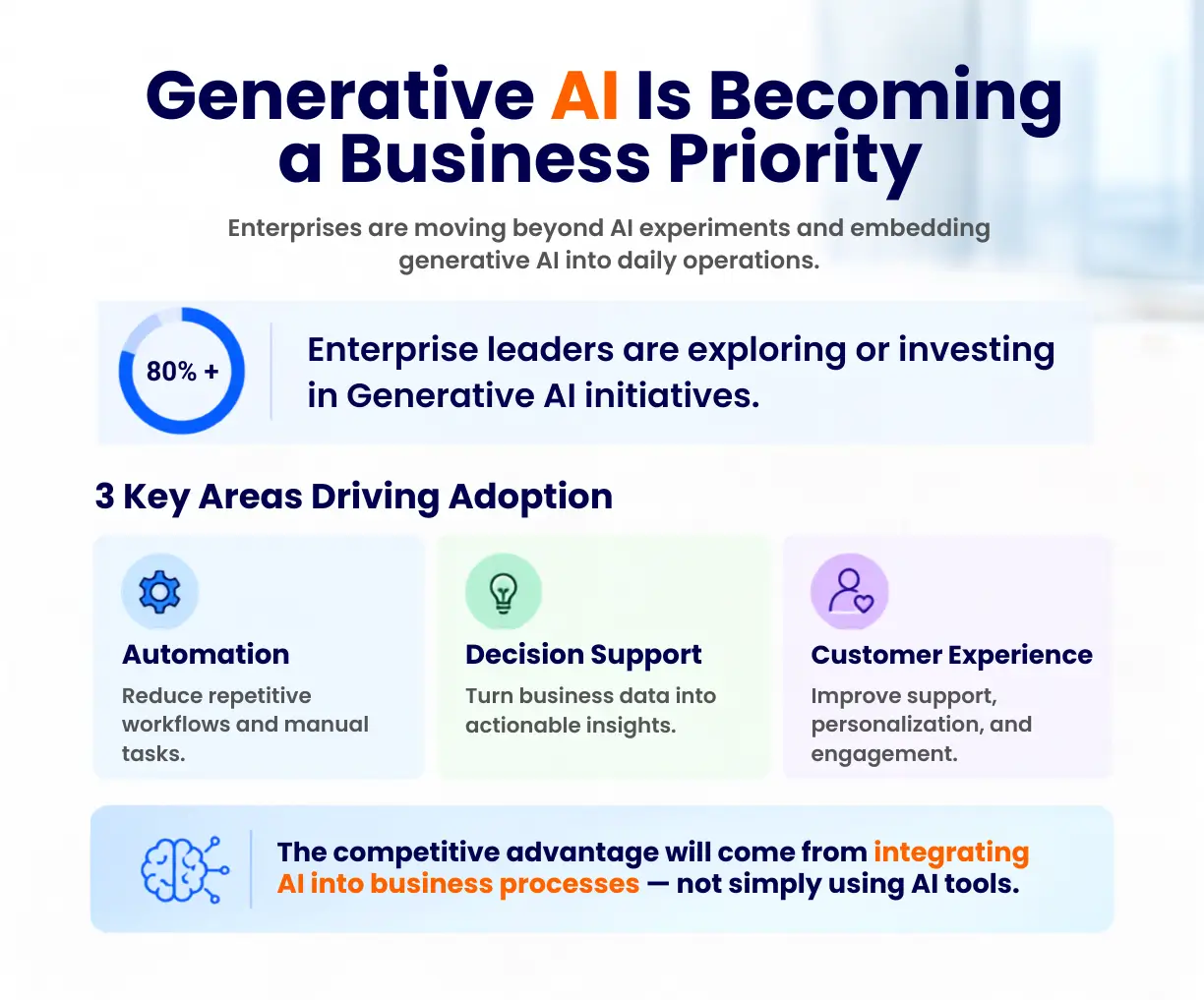
Generative AI is no longer a future concept. It is already rewriting how enterprises build products, serve customers, and run their operations. Businesses that once spent weeks on a single report are now producing it in hours. Teams that struggled to keep up with customer demand are now automating entire workflows without losing the human touch.
This is not hype. It is a real and permanent change in how organizations compete and grow. The companies moving fastest are not just using AI tools. They are embedding generative AI into their core business processes and decision-making.
Choosing the right path into generative AI, however, is not always straightforward. There are questions about where to start, what to build, who to work with, and how to measure success. Getting these answers right at the beginning of this transformation will save you enormous time, money, and frustration later.
This blog walks you through the complete guide to generative AI solutions for enterprise digital transformation, so you have what you need to make a confident, informed decision.
How Generative AI Is Reshaping Enterprise Operations from the Ground Up
The shift toward AI-powered enterprise software is happening faster than most organizations anticipated. And understanding what it really means in practice is the first step toward using it well.
1. What Is Generative AI & How Is It Transforming Business?
Generative AI refers to a class of artificial intelligence systems that can produce new content, including text, code, images, audio, and structured data, based on patterns the system learns by processing large amounts of existing content during its initial development and training phase.
Unlike traditional AI, which is built to sort, label, or predict outcomes based on fixed rules and predefined options (for instance, flagging a bank transaction as fraudulent or safe, or identifying whether a photograph contains a dog or a cat), generative AI creates something new in response to a prompt or context.
For businesses, this matters enormously. A generative AI system can draft a contract, summarize a 200-page report, write and explain a block of code, answer a customer's billing question, or generate product descriptions at scale. All of this happens without a human doing the actual writing. The underlying models that power these systems are known as large language models, or LLMs. These models are trained on vast amounts of data and are becoming increasingly capable of understanding industry-specific language, context, and nuance.
Generative AI is not a single product. It is a capability that can be embedded into existing software platforms, customer service tools, internal knowledge bases, and development environments. For instance, a manufacturing company might use it to generate maintenance reports, while a law firm might use it to summarize case precedents.
How you apply generative AI depends heavily on your specific business context, which is exactly why a thoughtful implementation strategy matters as much as the technology itself. Businesses that approach generative AI as a plug-and-play tool often underestimate the work required to make it genuinely useful.
2. How Gen AI Enhances the Software Development Process
Software development is one of the more time-consuming and expensive parts of running a technology business. Developers write code, review it, test it, document it, and then fix what breaks. Generative AI is changing each of those steps in meaningful ways.
AI-assisted code generation tools can now write boilerplate code, suggest completions, and even produce entire functions from plain-language descriptions. Boilerplate code refers to the repetitive, standard sections of code that developers write over and over across different projects. This does not replace developers. It gives them more time to focus on architecture, logic, and problem-solving.
AI tools can scan codebases (the full collection of source code that makes up a software application) for bugs, flag security vulnerabilities, and suggest refactors (improvements to the structure of existing code without changing what it does) that a human reviewer might miss after a long day.
Testing is often rushed when development timelines are tight, which means some checks are skipped, and issues only surface after the code is already in production. AI-generated test cases help address this by writing the checks that verify whether the code is working correctly, rather than leaving that work entirely to a developer doing it manually.
Documentation, which is one of the most commonly neglected parts of software projects, can be drafted automatically based on existing code. For instance, a developer can describe a function's purpose and the AI will generate clear, consistent documentation in seconds. The cumulative effect of all these improvements is significant in terms of speed, quality, and cost.
Organizations working with a good Gen AI development company will often integrate these tools directly into existing development pipelines, rather than adding them on as an afterthought. The goal is to reduce friction, not add a new layer of tools for developers to manage.
3. How to Build a Generative AI Application
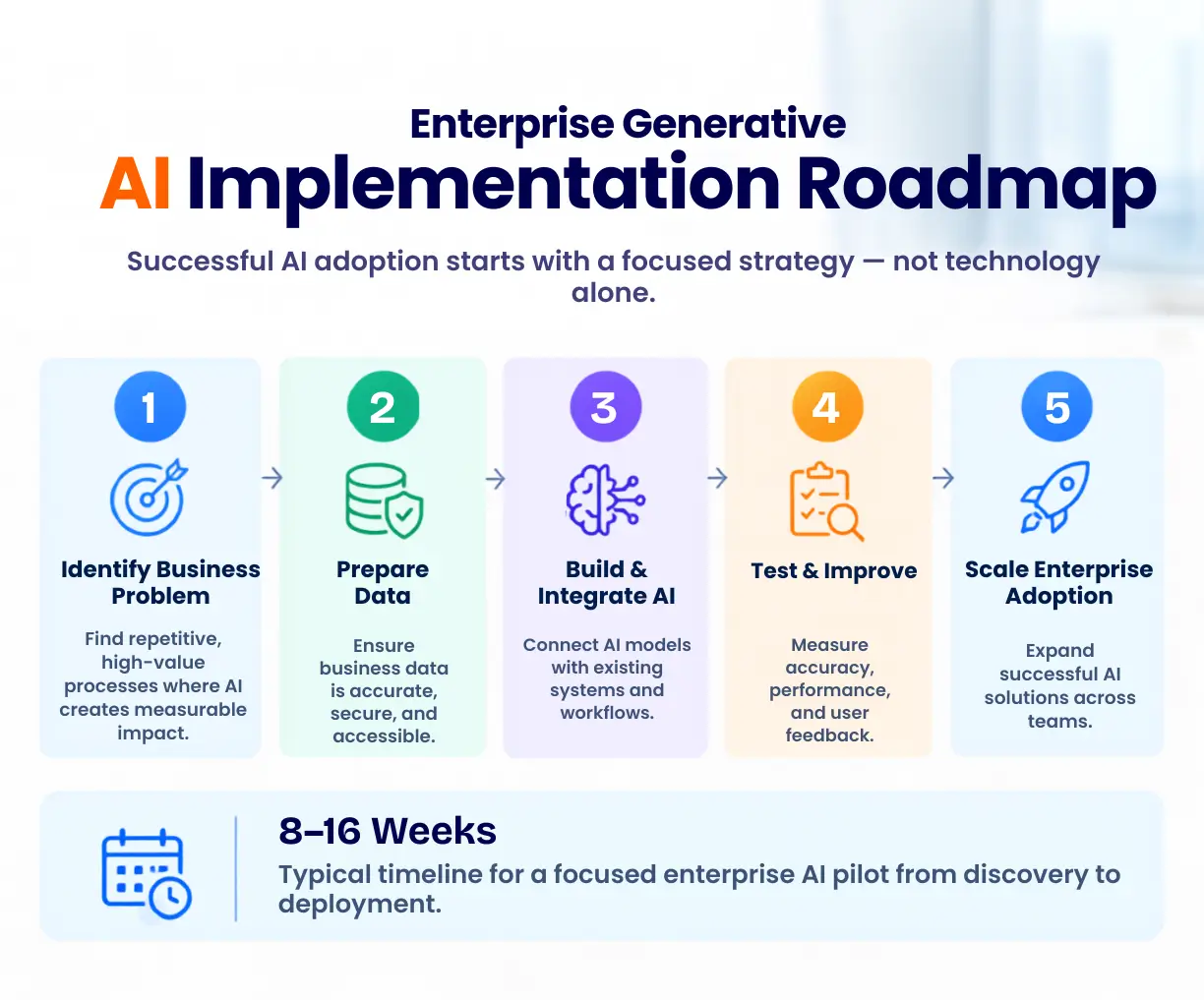
Building a generative AI application is not the same as buying one. Many enterprises start by identifying a specific, high-value problem, something repetitive, time-consuming, and predictable in its inputs and outputs. Starting with a narrow, well-defined problem is a smart way to begin. A customer support bot trained on your product documentation, for instance, will give far more accurate answers than a generic chatbot that has no knowledge of your business.
The process typically begins with data preparation. The quality of your outputs depends on the quality of the information the model has access to. For applications that need to draw on proprietary data, meaning information that belongs to your business and is not publicly available, a technique called retrieval-augmented generation, or RAG, can be useful.
RAG allows the AI to pull from specific documents or databases at the moment a question is asked, rather than relying solely on what it learned during its initial training phase. This matters greatly for enterprise use cases where accuracy and specificity are important.
Model selection is an important decision. There are many capable foundation models available, and the right one depends on factors like cost, response speed, security requirements, and the nature of the task.
For instance, a model built for code generation may not be the best choice for a tool that handles live conversations with customers. Once built, the application needs testing against real-world inputs, including unusual questions, ambiguous requests, and inputs the model was not explicitly prepared for.
Keeping a close eye on how the application is performing after launch is just as important as building it well in the first place. A generative AI application is not finished at launch. It gets better over time when there is a clear process for catching errors and improving responses based on how real users are using it.
4. Gen AI for Enterprise Digital Transformation
Enterprise digital transformation is a broad term, but in practice it comes down to replacing slow, manual, disconnected processes with faster, smarter, and better-connected ones. Generative AI plays a specific and useful role in this by helping connect data, systems, and people in ways that were not previously practical.
Large organizations often have enormous amounts of unstructured data, meaning information that is not organized in a neat, searchable format, such as emails, call recordings, meeting notes, and reports. This data contains valuable information but is rarely used in any systematic way. Generative AI can pull insights from this data, summarize it, direct it to the right people, and trigger the right actions. This turns information that was previously sitting idle into something the organization can actually use on a daily basis.
Bringing AI into a large organization requires more than simply choosing a model and switching it on. It requires a clear understanding of which processes to fully automate, which ones to support with AI while keeping a human in charge, and which ones to leave entirely human-led.
For instance, a claims processing workflow in insurance might be well suited to full automation, while a sensitive conversation with a client about their finances is better handled by a human who has used AI to prepare beforehand.
Governance matters. Enterprises need clear policies around how AI is used, how outputs are reviewed, how data is handled, and what happens when the system gets something wrong. Organizations that think through these questions from the beginning are the ones that build AI systems their employees trust and actually use day-to-day.
A smart generative AI consulting company will raise these governance questions from the start, not as an afterthought.
5. Gen AI Use Cases Across Industries
One of the useful ways to understand generative AI is to look at where it is already working. Across sectors, the pattern is consistent. AI handles the repetitive, high-volume parts of a process, freeing people to focus on the work that requires careful thinking, good judgment, and direct human interaction.
In healthcare, generative AI is being used to draft clinical notes, summarize patient histories, generate discharge instructions, and support medical coding, which is the process of translating medical records into standardized billing codes. This reduces the administrative workload on clinicians and frees up more time for direct patient care.
In financial services, AI is used for drafting fraud reports, preparing regulatory documents, summarizing investment research, and handling routine customer correspondence.
In retail, product descriptions, personalized promotions, and customer service responses are being generated at scale, enabling small teams to maintain a consistent voice across thousands of products.
In manufacturing, AI is supporting maintenance documentation, supplier communications, and quality control reporting. For instance, a production anomaly that used to require a manual incident report can now be documented automatically, with the relevant context pulled from connected systems.
Legal teams use AI to review contracts, flag clauses that fall outside standard terms, and draft routine agreements. Software teams use it for code review, documentation, and test generation.
What is common across all of these is that the AI is not making final decisions. It is doing the preparatory work that helps people make faster and better decisions. That is a starting point for any business trying to work out where generative AI will actually make a difference in their operations.
6. Gen AI Implementation Strategy: Planning & Execution
A strong generative AI implementation strategy starts with clarity, not technology. Before selecting a model or vendor, organizations need to answer a few straightforward questions. What specific problem are we solving? What does success look like? Who owns the outcome? Which data is available, and is it clean enough to use?
The most common implementation pitfall is starting too broadly. Organizations that try to apply AI across ten departments at once typically end up with ten half-finished projects, none of them particularly useful. A focused pilot—meaning one use case, one team, and clear measures of success—gives the organization practical experience and builds confidence needed to expand at a later stage.
Change management is an often-underestimated part of any AI rollout. Change management here means helping employees understand what the AI does and does not do, where to trust its outputs and where to verify them, and how their day-to-day work changes as a result.
The technical infrastructure matters too. This includes APIs, which are the connections that allow different software systems to talk to each other, and data pipelines, which are the pathways that move information from one system to another. It also includes security protocols and making sure the AI connects properly with the systems the organization already uses. All of these need to be in place before the AI goes live.
For instance, a generative AI tool that cannot connect to the company's existing customer relationship management (CRM) software will create workarounds rather than efficiencies. Planning for integration from day one prevents a great deal of rework later.
Organizations working with a Generative AI service provider who understands enterprise architecture will move significantly faster through this phase than those who treat it as an IT problem to be solved after the AI strategy is already decided.
How Sourcedesk Connects Gen AI Strategy to Real Enterprise Outcomes
Building a generative AI strategy is only part of the work. The rest comes down to execution, specifically who helps you build it, how it connects to your existing systems, and what happens after launch.
1. Gen AI Implementation Strategy: Planning & Execution
Sourcedesk approaches implementation as a structured engineering problem. The team works with enterprises to map existing workflows, identify the specific points where AI creates the most value, and design integrations that fit into what organizations are already using, whether that is a CRM, an ERP (a system that manages core business processes like finance, HR, and operations), a custom internal platform, or a combination of all three.
The planning phase includes a thorough assessment of data readiness, security requirements, and governance frameworks before a single line of code is written.
Sourcedesk's team of AI/ML developers has direct experience with a wide range of modern AI tools and infrastructure, including LangChain, LlamaIndex, OpenAI, Hugging Face, Mistral, and vector databases like Chroma and FAISS. Vector databases are specialized databases designed to store and search AI-generated data quickly and accurately.
For instance, this means that when a client needs a retrieval-augmented generation system, which allows the AI to pull from the company's own documents rather than relying on general knowledge, the team already knows the architecture, trade-offs, and edge cases.
Because Sourcedesk operates across global offices, enterprise clients get both local accountability and a depth of specialized talent that smaller, regional teams cannot match. The result is implementations that are thorough, well-documented, and built to last well beyond launch.
2. ROI & Business Impact of Generative AI
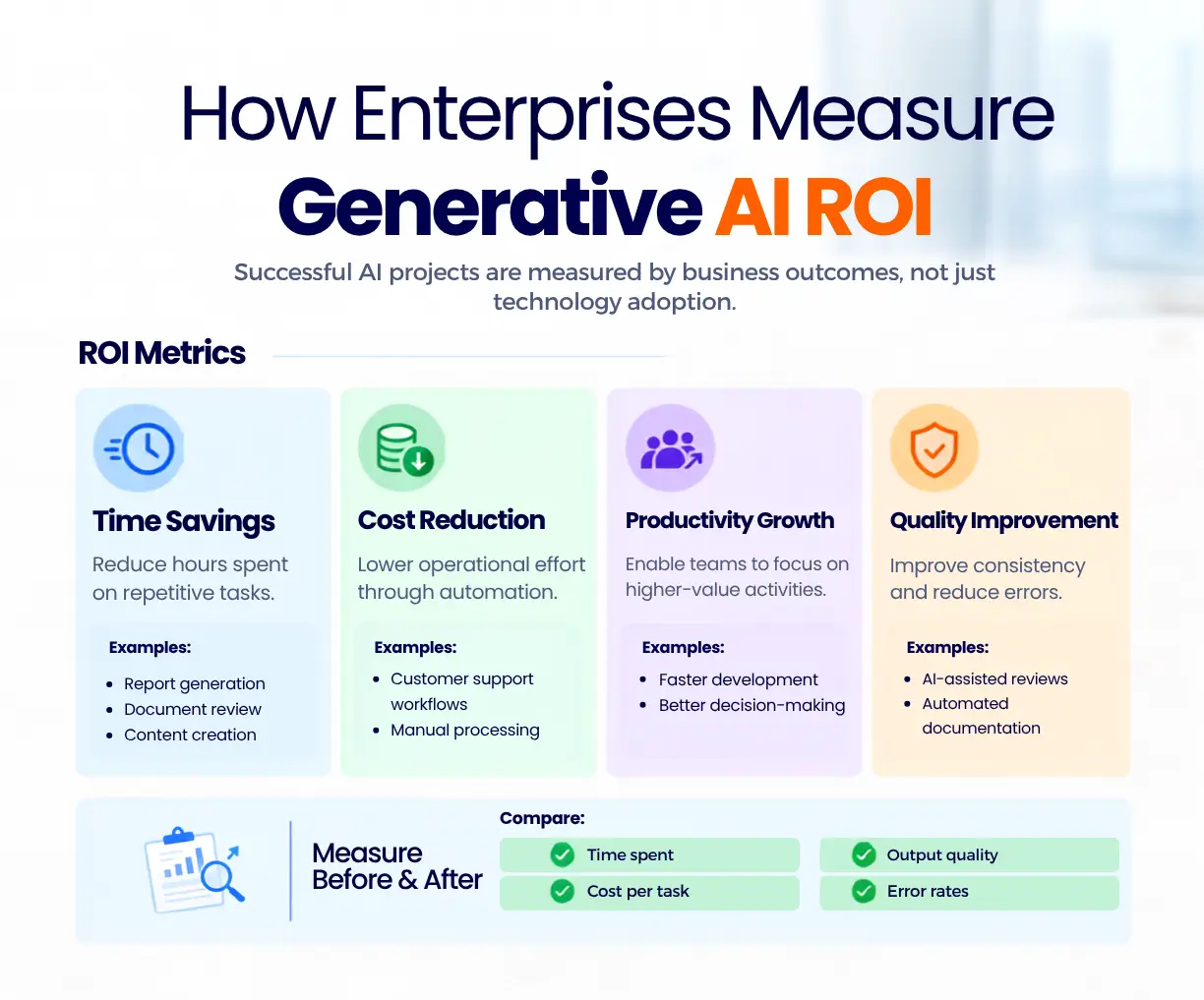
Sourcedesk designs every AI engagement with business outcomes as the primary measure of success. This means ROI is not treated as an afterthought at the project's end. It is built into the way the solution is planned and developed from the beginning. Before development starts, the team works with clients to establish clear, measurable baselines, meaning how long a task takes today, how much it costs, and how consistent the output is.
Sourcedesk's experience across industries, including fintech, healthcare, retail, manufacturing, and logistics, means the team brings relevant experience and realistic expectations to every engagement. For instance, a retail client implementing AI-powered product content generation will benefit from approaches already tested in similar environments, rather than starting from scratch.
Our post-launch support model ensures that the ROI conversation does not end at go-live. The team monitors performance, identifies situations where the AI begins producing outputs that are less accurate or less relevant than they were at launch, and refines the system based on actual usage data. This ongoing improvement process is what keeps AI systems useful and accurate over time.
3. Choosing the Right Gen AI Consulting Partner
Choosing a generative AI consulting partner is one of the more important decisions an enterprise makes in its AI journey. The right partner brings technical depth, industry experience, honest advice, and a clear way of working. The wrong one brings enthusiasm, generic proposals, and ends up learning on your timeline and budget.
Sourcedesk's generative AI consulting practice is built around finding the right fit for each client rather than simply winning the largest possible scope of work. This means the team asks straightforward questions early on. Is this problem suited to AI? Do you have the data to support it? Is your organization ready to use what we build?
With over 2,300 projects delivered and a team of more than 200 specialized engineers, Sourcedesk brings practical experience that comes from real delivery work across diverse industries and problem types.
For instance, a company deciding whether to build a custom AI agent or integrate an existing solution benefits greatly from a partner who has done both. That partner can give an honest assessment of the trade-offs involved, based on real experience rather than theory.
Sourcedesk holds ISO-certified quality standards and has a strong client retention record. Both of these give enterprises a reliable signal that the team delivers on what it commits to. This matters most when the project is central to how the business operates.
4. Building a Generative AI Application
Sourcedesk's custom AI application development covers every stage of the process, from initial discovery and data architecture through to deployment, integration, and ongoing support. The team works with enterprises on AI agents, chatbots, document intelligence systems, code generation tools, and multimodal applications. Multimodal applications are tools that can work with more than one type of input, such as text, images, and audio. The right choice depends entirely on what the actual business problem requires
Practically, this means that clients are not handed a finished product and left to figure out the rest. Sourcedesk builds with integration in mind from day one.
For instance, an AI chatbot built for a financial services client will be connected to the relevant data sources and tested against real customer queries. The chatbot will also have a clear process in place for redirecting questions that the AI should not handle on its own.
The team uses a modern, production-grade technology stack, including Vertex AI, Microsoft AutoGen, and Kubernetes, which is a system that manages and coordinates how AI applications run across multiple servers so that they remain stable under heavy use.
This ensures that the applications are scalable and reliable, not just functional in a demo environment. For enterprises that want to build internal AI capabilities over time, Sourcedesk structures engagements to include knowledge transfer. This means the client's own team is brought up to speed on how the system works, so they are not permanently dependent on external support for systems they own
Generative AI solutions for enterprise are neither a shortcut nor a quick fix. They work best for organizations that start with a clear, specific problem and realistic expectations. Having the right technical partners alongside you makes a significant difference to how smoothly that process goes. The enterprises seeing real returns are the ones that began with a focused problem. They built with their own data and workflows in mind and paid attention to governance and measurement from day one. If your organization is ready to move from curiosity to action, Sourcedesk brings the engineering depth, industry experience, and a clear way of working to help you build AI systems that deliver real, measurable results.
Frequently Asked Questions
Q1. What is the difference between generative AI and traditional AI?
Q2. How long does it take to build a generative AI application for an enterprise?
Q3. How do enterprises ensure their data stays secure when using generative AI?
Q4. What industries benefit most from generative AI right now?
Q5. How do you measure the ROI of a generative AI project?
Request a
Free Quote Today!


