


Table of Contents


As organizations generate vast volumes of data across digital platforms, machine learning (ML) has emerged as a key technology for identifying patterns, predicting outcomes, and supporting data-driven business strategies. From e-commerce recommendations to fraud detection in banking, machine learning technologies help businesses extract insights from these growing volumes of data and convert them into practical business outcomes.
For example, Netflix uses machine learning algorithms to recommend movies and shows based on the audience’s viewing history, boosting user engagement and retention. According to their engineering insights, recommendation systems influence over 80% of the content watched on the platform.
However, building a machine learning model is complex and requires expertise in data engineering, model development, infrastructure, and continuous optimization. Therefore, many organizations collaborate with machine learning development services providers to design and implement ML systems.
Let’s understand how organizations can evaluate the effectiveness of machine learning development service providers and choose a partner that supports their long-term success.
Understanding Machine Learning Development Services
Before evaluating vendors, it is useful to understand what ML development services include. Many businesses associate machine learning only with predictive models, but the process involves several technical stages that must work together.
Machine learning development services encompass a set of technical capabilities for designing, building, deploying, and maintaining machine learning systems. These capabilities typically include data engineering, model development, and model deployment within production environments.
Machine learning services encompass several key stages:
-
Data Preparation and Engineering
Data engineers transform raw data into structured formats that can be efficiently processed by machine learning algorithms. -
Model Development
Data scientists build and train algorithms that identify patterns from historical data, enabling predictive insights. - Model Deployment
Engineers integrate these trained models into business applications or workflows to drive real-world functionality. - Monitoring and Optimization
As new data emerge, continuous monitoring and adjustments ensure that the ML models remain accurate and effective.
An expert ML development company seamlessly combines these stages into a cohesive process, turning business data into valuable, actionable insights.
Core Components of Machine Learning Development
Machine learning development involves multiple stages, often referred to as the ML lifecycle. This lifecycle describes the sequence of steps involved in creating and managing a machine learning model from start to finish. It generally includes preparing data, training and testing the model, deploying it into real-world systems, and monitoring its performance over time so it can be updated when needed.
The core components of ML development are:
Data Collection and Preprocessing
Machine learning models learn patterns from historical data. Before model training begins, data must be collected, cleaned, and organized.
Data preprocessing involves tasks such as:
- Removing duplicate records
- Handling missing values
- Standardizing data formats
- Normalizing numerical values
High-quality data significantly improves model accuracy.
Model Training
During this stage, algorithms analyze historical data to identify patterns. Common algorithms include decision trees, neural networks, and gradient boosting models.
Model training requires selecting appropriate algorithms and adjusting parameters so that the model can learn meaningful relationships within the dataset.
Model Validation
Validation determines how well a model performs on new data. Techniques such as cross-validation split the data into training and test sets to assess its accuracy and reliability.
Model Deployment
Once a model demonstrates acceptable performance, it must be integrated into production systems. Deployment allows the model to generate predictions in real time or through batch processing.
Monitoring and Retraining
Machine learning models can lose accuracy as data patterns change. This phenomenon is called model drift. Continuous monitoring helps detect performance declines, enabling models to be retrained with updated data.
Types of Machine Learning Solutions Businesses Implement
Organizations apply machine learning in many ways to solve real-world business problems and improve decision-making. Some common ML applications include:
- Recommendation systems – Widely used by streaming platforms and e-commerce websites to suggest products, movies, or content based on user preferences and behaviour.
- Fraud detection models – Analyze transaction patterns to quickly identify unusual or suspicious activities.
- Predictive maintenance – Helps anticipate equipment failures in manufacturing or energy systems before they happen.
- Natural language processing (NLP) – Powers chatbots, text analysis, and sentiment detection from written content.
- Computer vision systems – Enable machines to interpret images and videos for tasks like quality inspection or facial recognition.
A capable machine learning development services provider can design models suited to specific business problems.
Why Choosing the Right ML Development Partner Matters
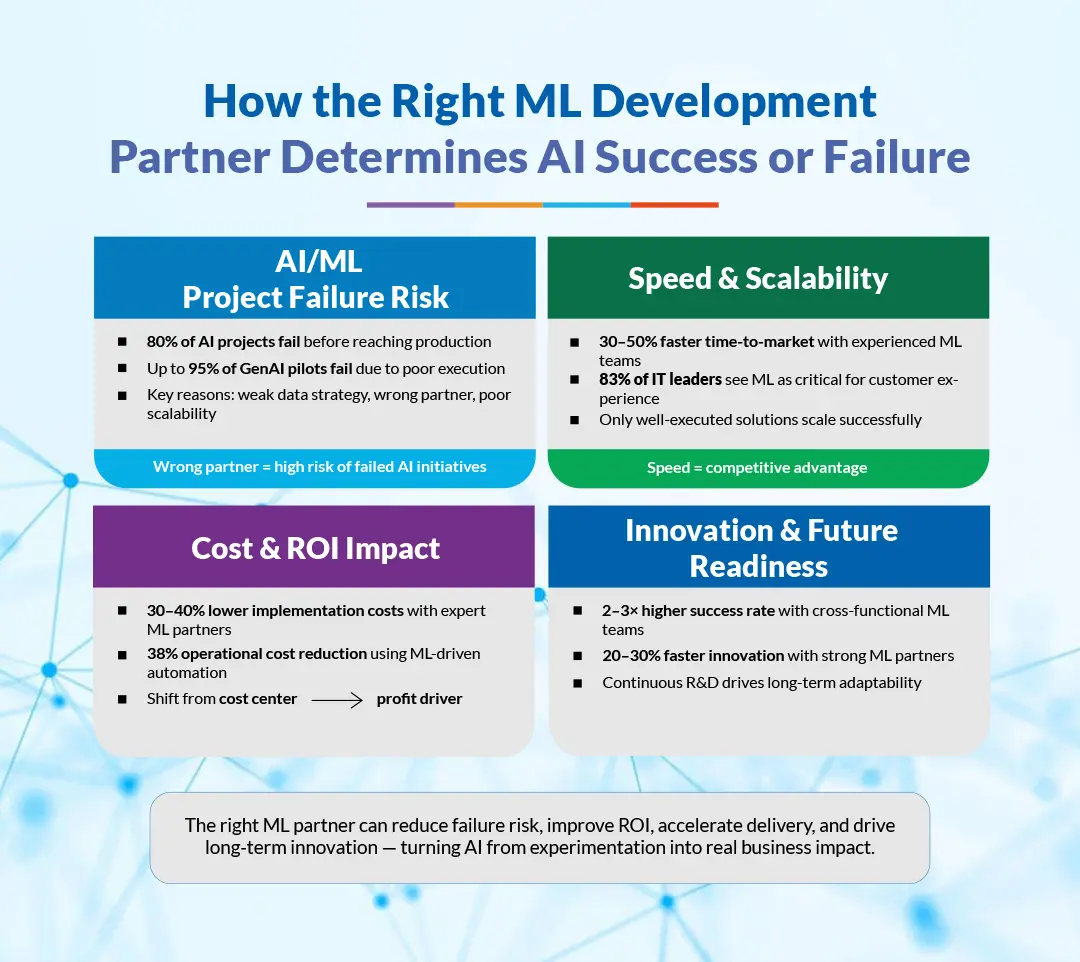
Machine learning projects often require months of development and ongoing refinement. The selection of a software development partner can impact both the technical performance of the model and its long-term business value. Image
Impact on Business Scalability
Machine learning systems must process increasing volumes of data as organizations grow. If models are not built on scalable infrastructure, performance problems can arise as data usage grows.
An experienced ML development company designs solutions that operate efficiently across large datasets and cloud environments.
Cost Efficiency and Return on Investment
Machine learning projects involve costs related to infrastructure, data preparation, and engineering talent. Poorly implemented models may fail to deliver measurable value.
A reliable ML partner focuses on building models that solve real business problems, helping organizations gain a stronger return on their AI investment.
Risk Management and Compliance
Machine learning systems frequently handle sensitive data. Financial institutions, healthcare organizations, and government agencies must follow strict data protection regulations.
Machine learning development services providers must understand data governance standards such as GDPR or HIPAA.
Long-Term Innovation Potential
A strong ML partner contributes more than technical implementation. Experienced teams can identify new opportunities for AI-driven innovation across business operations.
Steps to Consider When Choosing the Right ML Development Company
Selecting the right ML development company partner can influence the success of an AI initiative by building scalable, high-performing AI systems that drive long-term business success. In contrast, the wrong choice may result in poorly performing models, integration challenges, or high costs.
Here is a step-by-step guide to enforce better selection of an ML service partner:
Step 1 – Clearly Define Machine Learning Goals
Organizations should begin with a profound understanding of what to achieve with a machine learning model.
Identify the Business Problem
Machine learning should address specific operational or strategic challenges. Some examples include: Reducing customer attrition.
- Reducing customer attrition.
- Forecasting product demand.
- Detecting fraudulent transactions.
- Improving recommendation systems.
The clearly defined objectives help ML development services teams design effective models that cater to a business's specific needs.
Define Success Metrics
Machine learning success should be measured using quantifiable metrics. Common metrics include:
- Prediction accuracy.
- Reduced operational costs.
- Increases in revenue.
- Faster decision-making.
These benchmarks help evaluate whether the model delivers meaningful results that benefit the company in the long run.
Evaluate Data Readiness
Machine learning depends heavily on data quality and availability. Organizations should review:
- Data sources and accessibility.
- Data consistency and reliability.
- Existing data infrastructure.
Without reliable data, even the most advanced algorithms cannot produce meaningful insights.
Align Organizational Stakeholders
Machine learning initiatives involve collaboration between several teams across the organization, including:
- Business leaders.
- IT departments.
- Data engineering teams.
- Operations managers.
When these teams communicate clearly and stay aligned throughout the project, it becomes much easier to manage expectations, share insights, and ensure the machine learning solution supports real business needs and delivers better overall outcomes.
Step 2 – Evaluate Technical Expertise and Capabilities
Technical capability and expertise are among the most important criteria for selecting machine learning development services.
Core Machine Learning Expertise
A qualified ML development company should demonstrate expertise in key machine learning methods, including:
- Supervised learning – Algorithms trained on labelled datasets.
- Unsupervised learning – Models that identify hidden patterns in unlabeled data.
- Deep learning – Neural network architectures capable of analyzing complex data such as images and speech.
- Reinforcement learning – Models that learn optimal decisions through trial and feedback.
Each of these techniques addresses different types of business problems, such as:
- Predicting customer behaviour.
- Identifying hidden trends in large datasets.
- Automating image or speech recognition tasks.
- Optimizing decision-making processes in areas like logistics, finance, or recommendation systems.
Technology Stack and Frameworks
Machine learning engineers typically rely on specialized frameworks to build models. Common technologies include:
- Python – The most widely used programming language in ML development.
- TensorFlow – An open-source deep learning framework created by Google.
- PyTorch – A flexible deep learning library widely used in research and production systems.
- Scikit-learn – A library used for traditional machine learning algorithms.
Cloud platforms such as AWS, Google Cloud, and Microsoft Azure also provide tools for model training and deployment.
Data Engineering Capabilities
Machine learning projects depend on reliable data pipelines. Data engineering involves:
- Collecting data from multiple sources.
- Transforming raw data into usable formats.
- Building data warehouses or data lakes.
Strong data engineering practices support stable machine learning workflows.
MLOps and Deployment Expertise
MLOps refers to the set of practices used for deploying and managing machine learning models in production environments.
MLOps frameworks help organizations to:
- Automate model deployment.
- Monitor model performance.
- Track experiments and training versions.
A company providing ML development services should have expertise in these operational processes.
Step 3 – Review Portfolio, Case Studies, and Industry Experience
Evaluating past work can provide insight into a vendor’s capabilities.
Why a Strong Portfolio Matters
Case studies demonstrate how an ML development company solved real business challenges. These examples can reveal:
- The types of models developed.
- Industries served.
- Business outcomes achieved.
Successful case studies suggest a higher probability of project success.
Industry-Specific Experience
Some industries have specialized requirements. For example:
- Healthcare ML systems must comply with regulations governing patient data.
- Financial models require strong fraud detection capabilities.
- Retail analytics models must handle large customer datasets.
Industry experience helps ML development services teams understand domain-specific challenges.
Client Testimonials and Reviews
Independent reviews can provide valuable feedback about a company's reliability, communication style, and project delivery. Sources such as Clutch, Gartner Peer Insights, or client references can help organizations evaluate their reputation.
Step 4 – Assess Development Methodology and Workflow
The development process used by an ML partner plays a major role in project success.
Agile Development Practices
Many ML teams use Agile development, an iterative process that breaks projects into smaller phases, or ‘sprints’.
This approach allows teams to:
- Test models early.
- Gather feedback quickly.
- Improve solutions incrementally.
Agile workflows often accelerate innovation and reduce development risks.
Machine Learning Development Lifecycle
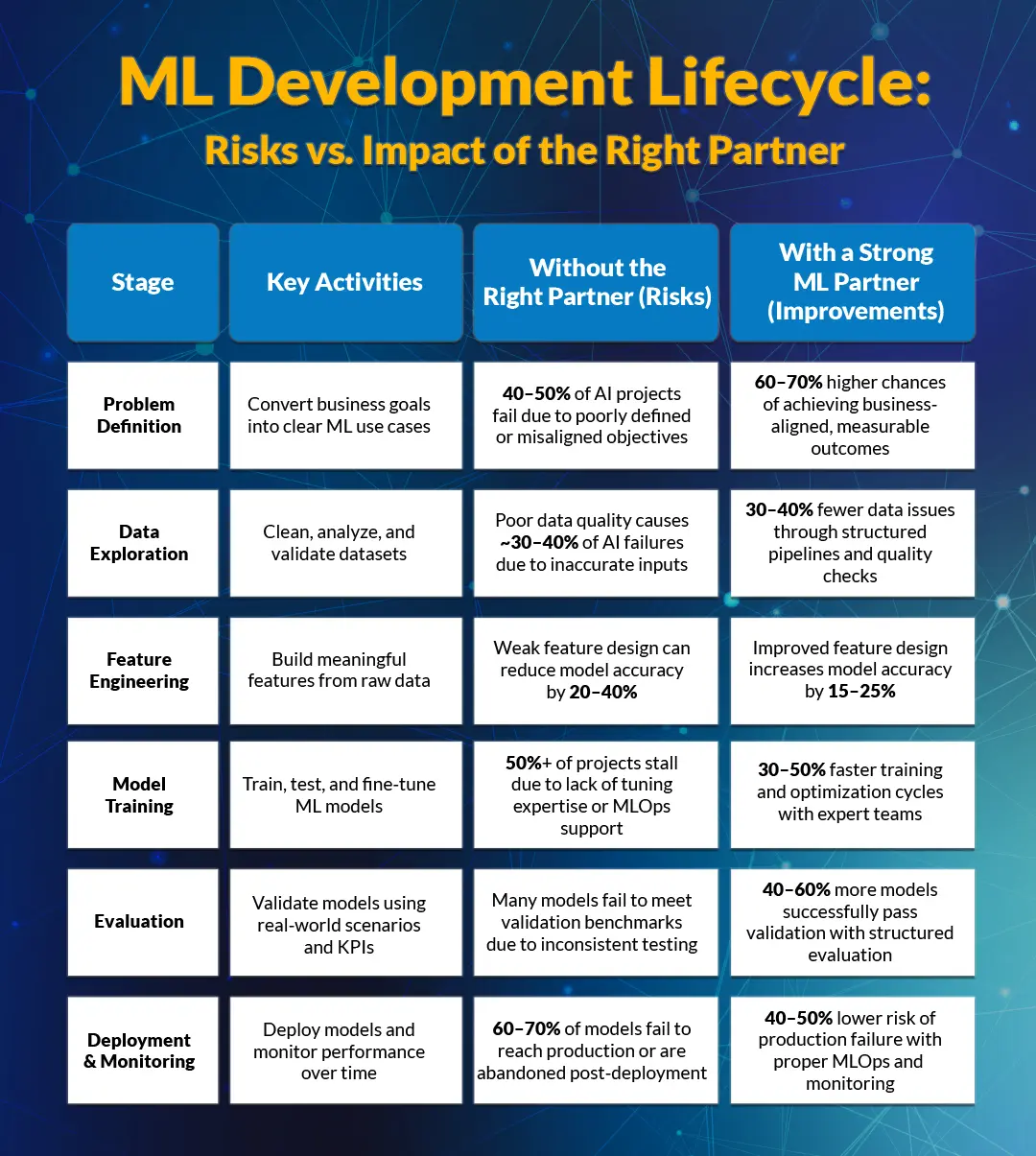
The typical ML lifecycle includes several stages:
- Problem definition
- Data exploration
- Feature engineering
- Model training
- Evaluation
- Deployment
Each stage plays an important role in the overall process and requires specific technical skills to execute effectively. When these steps are handled carefully by experienced professionals, it helps ensure that the machine learning model performs reliably and delivers meaningful business insights.
Testing and Model Validation
Testing helps determine whether a model performs reliably across different datasets. Common evaluation methods include:
- Cross-validation.
- Precision and recall metrics.
- A/B testing.
Rigorous validation reduces the likelihood of inaccurate predictions in real-world environments.
Step 5 – Evaluate Data Security, Ethics, and Compliance
Machine learning systems often analyze sensitive business or customer data.
Data Privacy and Protection
Data security measures may include:
- Encryption of stored data.
- Secure access controls.
- Data anonymization techniques.
To protect sensitive information, organizations should ensure that ML development services providers follow reliable data protection practices and maintain clear security standards throughout the development process. This helps safeguard business data while also supporting regulatory and compliance requirements.
Ethical AI and Bias Mitigation
Machine learning models can unintentionally develop biases if training data reflects historical inequalities.
Responsible AI practices involve:
- Evaluating datasets for bias.
- Testing models across demographic groups.
- Incorporating explainability techniques.
Explainability helps stakeholders understand how predictions are generated.
Governance and Model Auditability
Regulatory environments increasingly require transparency in automated decision systems.
Governance frameworks track:
- Model training data.
- Algorithm versions.
- Performance metrics
Maintaining these records helps organizations understand how a machine learning model was developed, trained, and updated over time. This level of documentation supports accountability by allowing teams and regulators to review the decision-making process, investigate potential issues, and ensure that the system follows required legal and compliance standards.
Step 6 – Analyze Communication and Collaboration Practices
Technical expertise alone does not guarantee successful machine learning projects. Effective collaboration is equally important.
Transparency and Reporting
Organizations should expect regular updates about their project’s progress.
Typical reporting includes:
- Sprint reviews.
- Model performance summaries.
- Milestone updates
Clear reporting helps stakeholders stay informed throughout development.
Collaboration Tools and Processes
ML development teams frequently use collaboration platforms such as:
- Jira for project management.
- GitHub for code version control.
- Slack or Microsoft Teams for communication.
These tools help in keeping tasks, code changes, and team communication structured in one place. As a result, teams can coordinate more efficiently, track project progress, manage updates, and reduce confusion during different stages of the machine learning development process.
Cultural and Time Zone Alignment
When organizations work with global development teams, differences in time zones and communication styles can sometimes affect how smoothly teams collaborate. Setting clear communication guidelines and expectations helps teams stay aligned, respond more efficiently, and maintain steady productivity throughout the project.
Step 7 – Understanding the Pricing Models and Cost Structures
Machine learning development services can be priced using several different models.
Common Pricing Models
- Fixed-price contracts – A predetermined cost for a specific project scope.
- Time and materials – Billing based on hours worked.
- Dedicated team model – A full ML development team working exclusively for a client.
Each pricing structure suits different project types.
Hidden Costs to Consider
Machine learning projects often involve additional costs beyond development, including:
- Data labelling and annotation.
- Cloud infrastructure usage.
- Model retraining and monitoring.
Understanding these factors helps organizations estimate long-term budgets.
Step 8 – Evaluate Post-Deployment Support and Maintenance
Machine learning systems usually need ongoing maintenance even after they are deployed in real-world environments.
Model Monitoring and Drift Detection
Over time, patterns in data can change, which may gradually affect the accuracy of a model. Monitoring systems help track key performance metrics and identify any drift in prediction results so that issues can be addressed early.
Continuous Model Retraining
Retraining means updating the model with new or recent datasets so it reflects current business conditions. This helps ensure that predictions remain accurate and useful over time.
Ongoing Optimization
Machine learning systems may also need regular improvements to keep up with evolving technologies, changing datasets, or new operational requirements. Continuous optimization helps maintain performance and long-term reliability.
Red Flags to Watch for When Choosing ML Development Services
When assessing machine learning development services, organizations should remain mindful of a few warning signs that might point to potential problems down the line. A common concern arises when a vendor is not open about their development approach, timelines, or the technologies they plan to use. This lack of clarity can make collaboration harder and often leads to misunderstandings as the project progresses.
Another point to watch for is when providers promise extremely high model accuracy without first evaluating the quality of the available data or understanding the actual business challenge. Since machine learning performance largely depends on the dataset and use case, such assurances should be considered carefully.
Poor documentation, overly technical yet unclear explanations, or difficulty explaining how the models operate may also indicate limited expertise. Similarly, if a company does not offer post-deployment support or model monitoring, it can create issues after the system goes live. For this reason, organizations should review these aspects thoroughly before selecting a machine learning development partner.
Questions Business Owners Must Ask Before Selecting a ML Development Company
Decision-makers can gain valuable insight by asking the following questions:
- What industries have your ML models been used in?
- How do you handle data security and regulatory compliance?
- Which frameworks and tools does your team use?
- How do you monitor model performance after deployment?
- What support services are available after the project ends?
These questions help clarify expectations before signing a contract.
Emerging Trends in Machine Learning Development Services
Machine learning technology continues to evolve rapidly.
1. AutoML Platforms
AutoML tools automate many aspects of model training, enabling developers to generate baseline models quickly.
2. Generative AI Integration
Large language models and generative AI systems are expanding the scope of machine learning applications across content creation, coding assistance, and conversational interfaces.
3. MLOps Automation
Automation tools are improving the efficiency of model deployment and monitoring processes.
4. Edge AI
Edge computing enables machine learning models to run directly on devices, such as smartphones or industrial sensors.
Machine learning has emerged as a pivotal technology for organizations seeking data-driven decision-making. From recommendation engines to predictive analytics, ML systems allow businesses to discover insights that improve their efficiency and customer experiences. Organizations that invest time in evaluating an ML development company by defining objectives and assessing technical capabilities position themselves to build reliable machine learning solutions. Over time, these systems can support innovation, operational efficiency, and sustained competitive advantage in an increasingly data-driven economy.
Frequently Asked Questions
1. What are machine learning development services?
Machine learning development services encompass the design, development, deployment, and maintenance of machine learning models that help businesses analyze data, identify patterns, and make predictions. These services typically include data engineering, model development, deployment, and ongoing monitoring to ensure optimal performance.
2. How do I choose the right ML development company?
3. What industries benefit the most from machine learning development services?
4. What technologies are commonly used in ML development?
5. What is the time taken to develop a machine learning solution?
6. What is the cost of machine learning development services?
7. What are the primary advantages of hiring an ML development company?
8. How do machine learning models stay accurate over time?
Request a
Free Quote Today!


