


Table of Contents


For years, businesses across the USA, UK, and Australia have followed a simple approach—find a widely used software platform and build operations around it.
That approach works well in the early stages of software development. Over time, though, compliance rules get more complex, workflows become more specific, and the gaps in a generic platform start to show.
For businesses in financial services, healthcare, retail, and manufacturing, those gaps often translate into real operational problems. For example, a financial services firm has entirely different technical needs than a hospital, while a manufacturing plant operates nothing like an online retailer.
When operational software is designed around the actual demands of a specific industry, it stops being something teams work around and becomes something upon which they genuinely rely.
Choosing the right software development company is often the turning point for businesses ready to make that shift. It moves the conversation from "what can this platform technically do?" to "does this platform match how we work?" In competitive, heavily regulated sectors, that distinction changes outcomes in a real and measurable way.
This article breaks down what industry-specific software development looks like across five major sectors and why it matters for businesses operating across these three markets.
Why Industry-Specific Software Makes a Difference
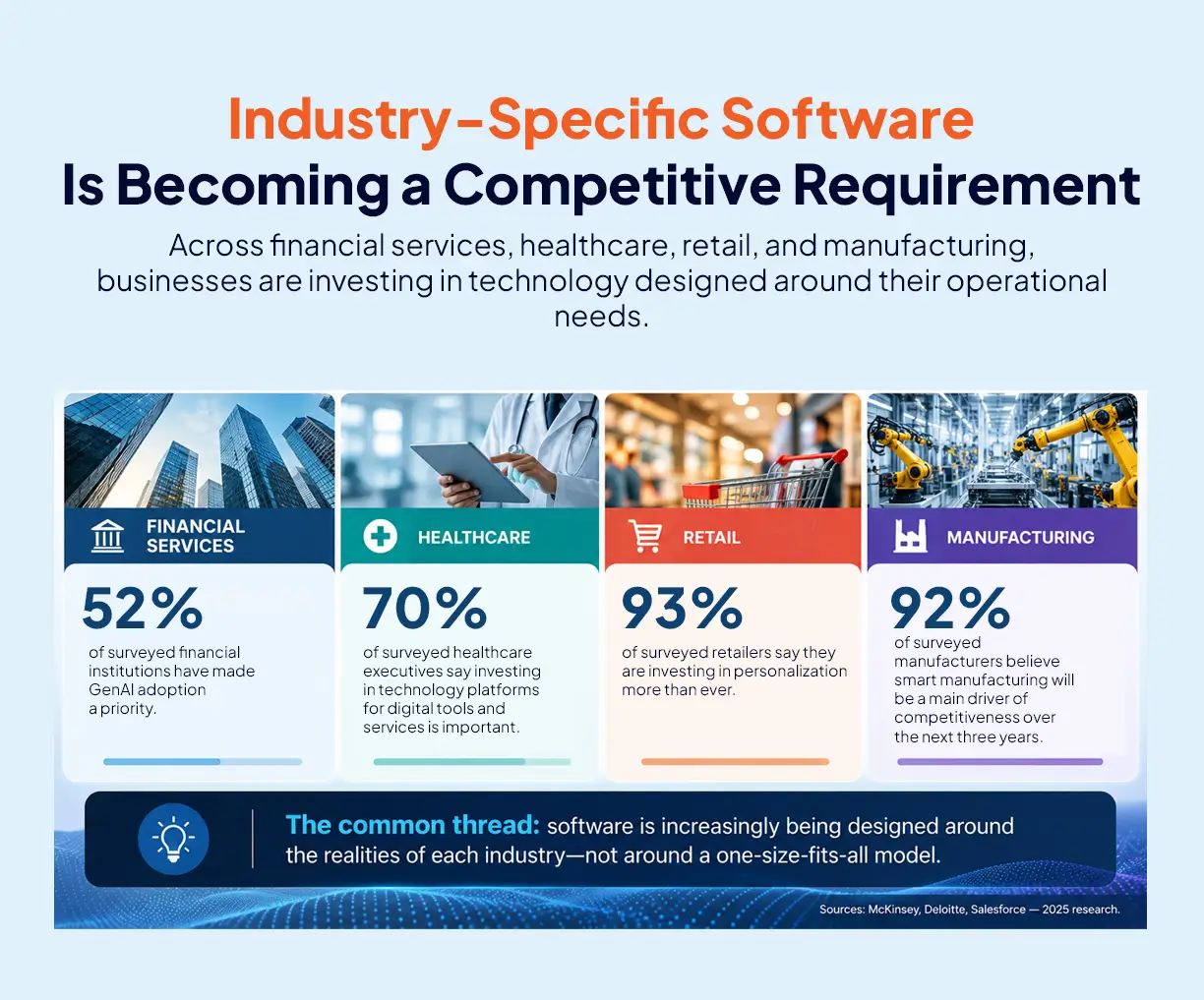
Generic software is built around what most businesses have in common, not around what makes a particular industry different. That distinction matters most when a business has to meet sector-specific compliance requirements, manage specialized data, or support workflows that go well beyond what a standard platform was designed to handle.
Here is why industry-specific development consistently delivers better results:
- Relevance from day one: Features are built around what that sector does, not what most businesses generally require.
- Compliance built into the design: Regulatory requirements are part of the blueprint, not patched in after the fact.
- Fewer operational workarounds: When software genuinely fits the industry in question, teams spend far less time compensating for platform limitations.
- Smarter data architecture: Information is structured the way the industry thinks, which makes reporting faster, cleaner, and more actionable.
- Easier long-term adaptation: When regulations shift, or business models change, industry-specific software adapts more readily than a generic platform ever could.
For businesses across the USA, UK, and Australia—where regulations differ significantly by country and sector—working with a capable software development company gives organizations a fundamentally stronger foundation.
Fintech Software Development for Financial Services
Financial services is among the most technically demanding environments for any development team. Banks, payment processors, insurance firms, lending platforms, and investment managers all rely on digital systems to handle sensitive data, maintain compliance, and process transactions simultaneously and without error.
What Makes Fintech Software Different
Financial services software operates under conditions that most platforms never encounter. The margin for error in this environment is close to zero. Also, regulatory frameworks governing financial operations are complex and continuously evolving. When systems fail here, the impact travels far beyond the development team.
Strong fintech software typically includes:
- Compliance-first architecture: Financial businesses in the USA answer to bodies such as the SEC and FDIC. UK firms operate within FCA guidelines. Australian institutions fall under ASIC oversight. Compliance must be core to the system's design, not an afterthought.
- Layered data security: Financial data is one of the most targeted categories of information online, so protection cannot rely on a single security measure. Strong fintech software embeds security at every level — encrypting data in storage and transit, controlling user access, and monitoring for unusual activity in real time.
- High-volume transaction accuracy: Financial platforms process enormous volumes of transactions. Both speed and precision are non-negotiable at this scale.
- Automated audit logging: Regulatory bodies can request complete transaction records at any point. Well-built FinTech software handles this automatically, without manual intervention.
- Multi-currency and multi-market support: For businesses operating across the USA, UK, and Australia, handling different currencies cleanly is a baseline requirement, not an add-on.
How AI Is Reshaping Financial Software
Artificial intelligence has become deeply embedded in how financial institutions now operate. Fraud detection that once required manual review happens in real time. Credit risk assessment is faster and more consistent. Portfolio management tools can process market signals and generate actionable recommendations without human input at every step.
An experienced AI custom software development company working in the financial space brings the ability to build these capabilities in a way that is both functional and fully compliant. Fraud detection models, automated credit scoring engines, and AI-powered customer advisory tools must all perform accurately within strict regulatory parameters. That standard applies not just in controlled testing environments, but in live operational conditions where the stakes are real.
Commercially built AI software often falls short here. It may perform reasonably well in general settings but lack the precision, compliance alignment, and domain-specific training that financial institutions require. Purpose-built financial AI developed by a team that genuinely understands the sector is what delivers lasting value.
HealthTech Software for Healthcare and Pharmaceutical Companies
Healthcare sits at the intersection of patient wellbeing and some of the most sensitive data any organization handles. Hospitals, private clinics, senior care facilities, telehealth platforms, and pharmaceutical companies all need software, but requirements across these sub-sectors differ considerably from one organization to the next.
What the Healthcare Sector Needs From Software
Several needs appear consistently across healthcare organizations, regardless of their size or specialty:
- Electronic health record systems: Patient data must be organized, accessible across departments, and protected at all times. EHR platforms built specifically for care settings consistently outperform generic database solutions in operational environments.
- Appointment and scheduling management: Healthcare scheduling involves multiple providers, locations, insurance types, and patient preferences—all simultaneously. Systems built to handle this complexity reduce administrative burden considerably.
- Telehealth infrastructure: Remote care has become a core part of service delivery across all three markets. Secure video, integrated health records, and billing capabilities need to work together in one platform.
- Clinical trial data management: Pharmaceutical companies running research trials need software that tracks participant data, consent records, and regulatory documentation with complete accuracy and no gaps.
- Pharmacy management: These systems simultaneously manage drug inventory, patient histories, dosage records, and supplier connections.
Regulatory Compliance Across Three Markets
Compliance is one of the most complex dimensions of healthcare software development, and the rules look entirely different depending on where the organization operates.
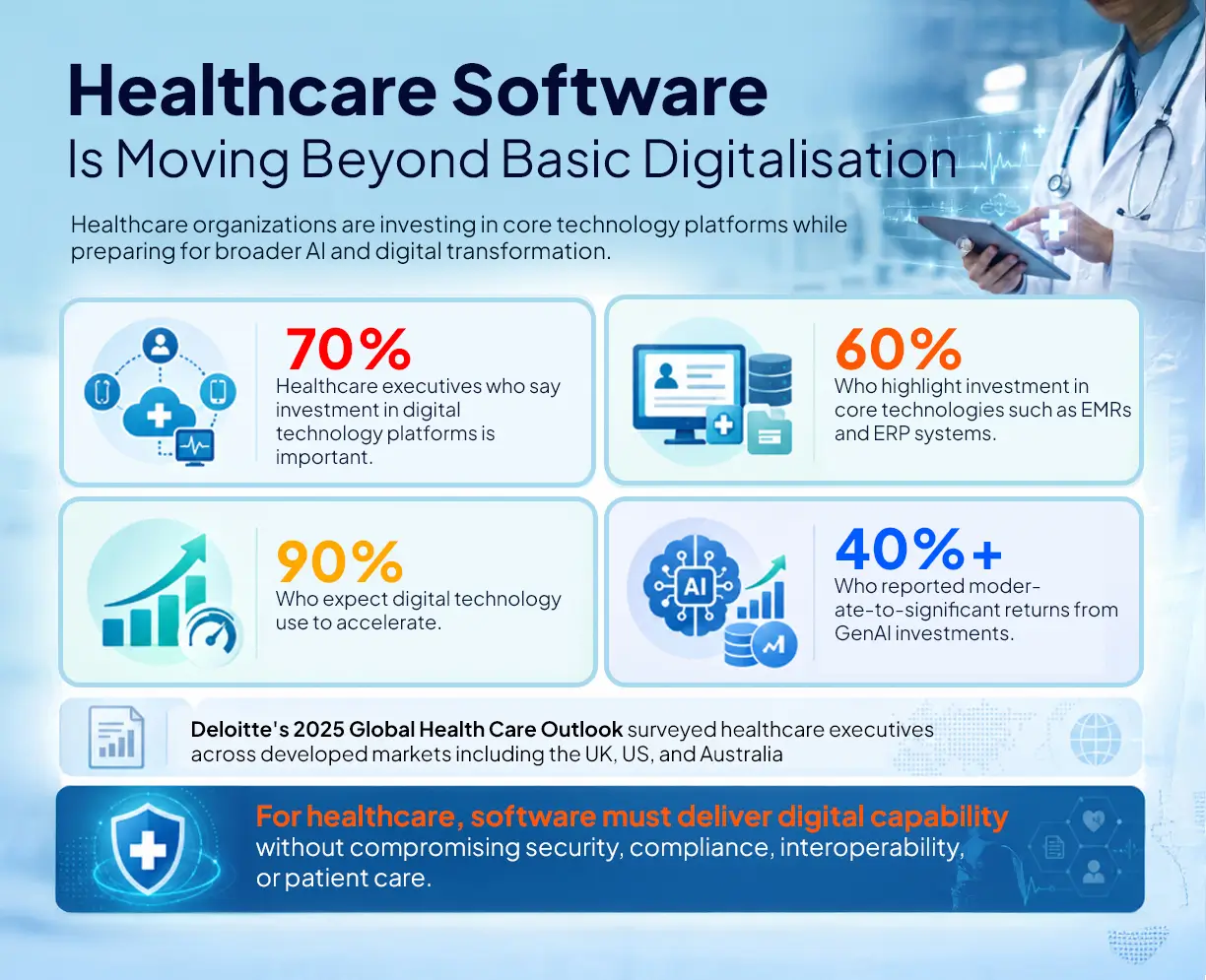
- In the USA, HIPAA governs how patient data is collected, stored, and shared across the healthcare ecosystem.
- In the UK, NHS Digital Standards and the Data Protection Act define what healthcare organizations are required to do with that data.
- In Australia, the My Health Records Act and the Privacy Act create the regulatory framework that all healthcare software must function within.
Any software development company working in this sector needs a thorough understanding of all three frameworks. A system fully compliant in the USA may require meaningful adjustments before it can operate legally in Australia or the UK. That kind of cross-market expertise comes specifically from working in healthcare, not from general development experience alone.
HealthTech is also growing rapidly as a domain for AI-driven applications. Diagnostic support tools, patient readmission prediction models, and drug interaction analysis platforms are being deployed across all three markets with measurable clinical impact.
E-Commerce Software Solutions for Modern Retail
Online retail grows considerably more complex with each passing year. Businesses selling across multiple countries, managing large product catalogues, and meeting rising customer expectations around speed and personalization are finding that standard e-commerce platforms cannot keep up at scale.
What Purpose-Built E-Commerce Software Handles
The limitations of generic retail platforms become apparent quickly as a business expands. Purpose-built e-commerce software addresses those limitations structurally rather than through workarounds:
- Multi-currency and regional pricing: Businesses selling across the USA, UK, and Australia must display their prices in local currencies, apply correct tax rates, and handle currency conversion automatically.
- Real-time inventory tracking: Live stock visibility across warehouses and multiple sales channels prevents overselling—a problem that damages customer trust.
- Localized payment gateway support: Shoppers in different countries have different payment preferences. Reflecting those preferences in the checkout process improves conversions across every market.
- Returns and refunds handling: Cross-border returns involve a logistical complexity that generic platforms manage poorly. Purpose-built systems handle this far more efficiently.
- Customer analytics and behavioural data: Understanding what customers buy, how often, and through which channels gives businesses the data they need to make better decisions about stock and marketing.
AI-Driven Personalization in Retail
E-commerce businesses working with an experienced AI software development company tend to see improvements in areas that directly affect revenue — not just in how products are recommended, but in how customers search for them in the first place. Most search tools work by matching keywords, which fails the moment a shopper describes a product differently than it is labelled in the catalogue. AI-driven search closes that gap by working from intent rather than exact phrasing, which meaningfully improves product discoverability across large inventories.
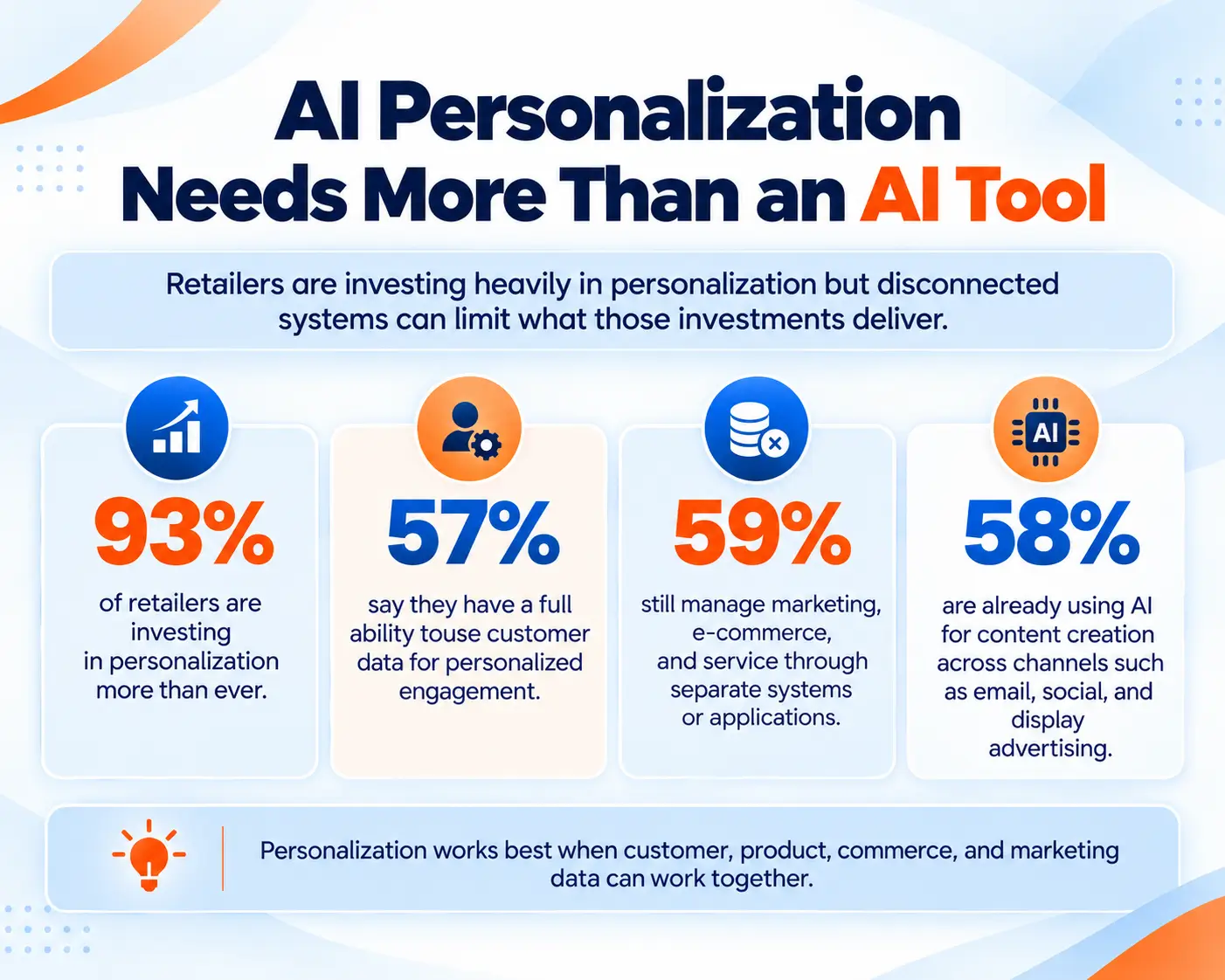
For businesses selling across three countries from a single platform, AI-driven demand forecasting also plays a significant role. Identifying which products are likely to sell in which market and when directly reduces the inventory problems that affect profitability. Retailers looking to compete in all three markets benefit substantially from working with a software development company. They build this kind of intelligence into the platform from the start, not one that bolts it on later through disconnected plugins.
Building in these capabilities early is far more effective than introducing them later through third-party tools that were not designed to work together. Inconsistencies in data flow and operational friction tend to compound over time when the underlying architecture was not built for the task.
Enterprise Software for Manufacturing and Supply Chains
Manufacturing is one of the most data-intensive environments in any economy. A business producing goods for international distribution simultaneously manages raw materials, production schedules, quality control, shipping logistics, compliance documentation, and customer orders.
There is rarely a quiet moment in this sector, and software that cannot handle that load quickly creates operational problems.
What Manufacturing Software Needs to Do
Enterprise software built for this sector carries a significant workload. Core requirements consistently include:
- Production planning and scheduling: Software must balance production runs against machine availability, workforce capacity, and raw material stock levels in real time.
- Supply chain visibility: Tracking materials from the supplier through every stage of production gives businesses the data they need to reduce delays and control costs.
- Quality control records: Inspection results, defect tracking, and audit documentation are critical in regulated manufacturing environments. These records must be accurate, accessible, and complete.
- ERP integration: Manufacturing software must connect with financial systems, HR tools, and customer order management without creating data silos that slow down decisions.
- Cross-border compliance documentation: International manufacturing involves customs processes, import/export regulations, and product safety standards that differ across the USA, UK, and Australia.
Why Real-Time Data Changes How Decisions Get Made
One of the most practical things a capable software development company delivers to manufacturing clients is live operational visibility. Not batch data refreshed overnight—actual, real-time information on what is happening in production, across the supply chain, and in the fulfilment pipeline at any given moment.
For manufacturers spread across the USA, UK, and Australia, real-time data visibility is a genuine competitive advantage. Problems get identified earlier, and decisions are made with information that is genuinely up to date. Cost management also improves when teams can clearly see what is driving expenditure at any given time.
Custom Software for Startups vs. Enterprises
Whether company size should change the approach to software development is a question that comes up regularly. The answer is a clear yes, and understanding the difference helps businesses at every stage invest more deliberately.
What Startups Need From Custom Software
Startups operate under fundamentally different conditions than established enterprises. Resources are limited, market fit is still being tested, and speed matters enormously. Custom software built for startups reflects those realities:
- A lean, purposeful feature set: Building what the business needs right now, rather than everything it might eventually require, keeps costs manageable and timelines realistic.
- Scalable architecture: Software should be built to grow alongside the business, without needing a complete overhaul when traction builds.
- Fast delivery cycles: Getting a working product in front of real users quickly is often more valuable than waiting for a finished one.
- Flexibility to adapt: Startups regularly change direction as they learn more about their market and customers. Software that cannot keep pace with those changes quickly becomes a constraint rather than an asset.
Working with an AI software development company from the beginning gives startups access to automation and personalization features that would take considerably longer to incorporate at a later growth stage.
What Enterprises Need From Custom Software
Enterprises approach software development with very different priorities. They are not building from zero. They are managing existing systems, large teams, significant compliance frameworks, and operations that simply cannot afford downtime.
Core enterprise software priorities include:
- Legacy system integration: Most large organizations still run critical processes on older platforms. New software must connect with those systems reliably without disrupting what already works.
- Enterprise-grade security: Large organizations handle enormous volumes of sensitive data. Security requirements are highly specific and non-negotiable in most regulated industries.
- Performance at scale: Enterprise software must handle high user counts, large data volumes, and complex access permission structures without degrading in speed or reliability.
- Sustained maintenance and support: Enterprises need a long-term development relationship — not a project that ends at launch and leaves the team to manage everything on their own.
A software development company that has worked extensively with enterprise clients understands that the real challenge is rarely just building something new. It is making something new work effectively alongside everything that already exists.
Industry-specific software development is not about adding more features to a platform. It is about building something that reflects how a specific business and its sector operate. For companies in financial services, healthcare, retail, and manufacturing across the USA, UK, and Australia, that distinction has a direct impact on how well the business runs from day to day. Whether a business is working with a dedicated software development company for the first time or moving away from a generic platform that has stopped meeting its needs, the principle stays the same: software built for the industry will always outperform software built for everyone.
Frequently Asked Questions
1. What is industry-specific software development?
Why do businesses in the USA, UK, and Australia need different software considerations?
3. How long does custom software development typically take?
4. How does AI add value to industry-specific software?
5. What should businesses look for in a software development partner?
6. Is it ever better to upgrade existing software rather than replace it entirely?
Request a
Free Quote Today!


